








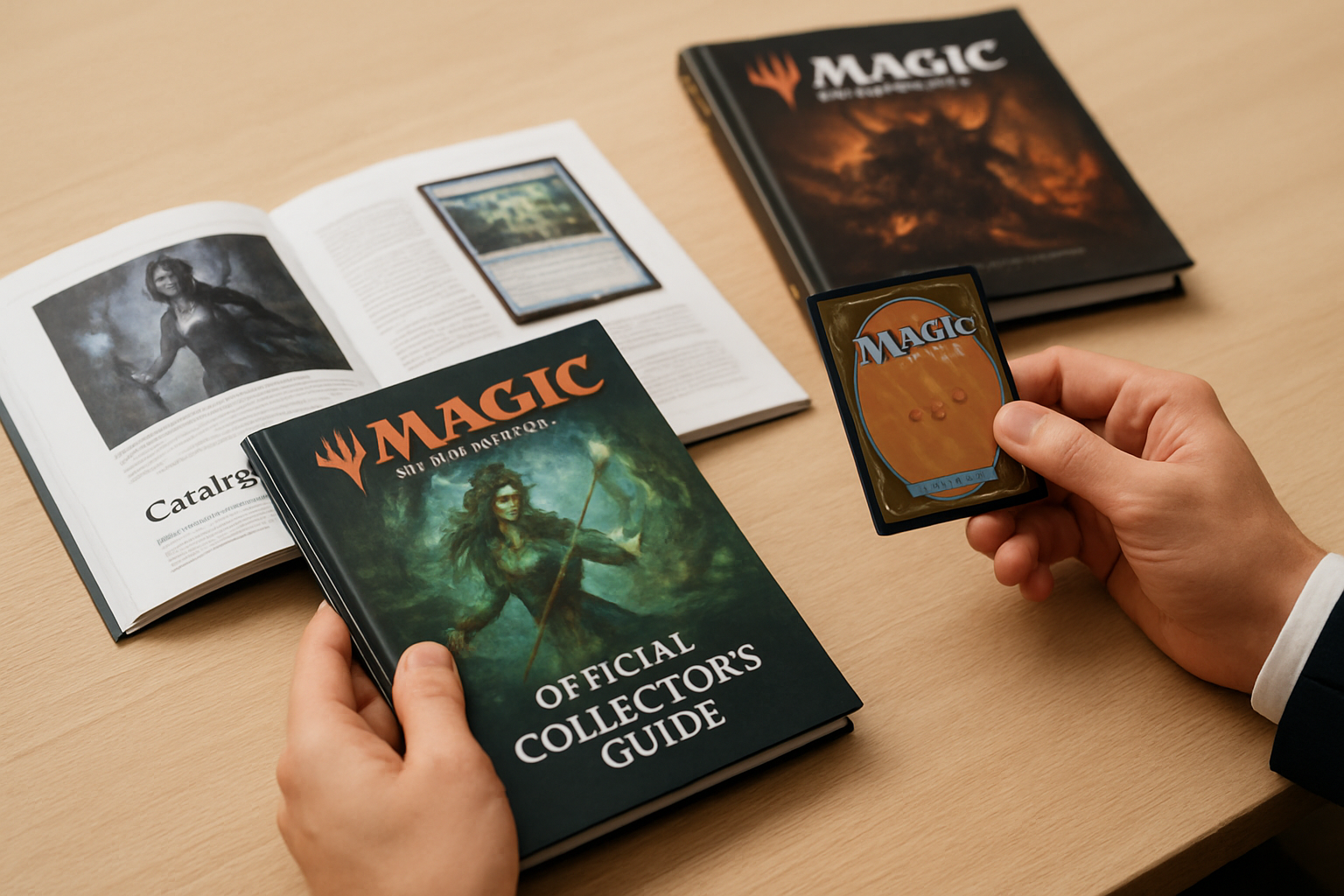
⚡ TL;DR: This guide explains how collectible magic catalogs verify rare items using dated print evidence, SKUs, and print-forensics.
📋 What You’ll Learn
In this comprehensive guide about collectible magic catalogs, we’ve compiled everything you need to know. Here’s what this covers:
- Why catalogs outperform modern listings for authentication – Collectible magic catalogs function as dated third-party paper trails that lock in maker, model names, options, and original packaging language.
- How advanced buyers build “concordance maps” – Cross-indexing SKUs, dealer terminology, variant options, and recurring illustrations reduces mis-buys and exposes rebrands, swaps, and “Frankenstein” sets.
- How to run a repeatable verification workflow – Define the seller’s claim, find the earliest verifiable catalog appearance, and match catalog option language and illustration quirks to the physical object and provenance.
- How catalog pricing becomes a scarcity signal (not a price tag) – Normalizing period prices for inflation and distribution tiers helps interpret positioning within the catalog ecosystem without treating “catalog price” as market value.
Quick Summary & Key Takeaways
- Buyers use collectible magic catalogs as dated, third-party “paper trails” to verify an item’s maker, model name, options, and packaging language—often more persuasive than modern listings.
- Verification hinges on concordance: matching catalog copy, line-art/halftone quirks, dealer SKUs, and period pricing structure to the physical object and its provenance.
- Catalog evidence becomes strongest when paired with print-forensics (paper stock, staples, offset dots), library holdings, and auction lot history from established houses.
- Pricing in catalogs is best treated as signal, not truth; serious buyers normalize for inflation, distribution tier, and variant upgrades rather than “catalog price = value.”
- Preservation matters: archive-grade digitization with embedded metadata prevents “orphan scans” that lose evidentiary weight in disputes and insurance files.
A buyer’s fastest shortcut to truth in the magician economy isn’t a viral unboxing or a marketplace “COA.” It’s collectible magic catalogs—the dealer circulars, wholesaler sheets, and manufacturer booklets that quietly recorded what was sold, how it was described, and which claims were acceptable in that era. In 2026, the strongest authentication dossiers for rare props and books routinely cite collectible magic catalogs alongside auction archives and institutional holdings, because a dated printed page is harder to launder than a refreshed listing.
The contrarian part: collectible magic catalogs don’t just help identify items; they expose the modern mislabeling that inflates “rare” into a sales tactic. When a 1970s brass gimmick is marketed today as “original,” a single line of catalog copy—especially a dealer SKU paired with a telltale illustration—can collapse the story. That’s why advanced buyers keep a working library of collectible magic catalogs, and why sellers who can cite them cleanly close higher-ticket deals faster.

Advanced Insights & Strategy
Serious verification is a systems problem: align catalog evidence, physical forensics, provenance, and market history into one coherent chain. The strategic edge comes from treating catalogs as structured data (SKUs, descriptions, ad layouts, distribution notes) rather than nostalgia objects. Buyers who build cross-indexes by manufacturer and year reduce guesswork and spot “Frankenstein” sets—original core items paired with later replacements.
Build A Concordance Map, Not A Scrapbook
High-end collectors don’t “flip through” catalogs; they compile concordances: a table that ties maker names, model names, dealer SKUs, variant options (finish, size, gimmick type), and packaging language to specific print appearances. The outcome is measurable: fewer mis-buys, sharper negotiation, and faster due diligence when a lot drops with a short inspection window.

In the magician industry, this looks like a crosswalk between manufacturer terminology (often romantic or vague) and dealer terminology (often SKU-driven). A catalog might call a prop “Improved” while the maker used “Mark II,” and the difference is the whole dispute. A concordance map catches these translation errors before money moves.
Use “Print-Forensics Triangulation” For Disputed Originals
When a seller can produce scans, buyers increasingly ask: is the page itself authentic? Print-forensics triangulation checks (1) the paper and binding characteristics of the catalog, (2) the print method and halftone pattern, and (3) independent holdings or references. This is the same kind of triangulation used in broader collectibles to identify reprints and facsimiles.
Institutional cross-checks matter because they provide time-stamped custody. WorldCat listings can confirm that a specific title exists in library holdings, and in some cases a library will confirm edition details on request. For auction comparables, major houses with published archives are useful because their lot descriptions often preserve period attributions even when the market later “renames” the item.
Normalize Catalog Pricing Into A “Signal Score”
Catalog price is a noisy input: it reflects dealer margin, distribution tier, and sometimes deliberate “prestige pricing.” Advanced buyers convert catalog prices into a signal score by normalizing for inflation and comparing the price’s position within that catalog’s product ecosystem (entry, mid-tier, premium). A premium-priced item in a catalog where most props cluster low-to-mid is a stronger scarcity signal than an isolated high price in a luxury-leaning catalog.
Inflation baselines can be grounded in public CPI methodology. The U.S. Bureau of Labor Statistics explains CPI calculation and series usage at https://www.bls.gov/cpi/. The point isn’t to compute a single “today value,” but to compare relative pricing across a catalog year and track which items were positioned as top-tier at release.
Verification Workflow: How Buyers Use Catalog Evidence
Verification works best as a repeatable workflow: identify the claim, locate the matching catalog reference, then test the physical object against catalog-specific signatures. Done properly, catalogs reduce reliance on seller narratives and turn a purchase into an evidence-backed decision. The best workflows treat each catalog page as a dated specification sheet, not an advertisement.
Step 1: Define The Claim In One Sentence
Buyers who win disputes start by compressing the seller’s story into a single sentence: “This is the first-run [maker] [model], complete with original packaging and instructions.” That sentence is then broken into components that can be verified: maker identity, model name, run/era, completeness, and originality of accessories.
This is where collectible magic catalogs shine: they freeze language in time. If the catalog calls it “with precision-milled insert” and the offered item has a cast insert with file marks, the claim starts to wobble. The more the sentence can be tied to catalog phrasing, the less room exists for creative interpretation.
Step 2: Find The Earliest Verifiable Catalog Appearance
The earliest appearance is typically the most valuable reference because it anchors introduction timing and original feature set. For magician props, “earliest appearance” also reveals whether the item was a dealer rebrand, a licensed run, or a knockoff-era derivative. Some dealers quietly sold near-identical apparatus under house names, which is why dating matters.
In practice, buyers search by maker, then by product family, then by illustrations. Line-art idiosyncrasies—like the angle of a hinge, a knurling pattern, or a specific velvet bag depiction—often outlast text changes across editions. When multiple catalogs match, the one with the cleanest bibliographic trail (publisher, date, page numbering, staples/binding) carries more weight.
Step 3: Match “Option Language” To Physical Build
Many disputed items are not fake; they’re variants. Catalogs frequently list options in a single sentence—“available in brass or nickel,” “also in jumbo size,” “new silent latch”—and that language is the buyer’s map. If the object’s features match a later option, the valuation changes even if the piece is period-correct.
This is especially common in stage apparatus and mentalism gear where incremental revisions were sold as upgrades without changing the product name. Buyers use option language to avoid paying “first run” premiums for a later revision—or to pay appropriately when a rarer option is present but the seller doesn’t realize it.
Step 4: Cross-Reference With Auction Archives And Bibliographic Records
Catalog evidence becomes stronger when it’s not alone. Auction archives provide a public record of how a piece was described at the time of sale, plus photos that can confirm construction details. Bibliographic records add a layer of institutional credibility, particularly for rare books and ephemeral dealer sheets.
For example, Sotheby’s and Christie’s maintain searchable results and editorial content that can help track maker attributions and period terminology (https://www.sothebys.com/, https://www.christies.com/). While magic-specific lots may be less frequent than art categories, the methodology—archival confirmation and public cataloging—translates cleanly into magician-industry verification files.
Collectible Magic Catalogs As Proof: What Actually Counts In A Dispute
Not all catalog evidence carries equal authority. In disputes—whether between buyer and seller, consignor and auctioneer, or collector and insurer—what matters is provenance strength, edition clarity, and whether the catalog reference can be independently verified. The goal is a “tight chain”: a catalog citation that stands up even when the other party contests it.
What Insurers And Appraisers Treat As “Hard” Documentation
Insurance schedules and professional appraisals usually prefer sources with publication details and stable custody: dated dealer catalogs with publisher identification, manufacturer booklets, and catalog pages that can be tied to known holdings. “Hard” documentation includes clear scans showing staples, paper tone, page numbers, and any imprint lines—details that help distinguish originals from modern reprints.
Appraisal practice, broadly, values traceable sources and repeatability. Professional guidance on appraisal standards can be found through organizations like the Appraisers Association of America (https://www.appraisersassociation.org/). While their focus spans categories, the logic—documented comparables and defensible attribution—applies directly to magic apparatus and rare conjuring books.
Dealer SKUs, House Brands, And The “Same Item, Different Name” Trap
A frequent market failure in magic is the assumption that a product name equals a product. In reality, dealers assigned SKUs, bundled instruction sheets, and sometimes renamed items for their own catalogs. Two catalogs may present the same prop with different copy, different photos, and different claims. That’s not deception; it was commerce.
Buyers use collectible magic catalogs to decode these overlays. The tell is consistency across non-name attributes: dimensions, included accessories, manufacturing clues, and sometimes the same stock illustration reused with new labeling. Once the overlay is recognized, valuation becomes less emotional and more mechanical.
Print Authentication: Paper, Staples, Halftones, And Reprint Signals
Modern scans are easy to doctor, but physical print traits are stubborn. Offset lithography halftones have a recognizable dot structure; photocopied reprints blur those dots differently. Saddle-stapled catalogs typically show oxidation patterns around staple legs; perfect-bound reprints rarely replicate that convincingly. Even the smell and stiffness of paper stock can correlate with era and storage conditions, though it’s not standalone proof.
For high-value disputes, some collectors use local paper conservators or document examiners to assess whether a catalog page is period-consistent. The American Institute for Conservation provides an entry point to conservation professionals and practices (https://www.culturalheritage.org/). In the magician industry, this approach is still niche—but it’s becoming the difference between “trust me” and “documented.”
When collectible magic catalogs Beat Certificates Of Authenticity
Certificates of authenticity in magic often fail for a simple reason: they’re easy to replicate, and they frequently lack serial linkage to the object. Catalogs, by contrast, are distributed artifacts from a specific period, created for sales—not future disputes. That makes them less likely to be tailored to a single transaction.
When a catalog page specifies packaging text, instruction format, or included gimmicks, it can contradict a questionable COA cleanly. Buyers increasingly treat COAs as supporting documents at best, while collectible magic catalogs sit closer to primary-source documentation—especially when a catalog citation can be corroborated via independent holdings or multiple dealer issues.
Price Signals, Scarcity, And Market Microdata In collectible magic catalogs
Catalog pricing isn’t a price tag; it’s a microdata record of how the industry positioned an effect at a moment in time. The smarter use of catalog prices is comparative: where the item sat within the dealer’s hierarchy, how often it reappeared, and whether it migrated from “new” to “closeout” language. Those changes tell a story about supply, demand, and reputation.
Reading Price As Positioning: Premium Bands And “Loss-Leader” Tricks
Within a single dealer catalog, price clustering often reveals what the dealer considered mainstream versus aspirational. If most apparatus sits within a narrow band but a handful of items jump into a higher tier, those are the products the dealer expected to sell with higher margins or lower volume. That’s useful because it signals how rare a piece might be in the wild today.
Some catalogs also ran loss-leader effects—low-priced items meant to trigger mail orders and upsells. Those can look “common” by price but “rare” by survival because cheap items were handled harder, stored worse, and tossed sooner. This is why scarcity can invert: the expensive prop survives; the cheap one disappears.
Variant Economics: When A One-Line Option Doubles Today’s Value
A single option line—“also available in sterling finish” or “with locking case”—can create two different modern markets. Catalogs document those options with a specificity that later collectors may not capture. When the physical object matches the rarer option, buyers can justify a premium without resorting to folklore.

In magician circles, “complete” is often a sliding definition. Catalogs help pin it down: if the ad text lists a specific accessory (extra shell, special thread, duplicate card gaff set), then completeness becomes measurable. That clarity reduces post-sale friction and makes high-dollar deals less personal and more procedural.
How Often It Appears Matters More Than The Price Itself
Frequency is an underrated signal. If an item shows up once, then vanishes, that suggests limited production, supplier issues, or weak demand. If it appears for a decade with minimal copy changes, it was likely a steady seller—or a dealer staple sourced reliably from a manufacturer. Buyers use appearance frequency to infer production runway.
For catalog-based researchers, the practical technique is a reappearance index: note each year/edition an item appears, log copy changes, and track image reuse. A reappearance index is also a fraud filter: if a seller claims a piece is “pre-release” or “prototype,” but it’s marketed across multiple catalog years with stable copy, the prototype narrative collapses quickly.
2026 Market Context: Collectibles Growth, Attention, And Price Volatility
The broader collectibles market has remained sensitive to macro conditions, and price volatility feeds into magic as a niche category. When alternative assets heat up, marginal categories get pulled along—sometimes irrationally. The practical response is stronger documentation: catalogs, archived listings, and defensible attribution.
For a 2026 snapshot of how alternative asset classes and collectibles are framed in mainstream finance coverage, see Forbes’ ongoing collectibles coverage hub at https://www.forbes.com/ (site-wide, finance/collectibles topics appear across sections). The takeaway for magic buyers is simple: when attention rises, misrepresentation rises faster. Catalog citations are cheap insurance.
Archive-Grade Handling: Digitizing And Preserving collectible magic catalogs
Catalogs only work as evidence if they remain stable and legible. That means preservation practices that protect paper originals and digitization practices that preserve context—publication details, physical traits, and scan provenance. A random JPEG of a cropped ad is not an archive; it’s a rumor with pixels.
Digitization That Holds Up: 600 DPI, Color Targets, And Metadata
For evidentiary scans, 600 DPI color is a common baseline because it captures halftone structure and subtle ink density differences that help authenticate printing method. Include a color target and a ruler in the first scan of a batch; it makes later comparisons more defensible. Save a lossless master (TIFF) and a working copy (JPEG/PDF) for easy sharing.
Metadata is where most private archives fail. Each file should carry: catalog title, publisher/dealer, city, approximate date, page number, and acquisition note. When disputes arise, being able to show “where this scan came from” matters almost as much as what it shows. Digital asset managers like Adobe Lightroom Classic or open-source alternatives can maintain consistent fields without turning the project into a software hobby.
Physical Storage: Acid-Free, Climate Control, And The Staple Problem
Paper ephemera hates humidity swings. Acid-free sleeves and buffered folders slow deterioration; stable temperature and humidity reduce warping and ink transfer. Staples are a hidden villain—rust migration can stain pages and weaken paper around the binding. Some archivists remove staples and store sheets flat; others keep them intact to preserve original condition and binding evidence.
When the catalog’s binding is part of authentication—common with dealer booklets—keeping staples intact can be a better choice. The compromise is isolation: store the catalog in archival enclosures and keep it away from high-humidity spaces. For collectors who lend catalogs for exhibitions or appraisals, a “handling copy” printout protects the original while still enabling reference.
Provenance For Scans: Chain-Of-Custody Notes And Watermark Ethics
Scan provenance sounds formal until a sale goes sideways. A simple chain-of-custody note—date scanned, device used, who scanned it, and where the original is stored—adds credibility. Buyers do not need a notarized dossier; they need enough detail to trust the reference wasn’t fabricated yesterday.
Watermarking is divisive in the magician industry because it can obscure key details. If used, it should be minimal and placed in margins, never across the ad text or illustration. The ethical goal is protection without degrading research utility. In practice, the cleanest solution is sharing low-resolution previews publicly and reserving full-resolution evidentiary scans for private transactions and insurance files.
Building A Shared Index Without Losing Control
The healthiest magic marketplaces tend to have informal documentation networks: collectors, dealers, and historians who share references responsibly. A shared index—who has which catalogs, which years, which editions—can reduce duplication and improve verification speed. It also raises the baseline of truth in the market.
The risk is obvious: uncontrolled distribution can devalue rare catalogs or enable counterfeiters to mimic copy. The middle ground is a controlled “reference registry” that lists holdings and bibliographic details without distributing full scans. Buyers can request specific pages when needed, keeping the archive useful without turning it into a free counterfeit kit.
What Most Get Completely Wrong About collectible magic catalogs
People treat collectible magic catalogs like a museum label: if the page exists, the item is automatically “real,” “rare,” and worth the asking price. That assumption burns money. In my experience, catalogs are most powerful when they’re used to eliminate possibilities, not to crown a winner—especially with dealer rebrands and late-run revisions that kept the same name.
My hard rule is to distrust single-source certainty. When only one catalog reference exists—and it’s a scan floating around without publication context—the probability of misattribution spikes. The best purchases have a boring paper trail: two separate dealer issues referencing the same features, a matching instruction sheet format, and at least one independent public record (auction archive, library listing, or a well-documented estate sale).
The other mistake is fetishizing price lines. I’ve watched bidders anchor to a 1970s catalog number and bid past modern market reality because it “feels official.” Catalog prices were marketing tools. The more aggressive the copy, the more skeptical the buyer should become—because hype language was as common then as it is now, just printed instead of posted.
Frequently Asked Questions About collectible magic catalogs
How Do Advanced Buyers Date An Undated Dealer Sheet Using collectible magic catalogs?
They triangulate: match product mix (new releases vs discontinued), compare typography and address blocks to dated issues, and check price formats (currency symbol placement, discount language). Then they validate against independent records like WorldCat holdings (https://www.worldcat.org/) or auction listings with known dates. Paper stock and staple oxidation can support the estimate.
Conclusion
collectible magic catalogs function as the magician industry’s quiet verification layer: a dated record of names, options, inclusions, and the market language that shaped an item’s original identity. When collectible magic catalogs are paired with print forensics, auction archives, and disciplined citation, “rare” becomes testable instead of theatrical—and expensive mistakes get rarer than the props themselves.
The Unpopular Truth: Nostalgia Is A Terrible Authenticator
The market keeps rewarding the most romantic story, even when the paper trail contradicts it. The better bet is boring documentation—catalog concordance, edition clarity, and physical matching—because it beats charisma in every dispute that matters.
A Real-World Pattern: How Major Auction Houses Set The Tone
Sotheby’s and Christie’s built their reputations on cataloging discipline: consistent attribution language, archived results, and repeatable reference structures (https://www.sothebys.com/, https://www.christies.com/). Magic collectors who mirror that approach—citing catalog pages like publications, not screenshots—tend to win authenticity arguments quickly.
The Core Rule: One Claim, Two Independent Anchors
Any high-value claim should be supported by at least two independent anchors: a catalog reference with clear publication context plus an external corroboration (auction archive, library holding, or documented estate provenance). If one anchor fails, the deal should slow down—every time.

Find out more information about “collectible magic catalogs”
Search for more resources and information: