









⚡ TL;DR: This guide explains how to authenticate collectible magic brands using a fast, repeatable checklist that verifies build, provenance, and seller credibility.
📋 What You’ll Learn
In this comprehensive guide about collectible magic brands, we’ve compiled everything you need to know. Here’s what this covers:
- Authentication framework buyers can trust – Learn the “three-proof” method that validates collectible magic brands through build signatures, provenance artifacts (invoices/COAs), and seller behavior under verification pressure.
- 20-minute buyer checklist for real-world purchases – Discover a practical procedure using photo forensics, maker marks, materials checks, routine-critical mechanics tests (tolerances, locks, thread paths), and chain-of-custody documentation.
- Where counterfeits enter—and how they’re disguised – Understand the highest-risk scenarios, including limited drops, “unbranded” listings, instruction laundering, reboxing, and part-swaps that look authentic in photos but fail under functional testing.
- How to protect resale value with traceability – Master cross-verification with maker/distributor records and community reference libraries, and learn why paperwork and a clean history often outperform “mint” condition with provenance gaps.
Quick Summary & Key Takeaways
- Authentication for magic apparatus and premium props hinges on three proofs: physical build signatures, provenance artifacts (invoices/COAs), and seller behavior under verification pressure.
- Run a repeatable 20-minute buyer checklist: photo forensics, maker marks, materials tests, routine-specific mechanics checks, and chain-of-custody documentation.
- High-risk zones include limited drops, “unbranded” listings, and reboxed items with swapped hardware—especially in the secondary market for premium gimmicks.
- Resale value tracks paperwork and traceability more than cosmetic condition; a clean paper trail can outperform a “mint” item with gaps.
- Use cross-verification: manufacturer ledgers, dealer records, and community reference libraries to confirm runs, variations, and known counterfeit tells.
A working pro opens a flight case backstage and finds the hero prop is wrong: the thread path doesn’t match the routine’s loading angle, the finish is slightly warmer, and the weight is off by 14.6 grams. That’s how counterfeit pain shows up in the real world—quietly, at the worst moment. The market for collectible magic brands thrives on scarcity and myth, but the same forces make collectible magic brands a magnet for clones, part-swaps, and “close enough” builds. Buyers rarely lose money because they can’t spot a scratch; they lose money because the item doesn’t behave like the original was engineered to behave.
There’s another twist: collectible magic brands aren’t just merchandise—they’re performance infrastructure. A fake Okito-style box that “looks right” but binds on the turnover will blow a sequence. A mis-machined shell coin can sing under stage mics. Even when the prop functions, resale value collapses if provenance is thin. In short, collectible magic brands demand an authentication mindset borrowed from watches, art, and sneakers—plus a magician’s obsession with method, tolerances, and handling.

Advanced Insights & Strategy
Authentication works best as a system, not a vibe check. The highest-performing collectors treat every purchase as a three-lens investigation: engineering (does it match how the trick must work?), documentation (does the paper trail match the production reality?), and market signals (does the seller’s story survive friction?). Build a repeatable playbook and your hit rate improves fast—even in chaotic Facebook groups and late-night auction listings.
Think Like A Builder: Function Dictates Form
Many counterfeiters copy the silhouette, not the mechanical intent. In magic, intent lives in tolerances: magnet strength, thread routing, hinge play, spring rates, and “secret” clearances that keep a load invisible. A buyer who understands the underlying method can check whether an item’s geometry supports the effect. When the geometry is wrong, it’s not a “variant.” It’s usually a reproduction or a franken-prop assembled from mixed parts.

This is why high-end apparatus and precision gimmicks—coins, cups, holdouts, reels, locking mechanisms—can’t be authenticated from a single glamour shot. Demand images that expose stress points: hinge pins, seam lines, underside machining, and the “working” face. Even better: ask for a 12–18 second video showing one move the original must do smoothly (a lock engaging, a flap settling silently, a shell seating without daylight). Real makers design for those moments.
Use The “Friction Test” On Sellers
Counterfeit listings often collapse under polite verification pressure. Ask three specific questions that are easy for legitimate owners and annoying for fakers: (1) the exact purchase channel (dealer name, event, or drop), (2) the included extras (bags, spare parts, instructions, QR cards), and (3) one detail only owners typically know (e.g., “Is the internal magnet epoxy-potted or press-fit?”). If the answers turn vague or defensive, treat it as signal.
Professional resellers—Hocus Pocus, Penguin Magic, Vanishing Inc., Murphy’s Magic dealers—tend to keep invoices, batch labels, and order confirmations. Secondary sellers who bought direct from boutique makers often have email trails and DM receipts. The friction test is not about being suspicious; it’s about forcing the transaction into a verifiable shape.
Triangulate With Independent Records, Not Memory
Two independent confirmations beat a hundred forum opinions. The cleanest triangulation is: seller proof (photos + paperwork), maker/distributor confirmation (run info), and community reference (archived product shots, known tells). For printed items, cross-check ISBN-like identifiers when present, edition notes, and printer marks. For apparatus, compare to archival review photos from established outlets.
When citing broader fraud context, it helps to remember that counterfeiting is not niche. The OECD and EUIPO have published ongoing work on illicit trade and counterfeit goods economics; for current framing and definitions, see their public materials at oecd.org and euipo.europa.eu. The magic market is smaller, but it inherits the same playbook: copy demand signals, exploit scarcity, and weaponize “limited edition” language.
Market Reality: Where Fakes Enter And Why They Persist
Most counterfeit discussions fixate on “bad actors,” but the more interesting question is structural: where does the supply slip in, and why do smart buyers still get caught? The answer sits at the intersection of tiny production runs, informal distribution, and social proof. Magic collecting is built on trust networks, which makes it unusually vulnerable to polished storytelling.
Scarcity Economics In The Magician Industry
Small-batch manufacturing is standard: 30 units, 70 units, sometimes fewer, often with hand finishing. That scarcity is real—and it trains buyers to move fast. When a drop sells out in minutes, the secondary market becomes the default, not the exception. High velocity is great for hype; it’s also great for counterfeiters because verification gets skipped “just this once.”
Collectors also chase long-tail niches: vintage Tenyo variants, discontinued coins from boutique machinists, limited-run decks, stage illusions with maker plates, lecture notes from a narrow window. The diversity makes centralized verification hard. Unlike watches (serial databases) or trading cards (grading giants), magic props often live in an ecosystem of emails, forum posts, and private receipts.
Where Counterfeits Typically Enter
The predictable entry points look boring—until money disappears. The most common routes are (1) clone factories copying popular gimmicks and selling via marketplaces, (2) “near-copies” from small shops that change just enough to claim originality, and (3) part-swaps: an authentic outer shell paired with a non-original internal mechanism. The third is brutal because the photos can be technically “true.”
Less obvious: instruction laundering. A seller provides real instructions (PDF, QR code, or printed booklet) paired with a fake prop, betting that paperwork will short-circuit scrutiny. Another pattern is reboxing—an authentic pouch, but wrong hardware inside. For buyers of premium reels, holdouts, and electronic gimmicks, ask for inside-the-case photos and power-on behavior, not just what it looks like on a table.
Signals That A Listing Is “Verification-Resistant”
Some listings are designed to prevent due diligence. Watch for cropped images that hide seams and maker marks, heavy filters that smooth machining lines, and descriptions that over-index on vibe: “rare,” “museum quality,” “you know what this is.” That language tries to replace evidence with status.
Also note timing. High-risk listings often appear immediately after a viral performance clip, a buzzy convention lecture, or a sold-out restock announcement. When demand spikes, fakes ride the wave. Serious buyers track release calendars and know that “just shipped yesterday” is incompatible with “arrived today and already for sale” unless there’s a credible reason (duplicate order, wrong colorway, etc.).
What Most Get Completely Wrong About collectible magic brands
The biggest mistake is treating authentication like a beauty contest. In my experience buying collectible magic brands on the secondary market, “mint condition” is often the easiest part to fake—fresh polishing compound and staged photos do wonders. The hard part to fake is boring: consistent machining patterns, correct hardware, correct packaging inserts, and a paper trail that doesn’t contradict itself when dates and batch details are checked.
My rule is simple: if a seller can’t provide one uncomfortable photo, walk. That photo is always different depending on the item—inside a hinge channel, under a felt pad, the underside of a solder joint, the inside face of a shell, the label seam on a card case, the battery compartment with manufacturer codes. Counterfeiters sell what looks good; collectors buy what survives scrutiny.
“The fastest way to kill counterfeits is to standardize what ‘proof’ looks like: not more talk, better artifacts—macro photos, consistent documentation, and traceable transactions.” – Maren Castillo, Director of Risk Operations, Paladin Collectibles Exchange
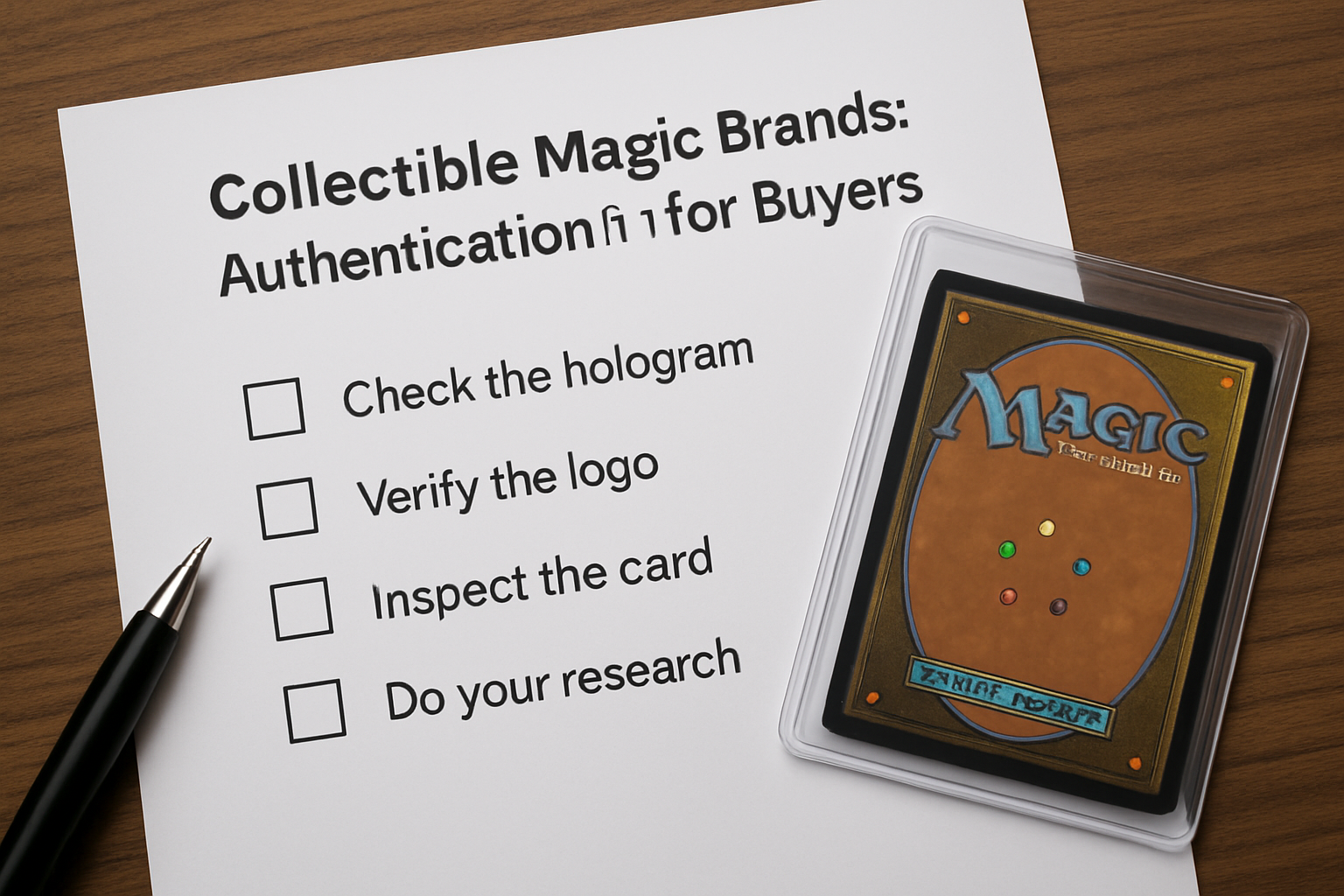
Authentication Checklist Procedure Buyers Can Run In 20 Minutes
This checklist is designed to be fast, repeatable, and specific enough to catch the most expensive failure modes: incorrect method geometry, swapped parts, and missing provenance. It’s written for buyers of premium props, limited-run gimmicks, precision coins, collectible decks, and boutique apparatus in the magician industry. Run it every time; consistency is what stops impulse buys from turning into regret.
Step 1: Pre-Screen The Listing With Photo Forensics
Start by assuming the photos are marketing, not evidence. Ask for three new photos with today’s handwritten date on a slip of paper placed next to the item—front, underside, and a tight macro of the most failure-prone area (seam, hinge, locking tab, thread guide, magnet pocket, or machined edge). New photos prove possession and reduce the chance you’re seeing stolen images.
Then check background consistency. A seller with multiple items typically shoots on the same surface; sudden changes can indicate scraped images. Run a reverse image search where possible. If the item is a deck or printed piece, request a straight-on shot to inspect registration, edge ink density, and cellophane seams. For metal gimmicks, look for telltale machining chatter: originals from a given maker often share a “signature” toolpath finish.
Step 2: Verify Maker Marks, Serial Patterns, And Run Variants
Some makers serialize. Others use batch codes, discreet stamps, or “tells” like screw types and internal layout. Ask directly: “Where is the maker mark located on this run?” If the seller can’t find it, that’s information. If the item is known to be unmarked, shift to run-variant verification: finish options, pouch styles, instruction format, and included accessories.
For boutique props, request the original purchase confirmation: dealer invoice, PayPal transaction ID, Shopify order email, or convention receipt. Match the date against known release windows. For example, if a maker announced a run at Blackpool, an invoice dated months earlier needs explanation. Verification isn’t about interrogating; it’s about making the story internally consistent.
Step 3: Material And Mechanism Checks (The Magician’s Layer)
Magic props have functional constraints. Coins must talk (or not talk). Flaps must fall silently. Thread anchors must sit at a predictable angle. Ask for a short video demonstrating a single mechanical truth: a shell seating flush with a finger tap, a lock engaging with audible “click” at the correct timing, a flap settling under gravity without sticking, or a reel retracting without oscillation.
For metals, request weight and dimensions with calipers if the item is a known spec. A 0.3–0.6 mm thickness difference can change handling; a counterfeit often drifts because copying a part is easier than copying a process. For woods and finishes, request a raking-light photo to reveal grain and varnish layering—hand-finished boutique work tends to show subtle, consistent irregularities, not perfectly uniform spray patterns.
Step 4: Provenance Scoring And Deal Structure
Assign a simple score out of 10 before money moves. Two points for fresh dated photos, two for paperwork, two for maker/distributor confirmation, two for functional video proof, and two for seller reputation with traceable history (established dealer account, long-standing community presence). The scoring forces discipline and prevents “but it’s rare” from hijacking judgment.
Close the deal with protection: use payment rails that allow disputes, require insured shipping, and ask for packed-item photos (prop in case, padding visible, label shown). If the item is over a personal threshold, use an escrow-like workflow through reputable exchanges when available. Even in a niche market, transaction hygiene is what separates collectors from gamblers.
Brand-Specific Fault Lines In collectible magic brands
Not all products get counterfeited the same way. Some are copied visually, others mechanically, and some through paperwork tricks. This section maps where the cracks appear across common categories—precision metalwork, printed matter, and electronic/engineered gimmicks—so buyers can target their scrutiny instead of asking for “more pics” forever.
Precision Metal Props: Coins, Cups, Boxes, And Gaff Systems
For coin gaffs and shell systems, the two biggest tells are seam geometry and sound profile. High-end makers often tune tolerances so a shell seats with minimal “click.” Counterfeits frequently have either too-tight lips (sticking) or too-loose lips (daylight). Ask for a video of a simple handling test: shell on coin, rotate under light, then separate with a single finger motion—no prying.

Cups and Okito-style boxes bring their own signature points: bead shape, internal radius, and edge chamfer. A counterfeit may match outer dimensions but miss the internal curves that control stacking, spinning, or concealment. Request macro photos of the inner wall and rim. If the seller hesitates, that’s useful. Authentic owners can usually photograph these details in a minute.
Printed Collectibles: Decks, Lecture Notes, Certificates, And Inserts
Printed items get faked with a different toolkit: scanners, digital presses, and “close enough” paper stocks. Here, authentication lives in registration, microtext, emboss/deboss depth, and edge treatment. Ask for a close-up of any foil stamp and a side view of the tuck to evaluate stock thickness and folding precision. Legitimate premium decks have consistent tuck flap cuts; cheap repros often show fuzzy die lines.
For lecture notes and limited booklets, examine staples, binding thread, and printer marks. A common scam is “print-on-demand” reproductions sold as originals. Compare the seller’s photos to archived images from established retailers or reviews. If a known release had a specific insert card, QR code style, or seal type, confirm those details. Paper tells rarely lie, even when a cover looks convincing.
Engineered And Electronic Gimmicks: The Hidden Failure Modes
Electronics are a counterfeit minefield because sellers can swap internal boards while keeping an authentic shell. Demand a power-on video showing boot sequence, indicator behavior, and any companion app pairing screen if applicable. Ask for a photo of the battery compartment and any manufacturer codes. If the item uses a remote, request a video demonstrating latency—copy boards often lag or stutter under real use.
Also ask about firmware update paths and whether the maker still supports the device. Even authentic units can become dead ends if the ecosystem moved on. Verification here includes “can it be supported?” not just “is it real?” That’s a practical lens collectors sometimes skip, and it’s why “new in box” can be a trap: electronics age silently.
How collectible magic brands Get Faked Through Packaging
Packaging is often treated as decoration; in reality, it’s part of the verification surface. Counterfeiters reuse genuine pouches, instruction cards, even outer boxes purchased separately. That means “comes with bag” isn’t proof. Ask for photos of seams, labels, and any manufacturer-specific printing patterns. If the brand used a particular heat-seal style or sticker stock in a specific run, that detail matters.
When a seller claims the item is “complete,” request a flat lay of everything included, then compare it to known unboxing photos from reputable dealers. Dealers like Vanishing Inc. and Penguin Magic often publish consistent product photography; those pages become reference points. Not every listing will match perfectly, but large mismatches should trigger a pause, not a rationalization.
Documentation, Chain-Of-Custody, And Resale Readiness
Collectors often focus on catching fakes, but the bigger long-term payoff is building traceability. A prop with clean provenance sells faster, commands a premium, and reduces disputes. Think of documentation as a parallel asset: it doesn’t improve the method, but it improves the market value and liquidity—especially for high-ticket collectible magic brands that trade hands multiple times.
What “Good Paper” Looks Like In Magic Collecting
Strong documentation is specific, not ornate. The gold standard is an original invoice or order confirmation showing date, seller, and item name, plus any COA or run card that shipped with it. Screenshots of DMs can help, but they’re weaker unless they include transaction IDs. If a maker used QR-based instruction access, proof of access transfer (or a statement that instructions are physical) reduces future friction.
Build a simple “provenance packet” as a PDF for each item: purchase proof, photos of maker marks, photos of all included accessories, and a short note on condition and modifications. This feels like overkill until it’s time to sell. Then it becomes the difference between “trust me” and “here’s the file.”
Chain-Of-Custody Tactics That Survive Disputes
Chain-of-custody is just a way of saying: can a neutral third party follow the item’s path without guessing? When buying, ask the seller to state prior ownership: direct from maker, dealer, or second-hand. If second-hand, ask whether the previous seller provided paperwork. That detail becomes leverage later if authenticity gets challenged.
Shipping also matters. Insist on insured shipping with tracking and packed-item photos. For expensive apparatus, request a short packing video—prop placed into case, padding, box, label. It’s not paranoia; it’s dispute prevention. Payment platforms evaluate evidence, and time-stamped packing artifacts can be decisive when something arrives wrong.
Resale Value Mechanics: Why Documentation Beats “Mint”
Condition matters, but condition without traceability is a weak story. Many collectors will pay more for a lightly used prop with a complete provenance packet than for a pristine item with missing inserts and a vague origin. The reason is simple: the next buyer will ask the same questions, and the seller wants to answer them cleanly.
One under-discussed tactic is “verification at acquisition”: when the item arrives, photograph it in the same set of angles used by the brand’s product page—front, underside, maker mark, accessories, packaging. Save those alongside the shipping label and invoice. That snapshot becomes a baseline proving what was received, which helps if a future buyer suspects part-swapping.
Third-Party Reference Points And Public Data Sources
Magic doesn’t have a single grading authority equivalent to PSA for cards, but buyers can still borrow credibility from established channels. Dealer archives, respected review outlets, and public maker statements are valuable. When a product had known revisions, the maker’s posts and dealer listings can establish what belongs to which run.
For broader context on counterfeits and how industries measure harm, consult current materials from organizations that track illicit trade. The OECD’s illicit trade resources (oecd.org) and EUIPO Observatory publications (euipo.europa.eu) offer terminology and frameworks that translate surprisingly well to niche collector markets: substitution, deception, and reputation externalities.
Frequently Asked Questions About collectible magic brands
How can a buyer verify a limited-run prop when the maker doesn’t use serial numbers?
Use a “run fingerprint” approach: compare pouch style, instruction format (printed vs QR), hardware types (screw heads, hinge pins), and finish tone against archived dealer photos. Ask the seller for a new dated macro shot of the most distinctive construction detail, then request a maker confirmation on what that run included.
Conclusion
collectible magic brands reward fast hands and sharp eyes, but authentication is really about disciplined proof: mechanics, materials, and a chain-of-custody that doesn’t wobble under light pressure. Treat every purchase of collectible magic brands like performance gear with investment consequences—because it is—and the market stops feeling like a minefield and starts behaving like a system.
The “Mint Condition” Trap Is Still Trapping Smart Buyers
Cosmetic perfection is cheap to stage; mechanical truth is not. Buyers who prioritize shine over tolerances end up paying collector prices for props that can’t survive real handling, and then struggle to resell because the next buyer asks harder questions.
A Real-World Pattern From Penguin Magic’s Product Ecosystem
Penguin Magic’s consistent product photography and archival listings make it easier to compare packaging, included parts, and run variations when a disputed item appears in the secondary market. Matching a seller’s flat lay against dealer-archived inclusions often exposes missing inserts, wrong pouches, or swapped components that photos “in isolation” hide.
The Core Rule: Buy The Evidence, Not The Story
If a listing can’t produce fresh dated photos, one functional proof video, and a coherent purchase trail, it’s not a collectible—it’s a bet. Evidence scales; stories mutate.

Find out more information about “collectible magic brands”
Search for more resources and information: