Sawing a Woman in Half: Magic’s Biggest Feud
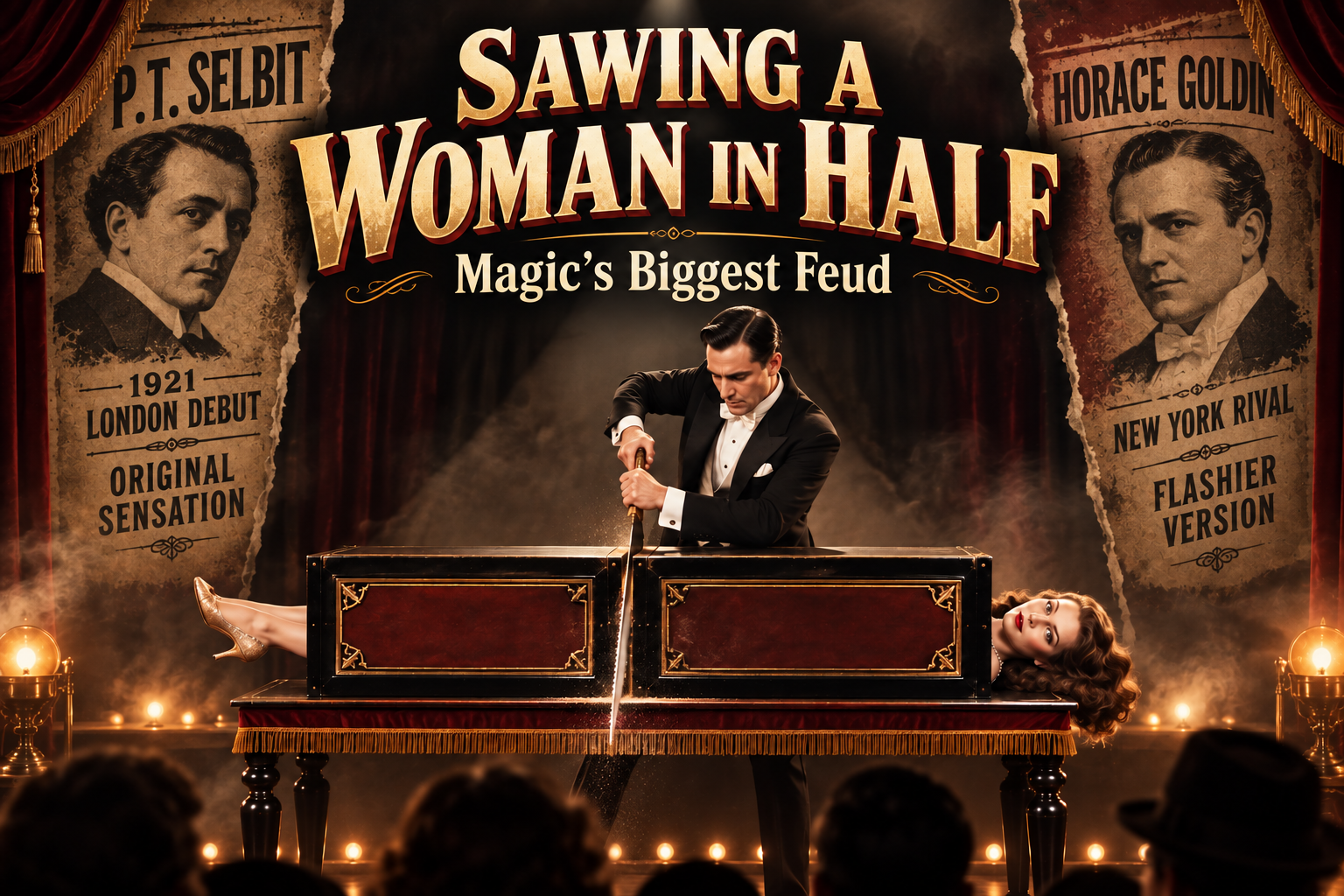
⚡ TL;DR: Sawing a Woman in Half: Magic’s Biggest Feud. A former magic magazine editor born Percy Thomas Tibbles — who reversed his own surname to invent the stage name “P.T. Selbit” — sawed a woman in half for the first time on a London stage in January 1921, using a real crosscut saw, a wooden crate, and sheets of glass and metal to divide a bound assistant into eight sections. Within five months Horace Goldin was performing a flashier version in New York, and the two men spent the rest of 1921 accusing each other of theft in court.
📋 What You’ll Learn
In this guide to Sawing a Woman in Half: Magic’s Biggest Feud, here’s what we cover:
- Meet the real inventor – Percy Thomas Tibbles, a magic magazine editor who spelled his own last name backward to become P.T. Selbit.
- See the original method – ropes, glass sheets, and an actual saw, not the smoke-and-mirrors version most people picture today.
- Learn about the Goldin feud – how a rival illusionist’s flashier version led to a real courtroom fight over who owned the trick.
- Understand why it still matters – a patent, a licensing empire, and a 1930s tobacco advertisement that blew the secret wide open.
Quick Summary & Key Takeaways
- P.T. Selbit — born Percy Thomas Tibbles in Hampstead, London, in 1881 — publicly debuted “Sawing Through a Woman” on January 17, 1921, at the Finsbury Park Empire, after a private demonstration for theatrical bookers the previous month.
- The original method used a closed wooden crate, ropes tied to the assistant’s hands, feet, and neck and held by audience volunteers, and sheets of glass and metal slid through the box before a genuine crosscut saw went through the wood itself.
- Horace Goldin debuted a competing New York version on June 3, 1921 that left the assistant’s head, hands, and feet visible the entire time and let him separate the two halves of the box — a far more visual effect than Selbit’s closed-crate original.
- Selbit sued Goldin for piracy that August; the case dragged through multiple courts, turned up an 1887 predecessor illusion, and ultimately ended with Goldin’s version ruled different enough to stand.
- Goldin patented and licensed his version to stars including Howard Thurston and Dante, and was still defending it in court as late as 1938 — by which point the method had already leaked into a cigarette advertisement.
Ask most people to name a classic magic trick and this is usually the first one they’ll describe — even if they’ve never set foot in a theater. Sawing a woman in half has been parodied, referenced, and reinvented for over a century, to the point that its actual origin story has mostly been forgotten underneath the cliché. That’s a shame, because the real history is sharper and stranger than the joke version: a magazine editor with a backward pen name, a secret rehearsal on a friend’s kitchen table, a rival who claimed he’d dreamed up the same idea fifteen years earlier, and a legal fight that turned up an illusion nobody involved had ever heard of.
The Editor Who Reversed His Own Name
P.T. Selbit was born Percy Thomas Tibbles in Hampstead, London, on November 17, 1881, and died on November 19, 1938. He got into magic early and was performing professionally by his early twenties, first under the stage name Joad Heteb as part of a pseudo-Egyptian act he ran from roughly 1902 to 1908. The name that stuck, though, came from his own surname: he spelled “Tibbles” backward, dropped one of the B’s, and became P.T. Selbit.
Selbit wasn’t just a performer. He was also a working magic writer and editor, publishing “The Magician’s Handbook” in 1901 and editing the trade magazine “The Wizard” from 1905 to 1910. He spent his career inventing illusions at a steady clip — Walking Through a Wall in 1914, and later “Girl Without a Middle” in 1924 among others — but nothing he created came close to the impact of the trick that made his name a permanent fixture in magic history.
A Secret Rehearsal, Then a Public Debut
Selbit worked out the illusion in 1920 in his own Bloomsbury apartment, then tested it in about as unglamorous a setting as magic history offers: on a kitchen table at the home of his friend, fellow magician Fred Culpitt, with Culpitt’s partner Jan Glenrose serving as the assistant. That informal run-through led to a private demonstration in December 1920 at St. George’s Hall in London, staged specifically for theatrical agents and promoters whose job was to decide whether this was worth booking.
It was. Selbit’s public debut came on January 17, 1921, at the Finsbury Park Empire, billed under the deliberately blunt title “Sawing Through a Woman.” His regular stage assistant, Betty Barker, took the part for the public performance. From that first night, Selbit leaned hard into the illusion of real danger — down to the choice, described below, that let members of the audience physically confirm the woman couldn’t have escaped.
Ropes, Glass, and a Real Saw
The version most people picture when they hear “sawing a woman in half” — a box separated into two halves with the assistant’s head and feet sticking out the ends — is actually Goldin’s later refinement, not Selbit’s original. Selbit’s 1921 version was both simpler and, in some ways, more unsettling.
The assistant was sealed inside a closed wooden crate resting on trestles, entirely out of sight. Before the box closed, ropes were tied to her hands, feet, and neck, with the free ends run out through holes in the crate and handed to audience volunteers, who held them for the entire routine — a direct, physical guarantee to the crowd that she hadn’t been swapped out or repositioned. Selbit then slid sheets of glass and metal through slots in the box, dividing the interior into eight separate sections before a genuine crosscut saw was drawn through the wood itself, splitting the crate in two. The box was never pulled apart afterward — the audience saw a sawn-through crate, not a separated one — and once the ropes were untied, the assistant emerged unharmed. It was a slower, more clinical presentation than what came later, built entirely around the audience’s own hands holding the proof.
Horace Goldin’s Flashier Answer
Selbit’s rival was every bit as colorful as the feud itself. Horace Goldin was born Hyman Elias Goldstein in Vilnius in 1873 and immigrated with his family to Nashville, Tennessee, as a teenager. His first act, a “Humorous Conjurer” routine, landed poorly, and a childhood accident had left him with a speech impediment that made patter-heavy comedy a difficult sell. Around 1901, inspired by fellow magician Imro Fox, he reinvented himself entirely: a rapid-fire, largely silent act that raced from one illusion to the next without breaking pace. It earned him the nickname “The Whirlwind Illusionist” and carried him through vaudeville and international tours for two decades before the sawing illusion ever entered the picture.
Goldin always maintained that he’d conceived the sawing idea back in 1906, describing it as coming to him in “a sort of vision” — but he didn’t actually put a version on stage until June 3, 1921, nearly five months after Selbit’s Finsbury Park debut and well after word of the English sensation had crossed the Atlantic.
Goldin’s version was a deliberate visual upgrade. Rather than sealing the assistant entirely from view, he let the audience see her head, hands, and feet the entire time the saw was working, and — unlike Selbit’s single sawn crate — he physically separated the two halves of the box and moved them apart on stage. It read as more dangerous and more visually complete than Selbit’s version, and it’s the template nearly every modern performance still follows. Goldin later pushed the presentation even further, developing versions that dropped the box altogether in favor of a buzzsaw running directly across the assistant’s midsection.
The Fight That Went to Court
Selbit wasn’t willing to let Goldin’s version pass as an independent creation. In August 1921 he accused Goldin of piracy, setting off a legal fight that stretched across multiple courts and multiple months. Goldin’s defense leaned on his claimed 1906 origin story, but the case took an unexpected turn when historical evidence surfaced showing the basic concept — a woman apparently sawn in two — dated back at least to 1887, in an illusion performed by Professor Hengler.
That discovery undercut both men’s originality claims at once. In November 1921, Selbit won an early skirmish in a Kansas City court when Goldin withdrew an injunction application after the 1887 precedent came to light. But the momentum didn’t hold — in the broader case that followed, the court sided with Goldin, ruling that his visible-limbs, separated-box presentation was different enough from Selbit’s sealed-crate original to stand on its own, and effectively recognizing Goldin as entitled to perform and control that version of the illusion going forward. Selbit had gotten there first; Goldin walked away with the legal high ground.
A Patent, a Licensing Empire, and a Tobacco Ad
Having prevailed, Goldin moved to lock down his version formally, securing U.S. Patent No. 1,458,575 on June 12, 1923. He built a real business around it, licensing the rights to major touring illusionists of the era including Howard Thurston and Dante — turning what had been a contested piece of stagecraft into a controlled, monetized product line.
Goldin defended that patent aggressively for the rest of his life. In one of the stranger footnotes to this story, he sued the R.J. Reynolds Tobacco Company in 1933 for $50,000 in damages after the company published the method behind the trick in one of its own advertisements — an act that, in Goldin’s view, gutted the illusion’s commercial value by handing the secret to the public for free. Federal courts dismissed the claim in 1938, the same year Selbit died, but the exposure had already done its damage: once an illusion’s mechanics are in wide circulation, no courtroom victory brings the mystery back. Goldin himself outlived his rival by less than a year — by then a British citizen billed as “Royal Illusionist” after performing for King Edward VII four times, he died in August 1939 immediately after a performance at London’s Wood Green Empire, the same city where Selbit had started it all.
Why Sawing a Woman in Half Still Matters to Collectors
Few illusions carry this much documented back-story — a named inventor, an exact debut date and venue, a named rival, an actual patent number, and a paper trail of lawsuits stretching across two decades. That’s unusually rich territory for anyone collecting apparatus or ephemera connected to golden-age stage illusions, because it means provenance questions here aren’t guesswork: a piece, poster, or program tied to either the Selbit or Goldin lineage is tied to a story that’s actually been verified, not just repeated.
It’s also a useful reminder of how differently two versions of the “same” trick can be built and staged — the sealed, rope-bound original versus the separated, limbs-visible version most people know today are genuinely different pieces of engineering, not just different presentations. If illusions with that kind of documented, competing lineage interest you, it’s worth browsing the stage illusions currently available through MagicTrickCollection.com.

Conclusion
Strip away the century of parody and pop-culture references, and what’s left is a genuinely well-documented piece of magic history: a magazine editor who tested his most famous invention on a friend’s kitchen table, a rival who beat him in court but not in the historical record, and a fight over ownership that ended up exposing an illusion neither man knew existed. Like the Zig-Zag Girl decades later, Sawing a Woman in Half proves the same pattern holds across magic history — a genuinely good idea, once it’s out in the world, invites imitation whether or not anyone gave permission, and sometimes the argument over who owns it becomes as much a part of the legend as the illusion itself.