Zig-Zag Girl Illusion: Magic’s Most Copied Trick
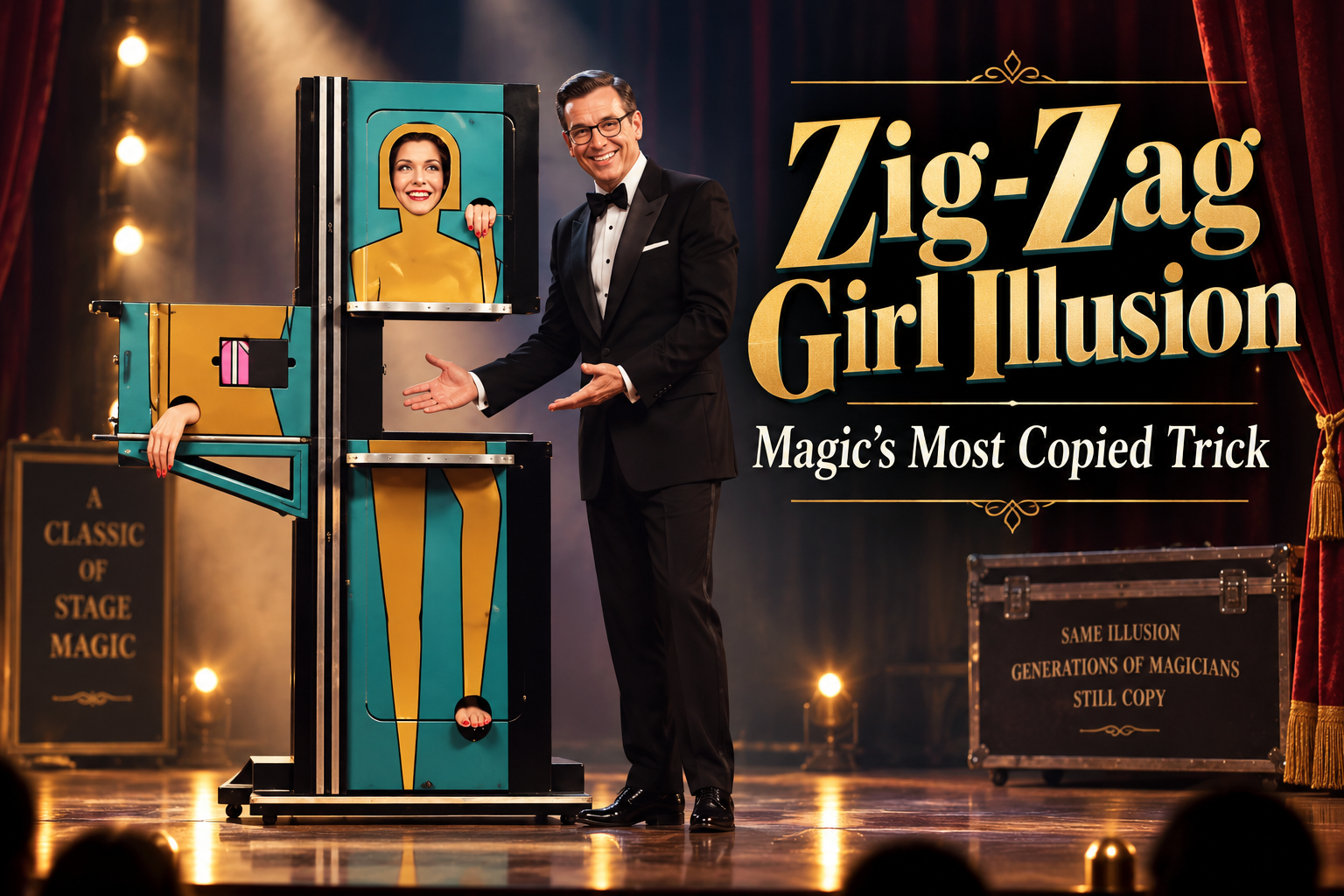
⚡ TL;DR: Zig-Zag Girl Illusion: Magic’s Most Copied Trick. An assistant stands in a cabinet, face and one hand and a bare foot in full view. The magician slides the middle third of her body sideways, out of line with the rest of her — and she’s still smiling. Robert Harbin unveiled it in London in 1965, tried to bury the method by destroying his own printing plates, and still watched it become the most copied stage illusion ever built.
📋 What You’ll Learn
In this guide to Zig-Zag Girl Illusion: Magic’s Most Copied Trick, here’s what we cover:
- Meet the real Robert Harbin – a South African-born origami pioneer who spent decades in London magic halls before creating his most famous illusion.
- See exactly what the effect looks like – the mechanics behind an illusion that can be examined by spectators from every side.
- Learn how Harbin tried to protect it – a 500-copy legal contract and a set of destroyed printing plates that didn’t stop a thing.
- Understand why it’s the most copied illusion in history – a Guinness World Record built on roughly 14,500 unauthorized copies.
- Discover why collectors still chase it – what separates an authorized build from the thousands of knockoffs on the market.
Quick Summary & Key Takeaways
- Robert Harbin, born Edward Richard Charles Williams in Balfour, South Africa in 1908, created the Zig-Zag Girl and first presented it at a Magic Circle banquet in London in October 1965.
- The illusion divides a standing assistant into three sections, sliding the middle section sideways while her face, one hand, and a bare foot remain in full view the entire time.
- Harbin published construction plans in 1970 in a limited edition of 500 copies, required buyers to sign a legal agreement restricting use, and later destroyed the printing plates, declaring the effect would never be released again.
- It didn’t stay contained. The 2005 Guinness Book of World Records named the Zig-Zag Girl the most copied stage illusion ever, with an estimated 15,000 versions built worldwide — roughly 14,500 of them unauthorized.
- Jim Steinmeyer later designed Modern Art specifically to address the physical casting limitations built into Harbin’s original method.
- Harbin was also a serious figure in an entirely different field: he’s credited as the first Westerner to popularize the term “origami” and founded the British Origami Society.
Most stage illusions fade in and out of fashion. A handful become classics that magicians keep performing for generations. And then there’s the Zig-Zag Girl — an illusion so relentlessly duplicated that the man who invented it tried to physically destroy the evidence of how it worked, and it made no difference at all.
Here’s the real story of Robert Harbin’s most famous creation: who built it, what it actually looks like on stage, and why an illusion designed to be kept under lock and key ended up in the hands of roughly 15,000 builders anyway.
The Man Behind the Illusion
Robert Harbin wasn’t his real name. He was born Edward Richard Charles Williams on February 12, 1908, in Balfour, South Africa, and his introduction to magic came early and unglamorously — an unknown ex-serviceman visited his school with a magic show that, by most accounts, wasn’t particularly good. It was enough to hook him anyway.
At 20, Williams moved to London and took a job in the magic department at Gamages, the department store that had already played a supporting role in the history of other famous illusions of the era. He worked the music halls under the stage name “Ned Williams, the Boy Magician from South Africa,” and by 1932 he was appearing in Maskelyne’s Mysteries, one of London’s premier magic showcases. Harbin also helped pioneer British magic’s move into a brand-new medium, appearing on BBC’s Variety program as early as 1937 and returning to television regularly once postwar broadcasting resumed.
By the time he created the Zig-Zag Girl in the mid-1960s, Harbin was already a veteran performer with decades of stagecraft behind him — not a newcomer stumbling onto a lucky idea, but an experienced illusion designer who had already built a career out of understanding exactly what an audience could and couldn’t be shown.
A London Banquet, October 1965
Harbin first presented the Zig-Zag Girl in October 1965, at a banquet held by the Magic Circle, London’s most prestigious magic society. It wasn’t a quiet debut — the effect also reached television audiences around the same period on the show International Showtime. Word spread through the magic world almost immediately, for a simple reason: nobody had seen anything built quite like it.
What set the Zig-Zag Girl apart from earlier cutting and sawing illusions wasn’t just the visual — it was how little the illusion needed to hide. Unlike effects that depended on distance, darkness, or a fixed viewing angle, the Zig-Zag Girl could be performed surrounded by spectators and hold up under close inspection, which made it exceptionally versatile for the kind of intimate, in-the-round performing conditions that other illusions of the era simply couldn’t survive.
What the Audience Actually Sees
The illusion places a female assistant standing upright inside a cabinet, with her face, one hand, and a bare foot visible to the audience throughout. Horizontal blades divide the cabinet into three sections. The magician then pushes the middle section sideways, creating the illusion’s namesake zig-zag offset — her midsection now appears to sit out of line with the rest of her body, as though she’d been sliced into three parts and shifted.
The effect’s real power is in what happens next: audience members can be invited to examine the offset middle section directly, at close range, while the assistant’s face and hand remain calmly visible above it and her foot below it. There’s no darkened stage, no distant sightline doing the hiding. After the inspection, the magician reassembles the sections and the assistant steps out completely unharmed. It’s a testament to how tightly the method holds up that an illusion built around three visibly separated sections of a human body can still be shown to skeptical spectators standing a few feet away.
The Book Harbin Tried to Bury
Harbin understood exactly what he had, and he tried to control it as tightly as the era’s technology and legal tools allowed. In 1970, he published the construction plans in a book titled The Magic of Robert Harbin, limited to just 500 copies. Buyers weren’t simply purchasing a book — they were required to sign a legal agreement promising to keep the method secret and restricting them to building a single version for their own personal use, not for resale or public construction plans.
Harbin went further than most creators ever have. After the limited print run sold out, he destroyed the printing plates outright and declared that the effect would never be published again. Today, the Magic Circle holds the publication rights to that original book — a fitting home, given that the illusion was born at one of the society’s own events. It’s hard to imagine a creator taking more deliberate steps to keep an invention contained.
The Trick That Wouldn’t Stay Secret
None of it worked, at least not in the way Harbin intended. Despite the signed agreements and the destroyed plates, the method spread anyway — through word of mouth, through builders who reverse-engineered what they saw on stage, and eventually through generations of unauthorized manufacturing. By the time the Guinness Book of World Records took notice in 2005, the Zig-Zag Girl was officially recognized as the most copied stage illusion ever made. Estimates put the number of versions built worldwide at around 15,000 — with roughly 14,500 of them unauthorized copies, built without Harbin’s plans, his permission, or a dime going back to his estate.
Not every version was a bootleg, though. Magician Dick Williams performed the first authorized American television version on April 4, 1971, giving the illusion a legitimate, sanctioned life on this side of the Atlantic even as unauthorized copies multiplied elsewhere. And decades after Harbin’s death, the trick found itself back in the spotlight for a very different reason: it was one of the illusions exposed on Fox’s Masked Magician specials, in which the performer Valentino revealed the workings of famous tricks to a prime-time television audience — the exact kind of broad, uncontrolled exposure Harbin had spent his own career trying to prevent.
An Illusion Designer’s Answer, Decades Later
The Zig-Zag Girl’s method came with a real practical limitation: it depended on an assistant within a fairly specific height and weight range, which restricted who a magician could actually cast in the role. That constraint didn’t go unnoticed by later illusion designers. Jim Steinmeyer, who would go on to design illusions for Doug Henning, David Copperfield, and Siegfried & Roy, spent years developing what became Modern Art — an illusion built specifically to accomplish a similar visual effect without the Zig-Zag Girl’s casting restrictions.
It’s a rare thing in magic history: one illusion so influential that a completely separate, independently documented illusion exists largely as an answer to its limitations, built by a different designer working a full generation later.
Harbin’s Other Legacy: Paper, Not Props
Here’s a detail that surprises most people who only know Harbin as “the Zig-Zag Girl guy”: he has a second, entirely unrelated legacy in a completely different craft. In 1953, Harbin was introduced to origami by filmmaker Cy Endfield, and he’s credited as the first Westerner to popularize the term “origami” itself in the English-speaking world. He went on to write multiple books on paper folding, founded the British Origami Society and served as its first president, and even presented origami segments on British children’s television programs into the 1970s.
It’s a genuine coincidence worth flagging, not a connection: Jim Steinmeyer’s illusion Origami — the folding-box illusion covered elsewhere on this site — takes its name from the same paper-folding art, but it has no historical link to Harbin’s origami work. Two completely different designers, working decades apart, each independently borrowed the same word from the same Japanese tradition to name something in magic.
Why Collectors Still Chase It
With an illusion this heavily copied, provenance is everything. A genuine, well-documented Zig-Zag build — one with a real performance history behind it, rather than one of the thousands of unmarked bootleg copies — carries a collectible weight that a generic knockoff simply can’t match. That’s exactly the kind of piece worth looking for: a stage illusion built by a known company, with paperwork or performance history to back it up, rather than an anonymous copy with no story attached.
Two pieces connected to MagicTrickCollection.com make that point directly, and each proves it a different way. One is a Zig-Zag built by Walter “Zaney” Blaney’s Show Stoppers company, currently part of this collection — in our own assessment, it’s the rolls-royce of Zig-Zag builds among the many variations out there, a reflection of Blaney’s reputation as one of the era’s most respected illusion manufacturers. The other carries a completely different kind of pedigree: a Zig-Zag manufactured by GEM Magic around 1975, acquired through an invitation to an early preview of a Criss Angel Productions warehouse sale in Las Vegas, with a documented line back to Criss Angel’s own performances.
Build quality on one side, performance history on the other — that’s exactly the kind of documentation missing from the vast majority of the roughly 15,000 Zig-Zags in circulation, and exactly what separates a real collector’s piece from an anonymous copy with no story attached.

Conclusion
Robert Harbin did almost everything a creator could do to keep the Zig-Zag Girl under control — a tiny print run, signed legal agreements, and printing plates destroyed by his own hand. It became the most copied stage illusion in history anyway, spawned a rival design a generation later, and got exposed on national television decades after its creator’s death. Harbin spent his life balancing two very different crafts, one built on carefully guarded secrets and one — origami — built on sharing a folding technique with anyone willing to learn it. The irony is that the secret he guarded hardest is the one that got away from him completely.