Robert-Houdin Fact vs Legend: Did Magic Stop a Revolt?
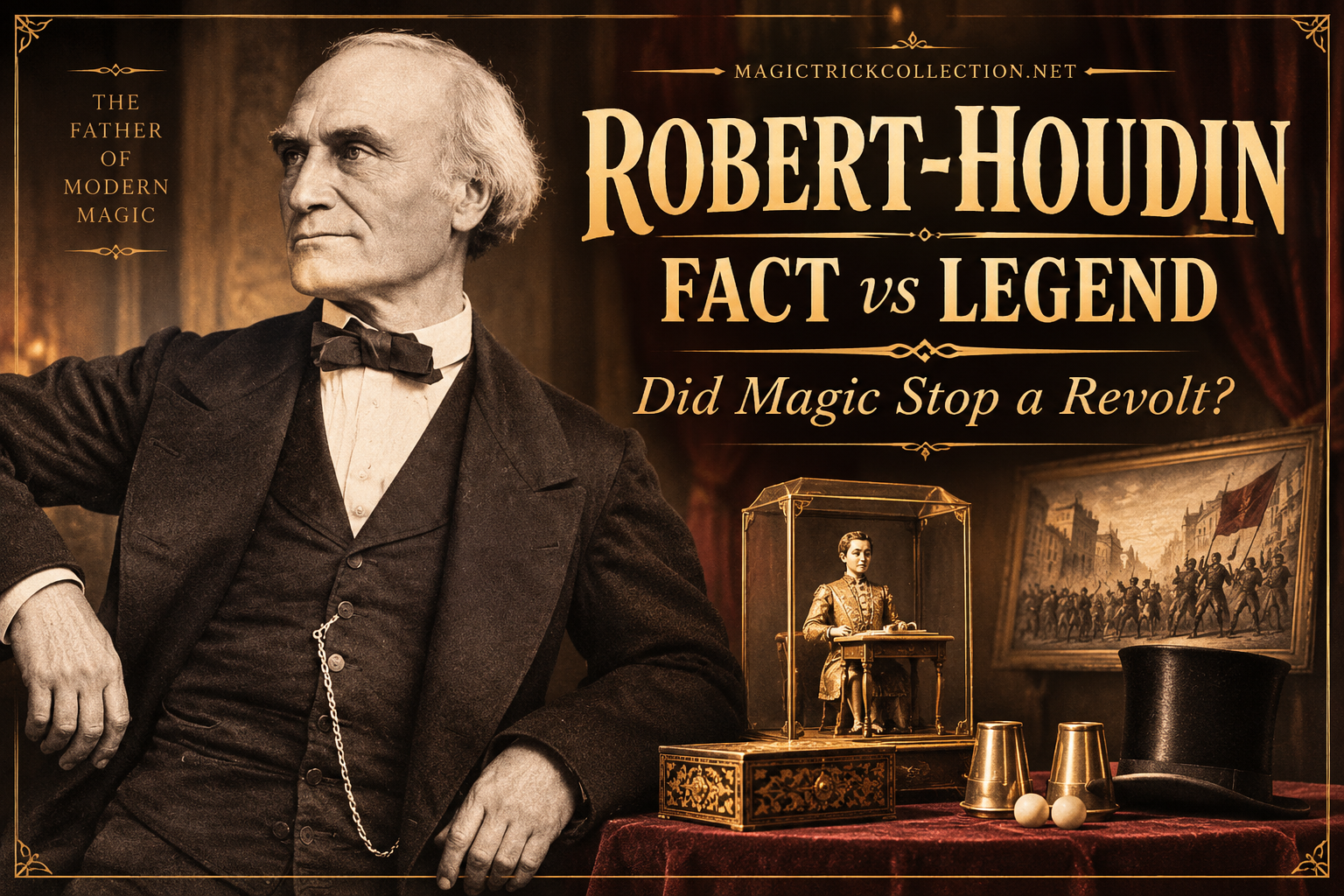
⚡ TL;DR: Robert-Houdin Fact vs Legend: Did Magic Stop a Revolt? He turned magic into an elegant theater, and his most famous story, stopping a rebellion with magic, rests mostly on his own memoirs. Every magician who walks on stage in a suit owes something to a French watchmaker. In 1845, Robert-Houdin opened a small Paris theater, dressed like a gentleman and presented magic as science and art rather than sorcery. Historians call him the father of modern magic. He also told great stories about himself. This first article in our ten-week series separates what the record shows from what Robert-Houdin wanted us to believe.
📋 What You’ll Learn
In this comprehensive guide about Robert-Houdin Fact vs Legend: Did Magic Stop a Revolt? we’ve compiled everything you need to know. Here’s what this covers:
- The Watchmaker of Blois: how a craftsman’s training shaped his magic.
- The 1845 Turning Point: why his Soirées Fantastiques changed how magicians look and perform.
- His Signature Wonders: Second Sight, Ethereal Suspension and the Light and Heavy Chest.
- Fact vs Legend: what really happened on his 1856 mission to Algeria.
- The Houdini Connection: how a young American took his name, then turned on him.
- For Collectors: where to see and collect Robert-Houdin today.
Meet the Legends, Part 1 of 10: a weekly series on the ten magicians in Amazing Famous Magician Answers for Kids.
1. The Watchmaker of Blois
He was born Jean-Eugène Robert in Blois, France, in December 1805. Even his birthday holds a small mystery. His memoirs give December 6. Historians working from the birth record put it one day later.
His father, Prosper Robert, was a respected watchmaker. The son trained in the same trade, and that training shaped everything he later did on stage. He understood springs, gears and timing. He built mechanical figures that wrote, drew and moved like living things.
By his own account, magic found him by accident. He went to buy a book on watchmaking and came home with a book on conjuring instead. It is a charming story. It is also his story, told years later, so treat it as a memory rather than a record.
In 1830 he married Cécile Houdin, the daughter of a watchmaker, and joined her name to his own. Robert became Robert-Houdin.
2. 1845: The Night Magic Changed Its Clothes
On July 3, 1845, Robert-Houdin opened a small theater of about 200 seats near the Palais-Royal in Paris. He called his performances the Soirées Fantastiques, or Fantastic Evenings.
The first night did not go well. In his memoirs he admits to stage fright, rushed delivery and a flat voice. He kept going, and the show found its audience.
What made it different was the look. Magicians of the day often wore robes and worked behind cluttered tables. Robert-Houdin wore ordinary evening dress and performed in an elegant room that looked like a fine Paris salon. The message was simple: this is a gentleman of science, not a sorcerer.
That image is still with you every time you watch a magician in a suit. Decades later, the theater that carried his name was bought by Georges Méliès, the stage magician who became one of the first great filmmakers.
3. The Wonders That Made His Name
Robert-Houdin blended clockwork, showmanship and the new science of his age. Three pieces stand out:
- Second Sight. His blindfolded son, Emile, named objects that audience members handed to his father. Paris could not stop talking about it.
- Ethereal Suspension. His son appeared to float in the air, resting on a single staff. Robert-Houdin presented it as an effect of ether, a hot topic in 1847 medicine.
- The Light and Heavy Chest. A small box that a child could lift. Then a strong man tried, and could not move it.
Notice the pattern. Each one borrowed the language of science to make the impossible feel believable. That was his real invention.
4. Fact vs Legend: Did Magic Stop a Rebellion
This is the story everyone repeats. In 1856 the French government sent Robert-Houdin to Algeria, then a French colony. His mission was to show local leaders that French magic was stronger than the wonders of the marabouts, religious holy men whose influence worried colonial officials. According to the legend, his performances helped stop a revolt.
What the record supports:
- The invitation was real. Colonel François-Edouard de Neveu of the Bureau of Arab Affairs asked him to go.
- Robert-Houdin did not jump at it. It took nearly two years and three requests before he agreed.
- He sailed from Marseille in September 1856 and performed for Algerian chiefs that autumn. The Light and Heavy Chest was part of the program.
What rests on his word alone:
- The dramatic scenes, the stunned chiefs and the claim that his show ended a rebellion come almost entirely from his memoirs, published about two years later.
- Magic historian Jim Steinmeyer points out that nearly every retelling traces back to that one book, and that the memoirs do not hold up well under careful study. Robert-Houdin even admitted he built the book like a magic show.
- Modern scholars, including anthropologist Graham M. Jones, also read the mission as colonial spectacle: a performance meant to impress a population under French rule.
The research is still moving. In March 2026, historian François Bost gave a public lecture in Geneva that re-examined the mission using archive material never studied before.
📜 History Check: The Algeria Mission
Documented: The French government invited him, and he performed for Algerian leaders in 1856.
Unconfirmed: That his performances stopped a rebellion. That claim comes mainly from his own memoirs.
This exact question gets its own History Check page in my book, Amazing Famous Magician Answers for Kids. Young readers learn to ask the question every collector asks: how do we know?

5. The Houdini Connection
Across the Atlantic, a teenager named Ehrich Weiss read Robert-Houdin’s memoirs and was hooked. He built a stage name from his hero’s: Houdini.
The admiration did not last. In 1908 Houdini published The Unmasking of Robert-Houdin, accusing the Frenchman of taking credit for other men’s inventions. The attack was so harsh that it pushed many magic historians to rush to Robert-Houdin’s defense. In trying to tear down his idol, Houdini helped keep him famous.
You can read more about Houdini’s own mix of fact and legend in Houdini Fact vs Legend: 100 Years After His Death.
6. Where You Can Still Find Him
Robert-Houdin retired to Saint-Gervais, near Blois, and died there on June 13, 1871. He spent his final years writing. His books include his memoirs, Confidences d’un prestidigitateur, and Les Secrets de la prestidigitation et de la magie (1868), which Professor Hoffmann later translated into English as The Secrets of Conjuring and Magic.
- Visit: La Maison de la Magie Robert-Houdin in Blois, opened in 1998, faces the royal Château de Blois. Mechanical dragons peer from its windows.
- Read: The English translation of his memoirs is free on Project Gutenberg. Read it as a showman’s autobiography, not a sworn statement.
- Collect: Original Robert-Houdin apparatus is museum-level and rarely changes hands. Early editions of his books and period engravings are a realistic way to bring him onto your shelf.
The lesson for collectors is the same one his life teaches: a great story deserves a second source.
Next Monday: Harry Kellar, the shipwrecked showman who became the Dean of American Magicians.
Sources
- Memoirs of Robert-Houdin (Project Gutenberg)
- Jim Steinmeyer, What We Hide: Problems in Algeria, Part One
- Encyclopaedia Britannica: Jean-Eugène Robert-Houdin
- The mission of the magician Robert-Houdin in Algeria (lecture, Geneva, 2026)
- Wikipedia: Jean-Eugène Robert-Houdin
About MagicTrickCollection.net
At MagicTrickCollection.net, we celebrate the extraordinary history of magic, the legendary performers who shaped the art, and the rare and vintage apparatus that helped bring their illusions to life.
Discover the Magic. Preserve the History. Celebrate the Legends.

Ten legends, 130 true answers, ages 8–12. See the book, or view it on Amazon.
Amazing Famous Magician Answers for Kids is my own book. Book links go to its Amazon listing.