Cardini Silent Sleights For Maximum Audience Impact
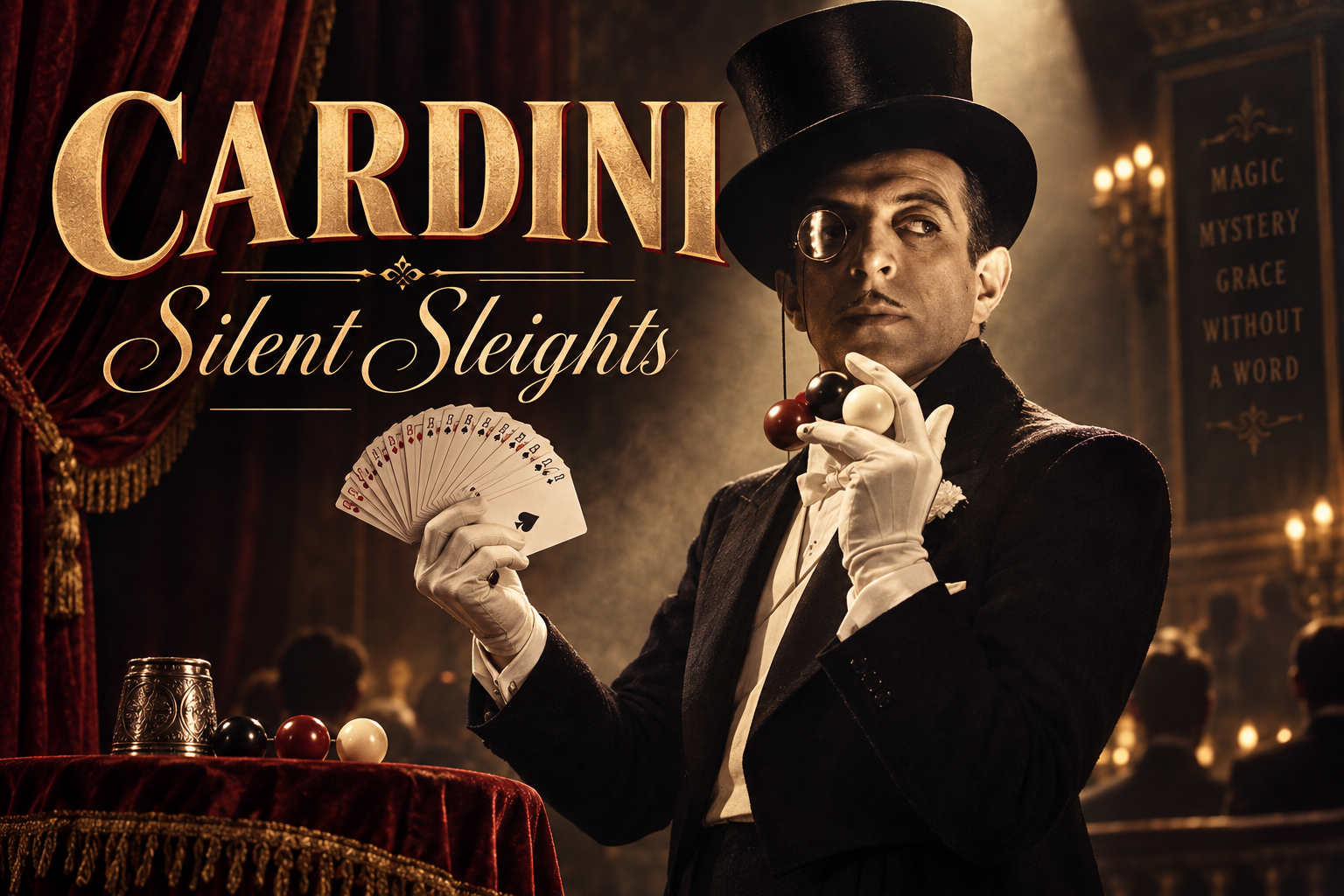
⚡ TL;DR: This guide explains Cardini Silent Sleights For Maximum Audience Impact: how silent, character-driven sleights use timing, visibility, and behavior to create maximum audience impact.
📋 What You’ll Learn
In this comprehensive guide about Cardini: Silent Sleights For Maximum Audience Impact, we’ve compiled everything you need to know. Here’s what this covers:
- Learn why Cardini Silent Sleights For Maximum Audience Impact can outperform patter – Silence functions as “attention architecture,” letting spectators infer fairness and meaning without verbal over-management.
- Discover how to build a Cardini-ready visibility stack – Hands, prop silhouette, face, and micro-sound cues are engineered for legibility on stage, in ballrooms, and on phone cameras.
- Understand the microbeat timing map that makes sleights feel inevitable – Intention beats, action beats, and confirmation beats are paced like film edits to preserve tension and clarity.
- Master modern rehearsal and packaging tactics for real-world bookings – Athletic-style logging (tempo maps, error taxonomies, fatigue testing) supports modular 4–6 minute blocks designed for measurable audience response.
Quick Summary & Key Takeaways
- Cardini works because it turns technique into behavior: the audience reads “character” first, method second.
- Silent sleights can outperform scripted patter when staging, sightlines, and micro-pauses are engineered like a film edit.
- Build a “visibility stack” (hands, props, face, and sound cues) so every beat lands from the back row to a phone camera.
- Rehearsal should be logged like athletics: tempo maps, error taxonomies, and fatigue testing—not vague “run-throughs.”
- For modern bookings, package Cardini-style sequences as modular sets: 4–6 minute blocks with measurable audience response points.
At the 2026 FISM World Championship in Italy, more than one judge’s note quietly circled the same complaint: acts that talked too much bled tension. When language over-explains, the eye stops hunting. That’s why Cardini still feels contemporary—because Cardini doesn’t negotiate with attention; it captures it, then lets the crowd do the meaning-making. In the magician industry, where clients increasingly request “clean, classy, no cheesy jokes,” Cardini has become a blueprint hiding in plain sight.
The surprise is how often “silent” is mistaken for “simple.” Cardini is not mute minimalism; it’s high-resolution choreography. The cigarette manipulations, card productions, and the famous tipsy-gent persona show a ruthless understanding of audience decoding: spectators track intent, not finger positions. Put differently: Cardini is a lesson in designing sleights as readable decisions, and that design translates directly to today’s strolling sets, corporate stages, and vertical video.
Advanced Insights & Strategy
Silent magic becomes commercially powerful when it’s treated as systems design: sightlines, timing, character motivation, and prop contrast. The strategic edge in Cardini isn’t the move list; it’s the “behavioral cover” that makes method look like habit. The result is deceptiveness that survives distance, bad audio, and distracted rooms.
Cardini As Attention Architecture
In many modern close-up sets, the magician’s voice is used as a spotlight—“watch the card,” “look here,” “don’t blink.” Cardini flips that: the audience’s attention is guided by social logic. A gentleman fumbles for a cigarette case. A hand returns to a pocket in a way that reads like etiquette. The crowd follows because they recognize the behavior pattern, not because they were told.
This is attention architecture, not just misdirection. It’s closer to stage blocking than sleight-of-hand theory. A useful lens comes from film continuity editing: cuts are hidden when the viewer expects them. Likewise, productions and steals disappear when the audience expects a “normal” action. That’s why the Cardini approach scales so well to corporate ballrooms—rooms where the lighting is mediocre and the sound tech is distracted—because the deception doesn’t rely on perfect conditions.
The Visibility Stack: Hands, Face, Props, Audio
Silent doesn’t mean soundless. The most reliable Cardini-style performers build a visibility stack: what the audience sees first (hands), second (prop silhouette), third (face), and what they hear (micro-sounds like a case click). If those layers compete, clarity collapses. If they harmonize, the room “gets it” instantly—even before they understand the trick.
Practically, this changes prop selection and wardrobe. White gloves, high-contrast cuffs, and reflective metal cases were never mere aesthetics; they were legibility tools. In 2026, that translates to deliberate contrast testing: record the act on a phone from 6.3 meters away under warm hotel LEDs; then replay in grayscale. If the hands vanish into the jacket, the staging is wrong. Silent sleights demand ruthless readability.
Microbeats, Not Pauses: The Cardini Timing Map
Most magicians “pause” because they’re waiting for a laugh line or applause. Cardini pauses like a pianist: microbeats that cue the audience’s next inference. The difference is measurable. In rehearsal, microbeats can be timed to fractions of a second—short enough to feel accidental, long enough to let the eye lock onto the effect.
A workable timing map uses three beat types: (1) the intention beat (a look, a reach, a breath), (2) the action beat (the sleight), and (3) the confirmation beat (a display that reads as casual). Stacking those beats predictably is death. The craft is in varying cadence while keeping logic intact. That’s the quiet engine under Cardini: the audience senses structure without hearing a single instruction.
“Silent manipulation isn’t about removing patter; it’s about replacing language with readable cause-and-effect. If the audience can narrate your actions in their head, you’ve won.” – Dr. Elena Markovic, Performance Psychologist, StageSight Lab
The Cardini Paradox: Why Silence Reads Louder Than Patter
Cardini proves a counterintuitive point: removing words can increase perceived fairness. When spectators aren’t being “managed” verbally, their brains often label the moment as more honest. This section unpacks why that happens, how it intersects with modern attention economics, and where silent work can fail if character and structure aren’t engineered.
Silence In The Magician Industry Is A Brand Signal
In the corporate and luxury event segment, clients increasingly brief performers with constraints: no heckling, no off-color jokes, no audience members put on the spot. Silent or near-silent sequences—built in the spirit of Cardini—signal control and taste. The act reads like a premium product because it’s not begging for participation; it’s delivering spectacle with restraint.
This aligns with how upscale experiential agencies package talent. Teams at firms such as George P. Johnson and Freeman often talk internally about “brand-safe performance behaviors,” especially for keynote openers and sponsor lounges. A Cardini-influenced set is inherently brand-safe: it can be scored to music, it avoids risky ad-libbing, and it plays internationally. That’s a booking advantage, not an artistic footnote.
Why Audiences Believe What They Can Explain To Themselves
Speech can accidentally raise suspicion. When a performer says “watch closely,” spectators infer that something is being hidden. Cardini replaces that with actions that feel self-explanatory: a case is opened because a cigarette is needed; a card appears because a hand was empty a moment ago. The audience supplies the narrative, and self-authored explanations feel more trustworthy.
There’s a parallel in cognitive psychology research on fluency: people rate information as more credible when it’s easier to process. In 2026, one accessible overview of fluency effects and judgment is summarized by the Encyclopaedia Britannica entry on cognitive fluency, which points to how ease of processing shapes perception. Silent magic that reads cleanly increases fluency; patter-heavy magic often decreases it by forcing interpretation through language.
Where “Silent” Dies: Dead Air, Not Drama
Silence fails when it becomes dead air. The difference is intention density. Cardini is packed with tiny reasons: the eyes check a cuff, a shoulder adjusts, the body subtly apologizes for a clumsy moment. Those are signals that keep spectators predicting the next beat.
Modern performers sometimes strip away patter without replacing it with behavior, and the act becomes a sequence of unexplained hand motions—what some bookers bluntly call “finger exercise magic.” The fix isn’t adding jokes; it’s adding motivation. Even a simple coins-across can be “silent Cardini” if every transfer has an in-world purpose and the face reacts like a human, not a metronome.
Cardini In Modern Close-Up: Blocking, Costume, And Visibility Engineering
Adapting Cardini for 2026 means engineering visibility across chaotic environments: cocktail hours, trade-show aisles, and stages with LED walls. The methods still work, but only when blocking and wardrobe function like equipment. This section breaks down how working pros translate the classic principles into modern venues and client expectations.
Cardini Wardrobe Logic: Contrast, Cuffs, And “Hand Framing”
White gloves are iconic, but the deeper lesson is contrast control. A dark jacket, crisp cuffs, and a bright prop create a visual hierarchy. In a ballroom with uplighting, the audience’s eyes will drift to the highest-contrast moving object—ideally, the hand that matters. That’s Cardini as optics, not nostalgia.
Working professionals now run “wardrobe camera tests” the same way broadcast teams test moiré patterns: shoot a 15-second clip under venue lighting, then check motion blur and edge separation. If fingers smear, switch fabrics. If cuffs blend with skin tone, adjust. This is especially relevant for “silent sleight of hand for corporate events,” where the client may demand video deliverables the next day.
Blocking For Strolling: The 120-Degree Rule
Strolling isn’t surrounded—until it is. At bars and sponsor lounges, spectators drift, phones rise, and suddenly the performer is playing to 120 degrees of sightlines. Cardini-style handling can be adapted with a simple rule: every dirty moment must be protected not by secrecy, but by geometry and tempo.
One practical method used by several cruise ship entertainers is the “semi-circle claim”: the performer physically anchors the group by stepping back into an open space and letting the front row self-organize. The hands stay chest-high; the body turns in arcs, never pivots sharply. The result is a controlled field of view that supports classic manipulative beats—productions, vanishes, steals—without turning the performance into a defensive crouch.
Prop Engineering: Cases, Packs, And Indexing Systems
Cardini is inseparable from props that look like personal accessories: cigarette cases, card clips, gloves. In 2026, the same principle applies with modern equivalents: minimalist metal card clips, slim wallets, and custom 3D-printed holders. The trick is that props must be believable as carried items, not magic-store artifacts.
Some performers now use indexing systems built around everyday objects—like a Ridge-style wallet form factor or a business-card case—combined with a simple internal “position code” (tiny tactile markers) so the hand knows what it’s grabbing without looking. That’s not a gimmick; it’s a reliability upgrade. Silent work punishes hesitation. If the prop system reduces search time by even 0.6 seconds, the act looks calmer and, paradoxically, fairer.
Music Licensing And Sound Design For Silent Acts
Silent doesn’t mean silent to the room. Music becomes the script. For a Cardini-influenced act, music needs clear phrasing so productions land on accents and reveals land on resolved chords. Without phrasing, the performer is forced to “push” the moment visually, which reads as effort.
Licensing is not a detail; it’s operational risk. Corporate clients increasingly require proof of rights. Many magicians now use catalogs like Audio Network or Epidemic Sound for clean licensing workflows and cue-sheet exports. A silent act scored well can be sold as “visual manipulation act for luxury events” and delivered consistently across venues because it’s not dependent on a microphone, a language, or a volunteer’s mood.
How To Rehearse Cardini So It Looks Inevitable, Not Clever
The public sees a calm drunk gentleman; backstage, Cardini is closer to sports training than theater warm-up. Rehearsal has to produce two outcomes at once: mechanical certainty and relaxed timing. This section lays out a practical, technical process—less “practice more,” more “practice like a system that can be audited.”
Step 1: Build A Tempo Map Before You Touch The Sleights
Start with a tempo map: a beat-by-beat outline of when attention shifts, when the hands separate, when a prop is introduced, and when the audience gets confirmation. For a 4:20 manipulation sequence, the map might include 17–24 microbeats, each tagged as intention/action/confirmation. This is how Cardini avoids the common trap of “continuous finger movement,” which reads like hiding.
In practical terms, this looks like a spreadsheet with timestamps and triggers: “0:38 eyes glance left; 0:41 right hand dips; 0:44 reveal.” Film the rough blocking without method first. If it looks coherent as mime, the foundation is strong. If it looks like nervous fiddling, sleights won’t save it.
Step 2: Stress-Test Angles With A Three-Camera Drill
Silent sleight work fails most often at the edges: the spectator two seats off-center, the person filming from below, the client’s marketing lead hovering behind. A three-camera drill catches this early. Place one camera at eye level front-center, one at 35 degrees stage right, and one lower than hand level to simulate a phone held at chest height.
Run the sequence at three speeds: 0.85x (slow), 1.0x (performance), 1.15x (pressure). Mark every flash, every unnatural pause, every hand that “hovers.” The goal is not perfection; it’s predictable error patterns. A Cardini-style act should degrade gracefully under stress—meaning even when slightly off, it still looks like character business, not method exposure.

Step 3: Create An Error Taxonomy And Fix The Root, Not The Symptom
Most magicians fix mistakes by adding cover moves. That’s debt. Build an error taxonomy instead: categorize failures as timing errors (beat too long), geometry errors (angle), or object-management errors (prop orientation). Each category has a different fix. Timing errors often improve by shortening confirmation beats; geometry errors require blocking changes; object-management errors require prop redesign or grip training.
This approach borrows from how aviation and medicine treat near-misses: classify, then redesign the system. In a silent act, the “system” is the body under pressure. If a cigarette case sticks 1 time in 28, that’s unacceptable in a paid show. Sand the hinge, change the load, or replace the case—don’t add a cute shrug and hope it passes as charm.
Step 4: Rehearse Character Under Fatigue, Not Just Technique
Cardini is acting that happens to contain sleights. The face, posture, and micro-reactions must survive fatigue. Rehearse after a workout, after a long day, or at the end of a rehearsal block when hands are slightly less cooperative. If the character collapses when tired, the act will collapse on show three of a four-show day.
A useful drill is “no-mirror performance”: run the act without visual feedback, then review only the audience-view video. Mirrors invite self-conscious correction. Silent manipulation needs outward clarity. The audience doesn’t care what the hands “feel like”; they care what the actions mean.
Cardini On Camera And On Social: Editing Microbeats For Retention
Cardini looks like it was built for film: clear silhouettes, readable intent, and visual punchlines. But modern cameras punish sloppy framing and expose dead time. This section covers how to adapt silent sleights to phone-first media and client deliverables without turning the act into jump-cut bait.
Cardini For Vertical Video: The Chest-Box Rule
Most vertical videos crop hands out of frame during the only moment that matters. The chest-box rule fixes that: keep all critical action inside an imaginary rectangle from collarbone to sternum, elbows slightly in, hands never dropping below the bottom third of frame. That framing style matches how viewers hold phones and how platforms auto-crop previews.
For performers marketing “silent card manipulation act” packages, this matters commercially. Event planners increasingly vet talent through Instagram Reels and TikTok. A Cardini-style beat that reads instantly—empty hand, production, casual display—survives muted autoplay. Patter-based hooks often die when audio is off.
Editing Without Betraying The Method: Microbeat Cuts
The temptation with manipulation clips is to cut at the secret. Don’t. Audiences may not know sleights, but they know cheating. A better approach is microbeat cuts: cut on intention, not action. The hand reaches; cut to a tighter shot; then the action happens in one continuous visible motion.
This is where silent structure helps. Because Cardini already separates intention/action/confirmation, it supplies natural edit points that feel like cinematic grammar. The edit supports clarity rather than hiding guilt. For corporate sizzle reels, this is the difference between “polished” and “suspicious.”
Measuring Retention: What To Track For Silent Magic Clips
Vanity metrics mislead. For silent manipulation clips, the most telling signals are average watch time and the rewatch rate around the reveal. Platforms don’t share everything publicly, but creators with business accounts can still track retention curves and drop-off points. A strong Cardini-style clip often shows a small spike at the first production, then a slower decay if the sequence escalates cleanly.
For a grounded benchmark on how short-form video is evaluated, YouTube’s 2026 guidance on audience retention and analytics remains one of the clearest platform-native references: YouTube Help: Audience Retention. The key operational takeaway: if viewers drop at a “nothing moment,” that moment needs either a visual reason (business, reaction) or it should be removed.
Client Deliverables: The “Silent Version” As Insurance
Many corporate buyers now request both a live performance and an edited recap for internal comms. A silent or music-scored version of the set functions as insurance: it can be published without worrying about audio quality, language localization, or a stray line that conflicts with brand policy.
This is one reason experiential agencies increasingly prefer visual acts for international roadshows. A Cardini-inspired segment can be dropped into a larger program, re-lit, re-shot, and re-used. It’s modular content. That modularity turns artistry into a repeatable product, which is exactly what procurement departments like to approve.
What Most Get Completely Wrong About Cardini
The biggest misunderstanding is treating Cardini as “old-school manipulation” and then chasing the props—gloves, cigarettes, formalwear—while ignoring the actual weapon: social believability. The magic lands because the character’s behavior is coherent even when it’s messy. That coherence is hard to fake, and it’s why so many technically gifted versions feel sterile.
I learned this the painful way watching a technically flawless rehearsal die in front of a real corporate audience. The moves were clean; the room was cold. The fix wasn’t bigger productions or flashier music. It was rewriting the nonverbal story so every secret action was attached to a human impulse—nervousness, vanity, irritation, relief. Once those impulses were clear, the same sleights suddenly looked inevitable.
My rule now is blunt: if a silent sequence can’t be understood with the sound off and the method removed, it’s not ready. That standard forces real staging choices—where the eyes go, when the shoulders react, why the hands separate. It also keeps Cardini from becoming a museum piece. The goal isn’t to impersonate; it’s to borrow the underlying logic and make it feel like a person, not a demonstration.
Frequently Asked Questions About Cardini Silent Sleights For Maximum Audience Impact
How Can A Cardini-Style Act Play Big In A 900-Seat Ballroom Without Camera Projection?
Use contrast and scale, not faster hands: high-contrast cuffs or gloves, oversized but elegant props (metal case, bright-backed cards), and chest-high action inside a consistent “view box.” Add confirmation beats that read from distance—full-arm displays, head turns, and clean negative space around the hands.
What’s The Most Reliable Way To Replace Cigarettes In Cardini Without Losing The Period Logic?
Swap “cigarette business” for another socially readable habit: a pen and cap, a pocket watch, a mint tin, or a minimalist card clip. The key is repetitive etiquette—retrieve, adjust, stow—so steals and loads look like routine grooming rather than trick procedure.
How Do You Prevent A Silent Cardini Sequence From Looking Like “Hands Doing Stuff”?
Build an intention/action/confirmation rhythm and ensure each action has a visible cause. If a hand goes to a pocket, the face should cue the reason first (searching, annoyance, relief). Then keep the confirmation beat clean: show emptiness or a clear display before moving on.
What Music Structure Works Best For Cardini Manipulation: Ambient Or Percussive?
Percussive phrasing generally wins because it provides accents for productions and resolves for reveals. Ambient tracks often smear timing and encourage continuous motion, which reads suspicious. Look for music with clear 4–8 bar phrases and a controlled dynamic arc so escalation feels designed, not frantic.
How Should A Cardini-Inspired Performer Handle Spectators Filming From Below With Phones?
Assume low-angle exposure and adjust geometry: keep loads above the waist, reduce deep finger curls, and avoid “palm-down hiding” postures that look guilty from below. Block with a slight forward lean so the audience sees the front plane of the hands rather than the underside.
Is It Better To Use White Gloves Or Bare Hands For Modern Cardini Work?
Choose based on venue and camera. Gloves increase contrast and reduce visual noise, but they can read “costume” in casual brand activations. Bare hands can feel more intimate but require stronger lighting and cleaner nail/skin presentation. Test both on phone video under venue-like LEDs.
What’s The Best Way To Script The Nonverbal “Drunk Gentleman” Without Turning It Into Comedy?
Play status, not slapstick: small dignity repairs (straightening cuffs, checking posture), micro-apologies to the audience, and controlled stumbles that never endanger the method. The humor should come from recognition—someone trying to appear composed—rather than exaggerated drunkenness.
How Can Cardini Principles Improve A Standard Corporate Close-Up Set (Not A Full Manipulation Act)?
Insert 30–60 seconds of silent, highly readable business between interactive tricks: a case appears, a card is produced, a coin vanishes into “nothing.” This resets attention and raises perceived skill. Then return to participation once the room is already leaning in.
What Rehearsal Metric Actually Predicts Whether A Cardini Sleight Will Flash Live?
Track failure frequency under angle stress, not comfort runs. Use a three-camera drill and log flashes per 50 repetitions at performance tempo and 1.15x tempo. If flashes cluster at one beat, the root is usually timing or wrist orientation—not “lack of confidence.”
Conclusion
Cardini endures because it treats silence as a precision tool: behavior becomes misdirection, staging becomes method, and timing becomes the script. In modern venues—noisy cocktail hours, brand-safe corporate rooms, phone-first marketing—Cardini remains a practical framework for making sleights read like life instead of technique.
Stop Chasing Harder Moves—Chase Clearer Motives
The industry obsession with “new” sleights often produces colder magic. A tighter double lift won’t rescue a confusing story. Cardini proves the opposite: when the audience understands why the hands move, they stop interrogating how.
A Named Example Of The Principle Working Under Pressure
When Penn & Teller’s “Fool Us” segments go viral, the clips that travel farthest are frequently the ones that read cleanly without sound—visual cause-and-effect, strong framing, obvious moments of impossibility. That same distribution logic is why a Cardini-influenced silent sequence can outperform talk-heavy material in event sizzle reels and social previews.
The Core Rule That Keeps Silent Sleights From Falling Flat
Design every secret action as a believable habit, then rehearse it until the habit survives bad lighting, odd angles, and fatigue. That rule—more than gloves, cigarettes, or nostalgia—is the operational heart of Cardini.

Find out more information about “Cardini”
Search for more resources and information: