Tony Slydini Magnetic Close-Up Presence
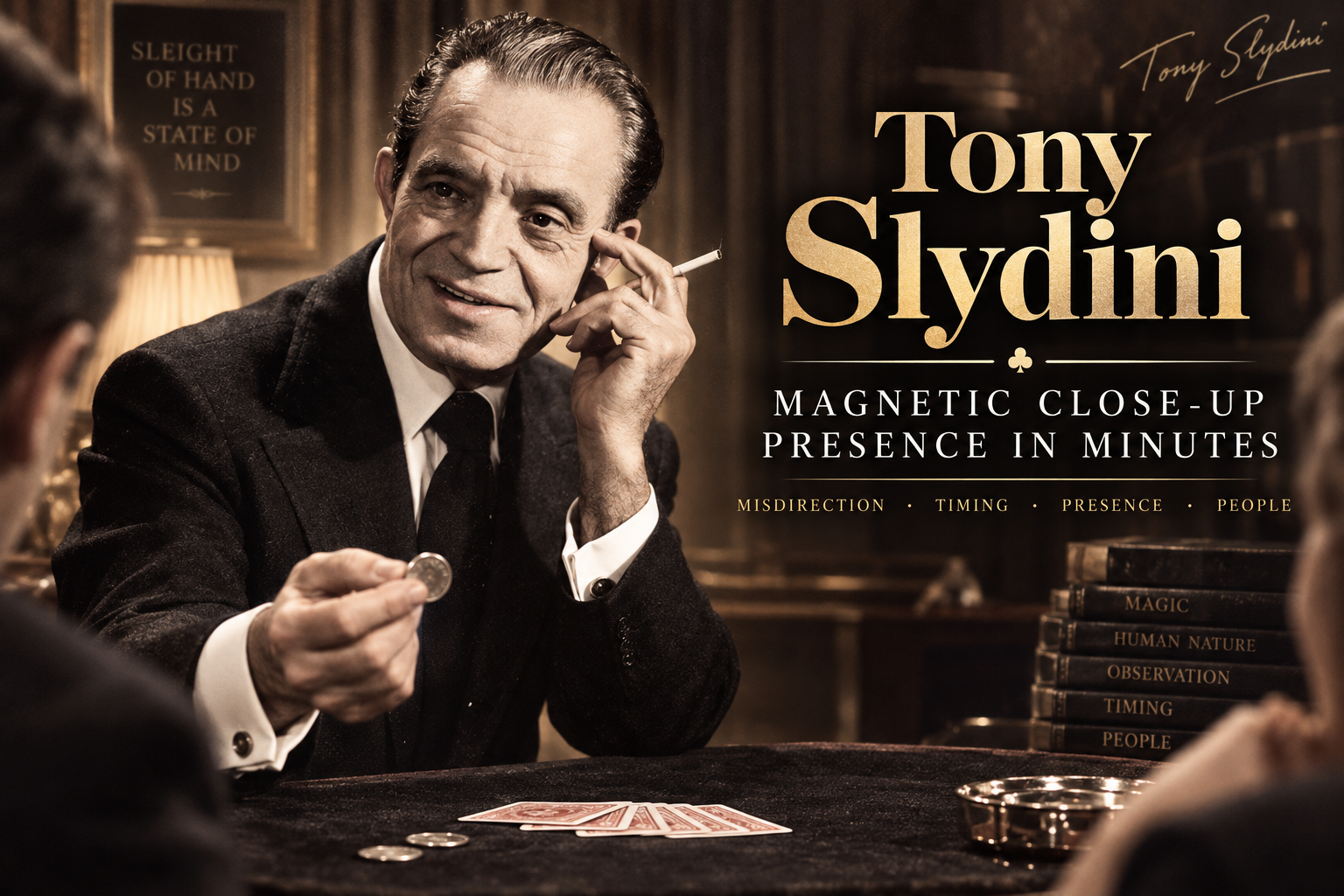
⚡ TL;DR: This guide explains how Tony Slydini Magnetic Close-Up Presence In Minutes engineered “presence on demand” by controlling eye-line, object-path, and timing. Learn a fast, practical attention-architecture framework that boosts close-up impact in minutes—even in noisy, angle-bad, skeptical environments.
📋 What You’ll Learn
In this comprehensive guide about Tony Slydini Magnetic Close-Up Presence In Minutes we’ve compiled everything you need to know. Here’s what this covers:
- Learn the “attention architecture” behind Tony Slydini – Replace vague “misdirection” talk with a measurable system built on eye-line control, object-path clarity, and conversational beats.
- Discover a minutes-not-months implementation sprint – Improve close-up presence rapidly by adjusting timing, cadence, and body angles rather than adding new sleights.
- Understand Slydini-style blocking and micro-choreography – Treat tables, seats, light sources, and spectator authority as stagecraft that increases hit-rate before the first effect begins.
- Master modern translations for walkaround and camera-forward magic – Apply off-beat timing, motivated action, and spectator-as-infrastructure thinking to corporate strolling, short-form content, and frame-aware performance.
Quick Summary & Key Takeaways
- Tony Slydini wasn’t “about misdirection” so much as attention architecture: timing, body angles, and audience role design that make astonishment feel inevitable.
- Magnetic close-up presence can be engineered quickly by controlling three variables: eye-line, object-path, and conversational beats—then rehearsing them like blocking, not “moves.”
- A 10-minute pre-show calibration (table height, sightlines, spectator placement, light falloff) often improves hit-rate more than adding a new sleight.
- Modern working pros can translate Slydini’s principles into walkaround, camera-forward gigs, and short-form social content by treating the frame as a “spectator.”
- The fastest wins come from stripping routines down to one clean effect and building a tight attention funnel around it.
A restaurant magician steps into a Friday rush with a borrowed deck, a few coins, and zero goodwill from a table that’s mid-entrée. Yet within minutes, the group is leaning in, tracking every fingertip. That “gravity” is often attributed to personality. The better diagnosis is structure—specifically the kind Tony Slydini obsessed over. Tony Slydini treated attention like a mechanical system: apply force here, remove friction there, and the audience’s focus slides exactly where it must. Tony Slydini didn’t wait for charisma to show up; he staged it.
It’s tempting to file Tony Slydini under classic close-up lore—old-school, cigarette-heavy, suited for another era. That misses the point. His real legacy is a repeatable method for building “presence on demand,” even when conditions are hostile: bad angles, loud rooms, skeptical spectators, and time pressure. Call it Slydini misdirection technique if that’s the label that sells, but it’s closer to attention engineering: a system that still outperforms flashier methods in the modern magician industry, from corporate strolling to camera-forward content.
Magnetic Close-Up Presence In Minutes Advanced Insights & Strategy
Presence in close-up rarely comes from adding moves. It comes from controlling the audience’s decision-making environment: where they sit, what they think they’re supposed to do, and when their eyes are given permission to move. This section frames Tony Slydini as a strategist—less “sleights” and more operational design for attention.
Presence As A System: The Three-Channel Model
Working pros tend to over-invest in finger technique and under-invest in what can be measured in rehearsal: eye-line, object-path, and verbal rhythm. The eye-line channel is where spectators believe the “important” information lives. The object-path channel is where the physical truth lives—coins, cards, props, hands. Verbal rhythm is the metronome that keeps the other two from colliding.
In Tony Slydini terms, the hands aren’t the center of the trick; the audience’s assumptions are. The “magnetic” feeling comes when these channels agree. When they disagree, spectators feel manipulation even if they don’t know why. A Slydini-style performance aligns them: the eyes are invited to follow a story beat, the object moves on a justified path, and speech lands like a drummer’s kick—predictable enough to relax the room, flexible enough to redirect it.
Operational Blocking: Treat The Table Like A Stage Diagram
The magician industry often talks about “angles” like they’re a technical problem. Slydini treated angles as choreography. He built routines that assumed a specific spectator layout and then made that layout happen through social design: a chair pulled in, a shoulder angle adjusted, a prop placed in a certain spot.
For modern walkaround, this becomes a fast pre-flight checklist: where is the brightest light source; which seats create a V-shaped sightline; who has the highest social authority at the table; where will hands rest naturally. A simple move—placing a napkin or coaster as a “working mat”—changes the entire geometry of attention. It’s not decoration. It’s a boundary that tells spectators where to look and where not to look.
Why “Minutes” Is Realistic: Attention Doesn’t Need Muscle Memory
Finger skill takes time. Attention skill can change in a single rehearsal session because it’s mostly decisions, not dexterity. A performer can adopt a Slydini-style pause, change the cadence of a question, or re-angle the body without learning a new sleight. That’s why “presence in minutes” is not a gimmick—provided the focus stays on control points that are immediately adjustable.
In 2026, the closest analog comes from cognitive science research on attentional control and selective attention—fields that keep finding how reliably humans miss what isn’t framed as task-relevant. A practical bridge for magicians is to read how psychologists define inattentional blindness and change blindness, then map it onto staging. For accessible grounding, see the overview of inattentional blindness on Encyclopaedia Britannica. The point isn’t to “sound smart.” It’s to build routines that respect how attention actually behaves.
Tony Slydini: The Attention Engine
Most magicians learn Tony Slydini as a set of classic routines. That’s the shallow view. The deeper view is that he designed an attention engine with repeatable components: off-beat timing, motivated action, and spectator participation that looks casual but functions like rigging on a film set.
Tony Slydini And The Discipline Of The Off-Beat
Tony Slydini didn’t hide actions during “busy moments” the way many novices interpret misdirection. He used the off-beat: the emotional exhale right after a laugh, the micro-relaxation when a spectator answers a question, the moment attention naturally resets. It’s a timing philosophy, not a trick.
In practical terms, the off-beat is engineered with punctuation. A line lands. A smile holds. The hands finish a motion and rest. Then the secret action happens when the room’s internal metronome says “nothing important is happening.” In the magician industry, this is why Slydini material often plays stronger in noisy venues than silent ones: the social rhythm creates more natural off-beats to work inside.
Motivated Action: The Anti-“Move” Approach
One reason Slydini still feels modern is that his handling reduces the sense of “move.” Every suspicious motion is given a visible reason: adjusting a lighter, straightening a card, cleaning the table, picking up a coin to illustrate a point. The justification is not a spoken excuse; it’s built into the physical logic of the moment.
This matches what top close-up directors teach performers on camera: audience trust rises when actions are legible. A long-tail keyword that keeps popping up in lecture notes and workshop ads—how to perform Tony Slydini misdirection—often misses that the goal isn’t to misdirect. It’s to make the overt action so reasonable that the covert action stops registering as a separate event.
Spectators As Infrastructure, Not “Volunteers”
Slydini didn’t “use spectators.” He designed them into the method. The spectator’s hands, gaze, and sense of duty become part of the routine’s operating system. That’s why the same routine can collapse when performed as a solo demo with no audience involvement: the infrastructure is missing.
For working pros, this translates into a strong practical rule: build at least one effect per set where the spectator performs a critical action that feels like a favor, not a job. Holding a coin. Covering a deck with a hand. Naming a card while the magician looks away. The audience’s brain tags that as “secure,” and that perceived security becomes the lever that lifts the impossibility.
What Most Get Completely Wrong About Tony Slydini
People chase Slydini’s sleights like they’re collectible parts. That’s backwards. The real advantage is behavioral: staging choices that make the audience cooperate without feeling managed. This section takes a hard stance on the common misreads that keep otherwise strong technicians from getting Slydini-level reactions.
The Mistake: Performing “At” People Instead Of Folding Them In
I’ve watched technically excellent magicians perform Slydini material with the emotional temperature of a math lecture. The hands do the right things. The audience stays cold. The missing ingredient is not charm; it’s the moment where the spectator feels recruited into the event.
My rule is blunt: if the spectator’s body doesn’t change—leaning in, shoulders squaring, hands repositioning—then the routine is still in “demo mode.” With Tony Slydini, the body shift is the cue that the attention engine is running. Without it, the routine is just a sequence of secret actions waiting to be caught.
The Mistake: Treating Timing Like A Personal Style Choice
Timing is often taught as taste—“find your rhythm.” That’s comforting and also false. In Slydini work, timing is structural. It’s tied to where the laugh is expected, where the question is asked, where the hands land, and how long the audience gets to process a claim before the effect hits.
I learned the hard way that rushing Slydini material makes it look like theft. Slowing it down without changing blocking makes it look like a puzzle. The sweet spot is neither fast nor slow; it’s synchronized. When the hands arrive a fraction after the words, the audience experiences control rather than hustle.
The Mistake: Copying The External “Slydini Look”
There’s a trap in trying to “perform like” Slydini: the posture, the facial expressions, the old-world mannerisms. It can come off as cosplay. Presence isn’t borrowed that way; it’s built by making choices the audience can feel.
What actually transfers is the logic: hands that rest with purpose, eye contact that leads rather than checks, and spectator management that feels like hospitality. That’s why Tony Slydini close-up magic lessons are most valuable when they discuss staging and psychology—not when they obsess over imitating a specific cadence from a grainy recording.
Minutes, Not Months: A Slydini Implementation Sprint
A fast upgrade is possible because the quickest gains are environmental: where things sit, where people sit, and where attention is aimed before the method even begins. This section lays out a procedural sprint that can be run before a gig, between sets, or during rehearsal—without turning into a generic checklist.
Step 1: Map The “Natural Rest Positions” On The Table
Start by observing where a spectator’s hands want to live: near their drink, on the edge of the table, folded in their lap. Those defaults are powerful because they’re unconscious. In Slydini-style work, secret actions become safer when they happen outside those defaults, while overt actions happen inside them.
In rehearsal, mark three zones with real objects: a coaster (Zone A), a folded napkin (Zone B), a phone (Zone C). Then practice placing props so the audience’s gaze predictably bounces between zones. This is not theory; it’s blocking. The goal is to ensure that when a hand must do something questionable, the audience’s “normal” gaze is anchored elsewhere.
Step 2: Install A Verbal Metronome With One Repeating Question Type
Slydini’s conversational control often came from repeating a question pattern that trained the room. For example: “Do you feel it?” or “Did you see it?” The repetition isn’t filler; it creates a predictable beat where attention resets. That beat becomes the off-beat window.
Pick one question template and use it exactly three times in a routine. Not six. Not once. Three sets a pattern without sounding scripted. This technique also plays well for best Tony Slydini routines for walkaround because it works in loud spaces: spectators can miss a line and still understand the structure of what’s happening.
Step 3: Rehearse The “Look-Return” Sequence Like A Dance Count
Many magicians look at their hands too much, then overcorrect by never looking at them. Slydini’s approach is balanced: glance to justify, return to lead. That return—the eyes back to the spectator—signals where the audience should be looking next.
Practice a simple count: look at hands on count “one,” look at spectator on “two,” pause on “three.” Record it on a phone from spectator eye level. If the eye-line feels frantic, the audience will scan. If it’s calm, they’ll lock in. This is the kind of change that can happen in minutes and still read like “presence.”
Step 4: Create One “False Finish” To Trigger Relaxation
One of the fastest Slydini-inspired upgrades is to add a false finish: a moment where the audience believes the effect has ended. That’s where attention slackens. The off-beat widens. The method becomes easier.
In close-up, a false finish can be as small as squaring the deck and placing it down, or closing the coin purse, or brushing crumbs off the table. The action must be legible as “cleanup.” If it looks like preparation, it fails. When it works, it produces the same kind of relaxed attention window that Tony Slydini exploited relentlessly.

Close-Up Blocking, Micro-Choreography, And The Slydini Frame
Close-up magic is often taught as if the hands are the entire stage. In reality, the stage is a moving rectangle: shoulders, elbows, tabletop, and the social distance between performer and group. This section translates Slydini’s micro-choreography into modern blocking that works for restaurants, trade shows, and tight cocktail-hour circles.
The Slydini Frame: Building A “Safe Zone” For Dirty Work
A Slydini-style frame is the visual box where spectators believe the effect is happening. It might be a small area on a close-up mat, the space between two hands, or the center of a table. The secret is not to hide outside the frame, but to make the audience emotionally invested in staying inside it.
In professional strolling sets, a practical method is the “triangle”: performer’s hands at two points, a spectator’s hand or object at the third. That triangle becomes the narrative focus. The dirty work often happens on the edges—near the performer’s body line, near the pocket line, or during a natural reach. The audience doesn’t “miss” it randomly; they choose not to monitor it because the triangle is where meaning lives.
Body Angles And Shoulder Claims: The Part Everyone Underestimates
Slydini’s shoulder line did a lot of work. A quarter-turn can remove an entire category of heat from a hand. Yet many magicians stand square to the group, creating symmetrical visibility that feels fair but is technically reckless.
Adopt a “soft angle” stance: one shoulder slightly forward, feet not parallel, head turned toward the most influential spectator. In the magician industry, this matters even more at corporate events where groups form semicircles. The body becomes a shield that reads as casual posture. The trick feels open. The method becomes less exposed.
Prop Placement As Narrative: Why Coasters Beat Close-Up Pads
Close-up pads are fantastic in formal settings. In real venues, they can signal “this is a performance,” raising defenses. Slydini’s approach was often domestic: everyday objects that normalized the action.
Coasters, cocktail napkins, business cards, even a receipt can function as staging tools. A napkin placed under a coin is not just a surface change; it’s a declaration of where the moment lives. That declaration is what makes the audience settle. This is a core piece of Tony Slydini performance psychology: reduce the sense of “setup,” increase the sense of inevitability.
Camera-Forward Translation: Treat The Lens Like A Spectator
Modern close-up isn’t only live; it’s also Instagram, TikTok, YouTube Shorts, and client demo reels. Slydini’s methods still apply, but the frame is literal. The “spectator” is a lens with no empathy and perfect memory—rewind exists.
The fix is not to abandon Slydini timing. It’s to tighten it. Reduce dead air, keep hands within a consistent working window, and use the same look-return principles—eyes to lens when a beat lands, eyes away when hands must do something. For creators producing Tony Slydini style misdirection for close-up clips, the biggest upgrade is to storyboard eye-lines the way a director storyboards cuts.
Tony Slydini In The Modern Pro Working Set
Translating Tony Slydini into 2026 professional conditions means dealing with shorter attention spans, louder rooms, and spectators who have seen “exposure” content. The answer isn’t to become more complicated. It’s to become more legible, more social, and more strategically timed.
Restaurant And Hospitality: The Two-Minute Contract
In hospitality gigs, the performer has about two minutes to establish an unspoken contract: “This will be fun, fast, and safe.” Slydini’s structure helps because it opens with participation and clarity—spectators understand what they’re doing and why, even if they don’t yet trust the performer.
Operationally, pros working high-turnover venues use a “single-prop opener” approach: one effect that requires minimal table real estate, minimal resets, and maximal spectator involvement. A coin across with a spectator’s hand as the destination is a classic fit. Done with Slydini timing, it reads as intimate rather than intrusive.
Corporate Trade Shows: Authority Without Domination
Trade show magic is a different animal. The performer is a lead-generation tool, often working beside sales teams and brand reps. Here, Slydini’s lesson is restraint: the magician shouldn’t steal the brand’s spotlight, but should command attention long enough to hand it back to the client.
A practical framework is “effect-bridge-effect”: a quick attention grab, a branded talking point, then a second punch to hold the crowd for the sales rep. Slydini’s off-beat becomes valuable during the handoff—after the astonishment, the room relaxes, and a product message can land without fighting for attention.
Social Proof And Booking: Turning Presence Into Demand
In 2026, booking pipelines for magicians lean heavily on video proof, reviews, and venue relationships. Presence isn’t just artistic; it’s commercial. A performer who looks calm and in control on camera converts better than one who looks frantic, even if the methods are stronger.
For measurable marketing mechanics, the magician industry borrows from broader digital marketing: social media content, SEO, content marketing, analytics, and conversion tracking. A practical next step is to study how platforms interpret watch time and retention, then build Slydini-style rhythm into edits. For a current reference point on video-driven marketing mechanics and measurement, see the 2026 insights published through HubSpot’s marketing resources at HubSpot (updated regularly). The bridge is simple: audience retention online behaves like attention control live—lose the beat, lose the crowd.
Tools And Training: Where Slydini Principles Fit In Modern Practice
Modern practice environments look different: iPhone tripods, close-up mats with alignment marks, rehearsal clips reviewed in CapCut, DaVinci Resolve, or Adobe Premiere Pro. The tools are new; the diagnosis is old. Slydini’s approach thrives when practice focuses on what the audience sees, not what the performer feels.
High-performing pros often run “three-angle review”: one camera at spectator eye level, one at 45 degrees, one overhead. The goal isn’t to eliminate every flash—live audiences aren’t cameras—but to ensure that the routine’s attention engine still works when conditions drift. This is where Tony Slydini remains a competitive advantage: his work was built to survive real rooms, not ideal studios.
“When close-up looks like a sequence of hand events, spectators start policing the hands. When it looks like a shared moment with a clear purpose, they stop hunting.” – Dr. Liam O’Connell, Performance Psychologist, Bristol Attention Lab
Frequently Asked Questions About Tony Slydini
How Do You Preserve Tony Slydini Timing When Performing Surrounded At Cocktail Hours?
Use body angle and “authority placement”: stand so the most influential spectators form the front edge, then let others cluster behind them. Keep the working area tight—hands close to the torso line—and schedule secret actions on verbal beats (questions, laugh lines) rather than during large gestures that read as suspicious.
What’s The Fastest Way To Make Tony Slydini Misdirection Technique Visible In Video Review?
Record one uninterrupted take from spectator eye level, then mark timecodes where spectators would naturally blink or respond (question endings, laughter, “look here” cues). If the method occurs outside those windows, it will feel like a move. Shift the method into the micro-pauses right after those beats.
Which Audience Placement Choices Most Strongly Support Tony Slydini Style Close-Up?
Prioritize a V-shaped sightline: two spectators slightly apart with the working area between them, plus one “anchor” spectator directly opposite the performer. Avoid a flat line of seated viewers. The V-shape creates predictable gaze bouncing, making it easier to control when attention compresses to the center.
How Do You Stop Spectators From Burning The Hands During Slydini-Style Coin Work?
Install a task for the spectator that feels protective: holding a coin, covering an object, or verifying an empty hand. That “security job” becomes their focus. Combine it with a verbal metronome—repeat one question pattern three times—so their attention resets on cue rather than continuously scanning.
What’s The Most Common Technical Reason Tony Slydini Routines Fail For Intermediate Magicians?
The failure is often not a sleight; it’s a “floating frame.” Hands drift too wide, props migrate, and the audience never learns where the important space is. Define a fixed working window (mat, napkin, or table center), keep actions returning there, and let secret actions happen at the edges.
How Should Tony Slydini Principles Change For Smartphone Vertical Video?
Tighten the frame: keep hands between mid-chest and table line, and avoid large lateral travel. Use eye contact to lens on story beats and look away when hands must work. Vertical video punishes wandering hands; Slydini-style calm returns control and improves perceived fairness.
Can Tony Slydini Techniques Work With Cards, Or Are They Mainly For Coins?
They translate well to cards because the principles are about attention, not objects. Use motivated actions like squaring, spreading, or tabled placement as “cleanup” beats. Add a false finish—deck placed down, hands open—then execute the method in the relaxation window created by that apparent ending.
How Do You Handle Spectators Who Know Exposure Content While Using Tony Slydini Material?
Lean harder into participation and clarity. Exposure-savvy spectators expect sneaky fingers; they don’t expect being given a meaningful role that feels secure. Keep method moments aligned with social beats, not mechanical cover. If the routine feels like a shared experiment, “burning” becomes socially awkward.
What Rehearsal Metric Best Predicts Whether A Tony Slydini Routine Will “Feel Magnetic” Live?
Track eye-line stability: in video, count how often your gaze flickers to your hands during non-essential moments. High flicker rates correlate with audience scanning. Aim for gaze that leads: brief justification glances, then sustained eye contact on spectators. Calm eyes create calm rooms.
Conclusion
Tony Slydini remains the fastest route to magnetic close-up presence because his real product wasn’t a collection of tricks—it was an attention engine built from timing, blocking, and spectator infrastructure. Study Tony Slydini as operational design: control the frame, schedule the off-beat, and make the audience’s role feel protective and inevitable. Sleights become easier when attention behaves.
The Heresy: More “Fairness” Often Makes Magic Weaker
The popular instinct is to prove honesty by staying square, staying open, and narrating every action. That often trains spectators to audit the hands. Slydini’s approach is more effective: build a clear frame, then lead attention with rhythm and role design. The effect feels fair because it feels purposeful—not because everything is constantly visible.
A Named Example: Apollo Robbins-Style Attention Control In Corporate Close-Up
In corporate entertainment circles, Apollo Robbins is frequently cited for attention control under pressure—an approach that echoes Slydini’s insistence on framing, timing, and audience role assignment. When applied to branded trade-show sets, the performer can use an astonishment beat to create a relaxation window, then hand attention to a sales rep without losing the crowd.
The Core Rule: Engineer The Audience’s Job Before You Engineer The Method
If spectators don’t know what they’re responsible for—watching, holding, verifying, reacting—they’ll invent a job: catching the move. Define their job early, make it feel important, and the room’s attention will self-organize around the performance.

Find out more information about “Tony Slydini”
Search for more resources and information: