The Broom Suspension One of Magic’s Great Illusions
⚡ TL;DR: The Broom Suspension One of Magic’s Great Illusions. A magician’s assistant floats in midair, held up by nothing but a broomstick — and the trick is older, stranger, and more hotly disputed than most magic history gets credit for.
📋 What You’ll Learn
In this guide to The Broom Suspension One of Magic’s Great Illusions using an ordinary object, here’s what we cover:
- Learn the real origin story – Jean-Eugène Robert-Houdin’s “Ethereal Suspension,” performed on his own son with a theatrical ether backstory.
- Discover the mystery nobody has settled – Houdini’s claim that the trick predates Robert-Houdin by a century, and why the debate is still open.
- Understand why a broom beats a fancy prop – the showmanship logic behind swapping engineered-looking canes for something you’d find in a closet.
- See why collectors chase this piece of history – what makes original suspension apparatus valuable, and where it fits in a serious collection.
Quick Summary & Key Takeaways
- The broom suspension traces back to Jean-Eugène Robert-Houdin’s “Ethereal Suspension,” performed on his own son using canes and a theatrical ether backstory.
- Harry Houdini disputed Robert-Houdin’s claim to the effect, arguing it was centuries older and rooted in fakir tradition — a debate historians still haven’t settled.
- Performers eventually swapped the canes for a broomstick, because an ordinary household object makes an impossible act feel even more impossible.
- The broom suspension is public domain — no one owns it, so any magician is free to build and perform their own version.
- Original and vintage suspension apparatus is a prized find for collectors tracing a direct line back to magic’s golden age.
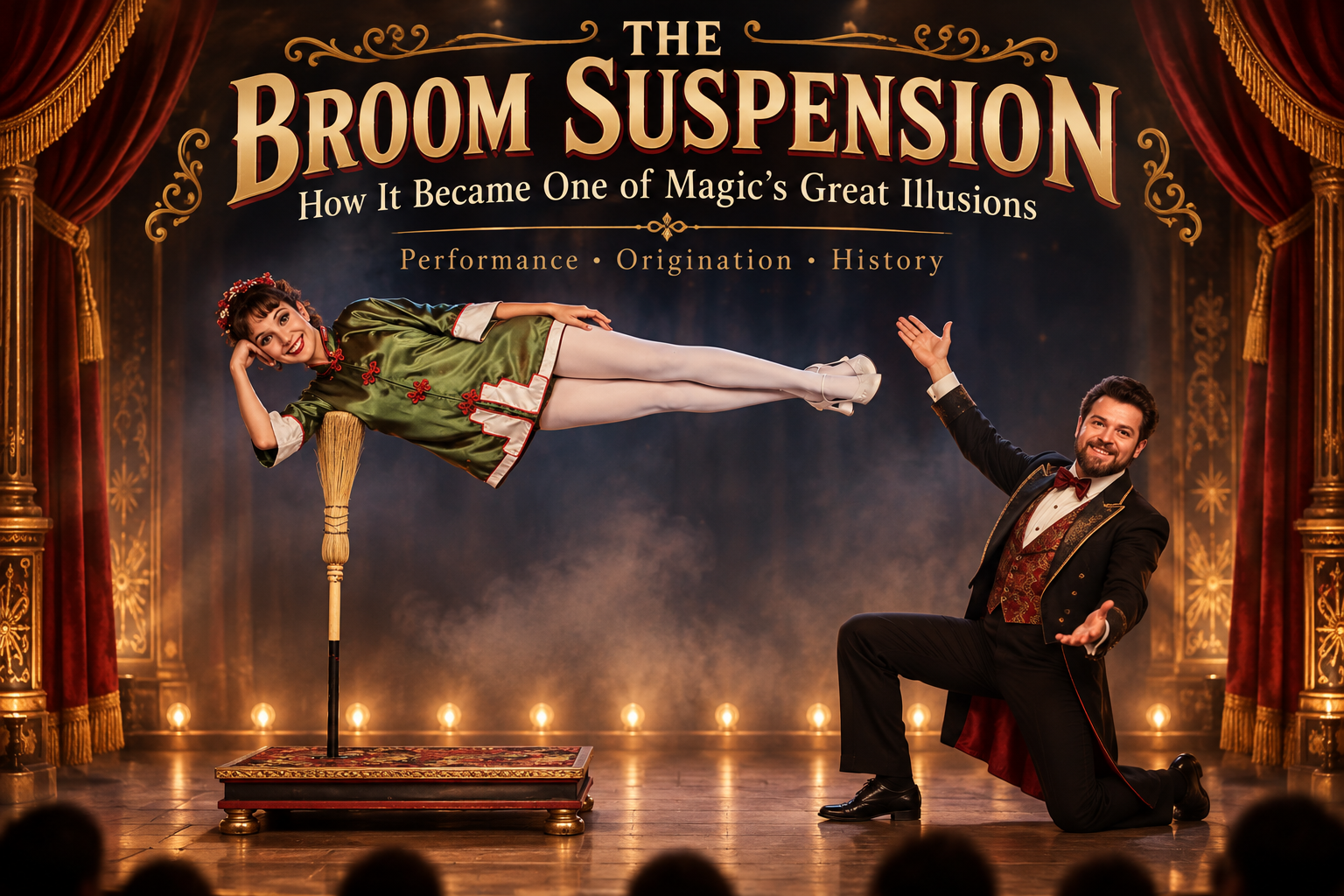
Picture this: a magician’s assistant lies stretched out, parallel to the floor, held up by nothing but a broomstick wedged under one arm. No wires. No table. No visible support — just a person floating in open air, suspended by a household object anyone could grab from a closet.
It’s one of the oldest tricks in magic, and it’s still one of the most baffling. Here’s where it actually came from.
A Trick Born From Ether and Nerve
The suspension illusion traces back to Jean-Eugène Robert-Houdin, the 19th-century French magician often called the father of modern conjuring. His version, which he called the Ethereal Suspension, wasn’t performed with a broom at all — it used his own young son as the subject, and a bottle of ether as the “explanation.”
The presentation was pure theater. Robert-Houdin had his son stand on a stool, propped up by two canes tucked under his arms. He’d wave a vial of ether under the boy’s nose while an assistant heated real ether backstage, filling the theater with its sweet, distinctive smell. Then, one by one, he removed the supports — the stool, then a cane, then the other — until his son appeared to hang in midair, balanced on nothing but a fingertip, then an elbow. Audiences were floored. The mysterious vapors gave the whole thing a hypnotic, almost medical air of legitimacy, decades before anyone understood stage hypnosis or misdirection the way we do now.

Older Than It Looks
Robert-Houdin gets the credit for popularizing the suspension, but he probably didn’t invent it. Harry Houdini — who adopted his stage name in tribute to Robert-Houdin before turning fiercely critical of him — argued the effect was at least a century older, with roots in fakir performances. Houdini made that case in his 1908 book attacking Robert-Houdin’s legacy, and while historians still debate how much of Houdini’s criticism was accurate versus personal grudge, the core question remains open: nobody can say for certain who suspended the first person in midair.
That kind of murky origin story is common in magic. Effects get passed from performer to performer, refined and reinvented, long before anyone writes them down.
From Cane to Broomstick
Over time, performers swapped Robert-Houdin’s canes for a single broomstick, bristles pointing up. It’s a small change with a big effect on the audience. A cane looks like stage equipment. A broom looks like something you’d find leaning against the wall of a garage. That contrast is exactly the point — the more ordinary the prop, the more impossible the illusion feels.
The broom suspension has been performed and adapted countless times since, and it’s now considered public domain in magic — no single creator owns the rights to it, so performers are free to build their own version and make it their own.
Why The Broom Suspension Still Works
Good magic often comes down to contrast: the impossible act paired with the most mundane object in the room. A floating body is already startling. A floating body held up by a broom instead of some obviously engineered rig turns startling into unforgettable. It’s the same instinct that makes a simple deck of cards or a borrowed coin more powerful than an elaborate box full of gadgets — the audience trusts what looks ordinary, and that trust is exactly what makes the trick land.
A Piece Worth Collecting
Suspension illusions occupy a special place in magic history. Original apparatus and vintage suspension gimmicks from earlier eras rarely surface, and when they do, they’re prized by collectors precisely because they represent this lineage — a direct line back to Robert-Houdin’s stage and the golden age of grand illusion. If you collect apparatus with real performance history, a suspension piece is the kind of find worth chasing. It’s the sort of artifact you’ll find showcased at MagicTrickCollection.com, where pieces are treated as history worth preserving, not just props worth owning.
If You Want to Perform The Broom Suspension Yourself
This is a big illusion, not a card trick — it involves a person’s safety, not just a secret. If you’re building or buying a suspension rig, work with an experienced illusion builder, test it thoroughly before it ever goes in front of an audience, and never improvise the rigging. The showmanship is timeless; the engineering behind it deserves to be taken just as seriously today as it was in Robert-Houdin’s era.
Conclusion
What starts as a broomstick and a bit of nerve becomes, in the right hands, one of magic’s most enduring illusions. Robert-Houdin turned a household object into an act of apparent sorcery, Houdini couldn’t resist picking a fight over who deserved the credit, and generations of performers have kept the mystery alive by never quite settling it. That’s proof that the best tricks aren’t always the most complicated ones — and that the history behind them can be just as captivating as the effect itself.