Harry Kellar Fact vs Legend: The Dean of American Magic
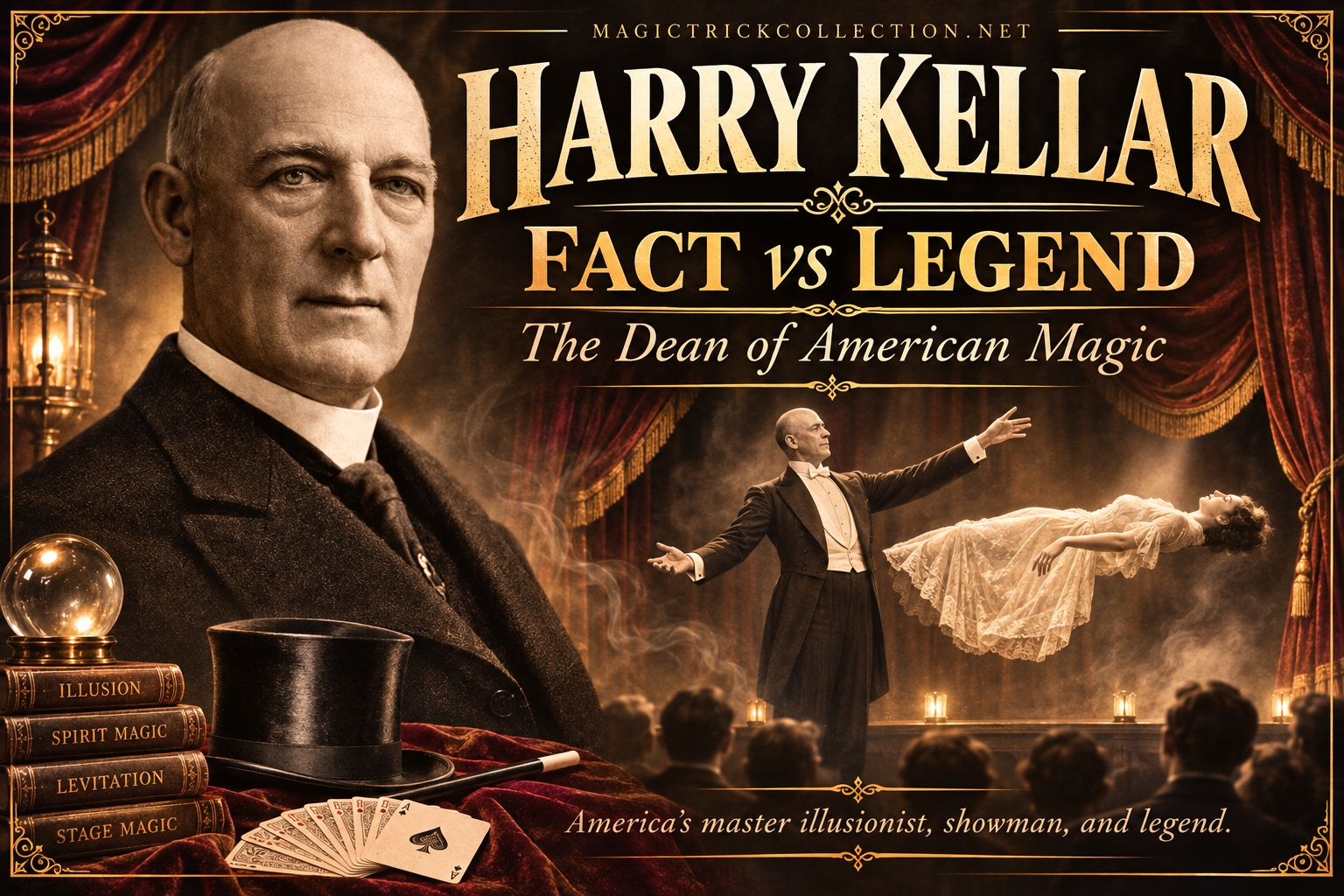
⚡ TL;DR: Harry Kellar Fact vs Legend: The Dean of American Magic survived a shipwreck and bankruptcy to build America’s greatest illusion show, though his famous levitation began as another magician’s idea. Before Houdini became a household name, America’s greatest magician was a runaway from Erie, Pennsylvania. Harry Kellar toured five continents, lost everything at sea and came back to become the “Dean of American Magicians.”
📋 What You’ll Learn
In this comprehensive guide about Harry Kellar Fact vs Legend: The Dean of American Magic we’ve compiled everything you need to know. Here’s what this covers:
- A Runaway Start: how a ten-year-old stowaway found magic.
- The Shipwreck: the disaster that wiped him out, and how he rebuilt.
- America’s Egyptian Hall: his Philadelphia theater and his rivalry with Herrmann.
- Fact vs Legend: the true story of the Levitation of Princess Karnac.
- Baltimore, 1908: the farewell that passed his mantle to Thurston.
- For Collectors: Kellar posters, books and surviving apparatus.
Meet the Legends, Part 2 of 10: a weekly series on the ten magicians in Amazing Famous Magician Answers for Kids.
1. The Boy From Erie Who Ran Away
Harry Kellar was born Heinrich Keller on July 11, 1849, in Erie, Pennsylvania, to German immigrant parents. Little about his childhood can be confirmed, which is common for magicians of his era.
The best-known story says he worked for a druggist, mixed the wrong chemicals and blew a hole in the shop floor. Rather than face his parents, he jumped a train. He was about ten years old.
A minister in upstate New York later offered to pay for his education if he would study for the ministry. Then the boy saw a traveling magician called the Fakir of Ava, the stage name of Isaiah Harris Hughes. Kellar later told Houdini that after the show he bought books on magic and left his benefactor. Hughes hired him as an assistant around age 12.
He also changed the spelling of his name from Keller to Kellar, partly to avoid confusion with a famous rival, Robert Heller.
2. Shipwrecked, Broke and Starting Over
In 1869 Kellar joined the Davenport Brothers and William Fay, a troupe that staged “spirit” cabinet séances. He learned how a touring show really runs: advance publicity, logistics and audience control.
In 1873 Kellar and Fay struck out on their own and toured Central and South America. They made real money, including a performance before Emperor Dom Pedro II of Brazil in 1875.
Then disaster. On the way to England, their ship, the Boyne, sank in the Bay of Biscay. Kellar lost his equipment and his wardrobe. Soon after, word came that his New York bank had failed. He was left, by the usual account, with the clothes on his back and a diamond ring, which he sold.
That is the part of Kellar’s story worth remembering. He rebuilt from nothing, more than once, and kept moving.
3. Building America’s Great Illusion Show
Kellar admired John Nevil Maskelyne’s Egyptian Hall in London, a theater devoted to magic. He bought the Vanishing Birdcage from its inventor, Buatier de Kolta, and returned to America with a plan.
In December 1884 he opened his own Egyptian Hall in a former Masonic temple on Chestnut Street in Philadelphia. It ran for 264 performances. He opened a second Philadelphia Egyptian Hall in 1891 for a seven-month run.
His rival in those years was Alexander Herrmann, a sleight-of-hand master who mocked Kellar for relying on apparatus. Kellar answered with misdirection. He once boasted that a brass band and a herd of elephants could cross the stage behind him and no one would notice.
His show drew the famous. In 1904 he performed a ring trick for President Theodore Roosevelt’s children. A borrowed ring vanished and reappeared tied to a guinea pig. Ethel Roosevelt was offered the guinea pig as a pet. When she unwrapped it, it had become a bouquet of roses.
4. Fact vs Legend: Did Kellar Steal the Floating Lady
Kellar’s masterpiece was the Levitation of Princess Karnac. A woman rose from a couch and floated in the air while Kellar passed a hoop around her body.
The legend: Kellar walked onto Maskelyne’s London stage mid-show, saw how the levitation worked and walked off with the secret.
What the record supports:
- The original levitation was Maskelyne’s, and Maskelyne would not sell it.
- Paul Valadon, a magician who had worked for Maskelyne, joined Kellar in America. Historians, including Jim Steinmeyer, believe Valadon supplied technical details.
- Kellar’s first copy did not work well. He developed a new, road-ready version, reportedly with help from the Otis Elevator Company.
The fair verdict: the stage-walk story is unconfirmed. The borrowing is not. Kellar took another man’s idea and turned it into a practical touring illusion. That pattern repeats across magic history. You can see it again in our story of the Zig-Zag Girl, magic’s most copied trick.
📜 History Check: “The Wizard of Oz Was Based on Kellar”
You’ll read it online: Kellar inspired L. Frank Baum’s Wizard of Oz.
The record: No document from Baum confirms it. Treat it as a fun theory, not a fact.
Kellar has his own chapter in my book, Amazing Famous Magician Answers for Kids, where young readers meet the “Dean of American Magicians” and learn to separate documented history from good stories.

5. Baltimore, 1908: Passing the Mantle
On May 16, 1908, at Ford’s Theatre in Baltimore, Kellar gave his farewell performance. On stage, he placed his cape on the shoulders of his chosen successor, Howard Thurston. The orchestra played “Auld Lang Syne.”
As a magician who learned the craft in Baltimore, I never tire of that scene. The Ford’s Theatre building is long gone, replaced by a parking garage. The moment still defines American magic.
The ceremony was also good business. Thurston was buying Kellar’s show. Next week’s article looks at what was ritual and what was a sales contract.
6. One Last Bow
Kellar retired to Los Angeles. On November 11, 1917, Houdini persuaded him to perform once more, at a Society of American Magicians benefit at the New York Hippodrome, then the largest stage in the city. The show raised money for families of sailors lost when a German U-boat sank the USS Antilles.
When Kellar finished and started to walk off, Houdini stopped him. America’s greatest magician, Houdini said, should be carried off in triumph. Members of the Society lifted Kellar in a sedan chair while the Hippodrome orchestra played “Auld Lang Syne.”
Kellar died in Los Angeles in March 1922. Sources disagree on the exact day.
7. For Collectors: Kellar on Paper
- Posters: Kellar’s Strobridge lithographs, including the famous designs showing imps whispering secrets in his ear, are among the most prized magic posters in existence. Condition and originality drive price. Reprints are common, so check paper, printing method and provenance.
- Books: Kellar wrote A Magician’s Tour: Up and Down and Round About the Earth (1890), a travel memoir that is free to read on the Internet Archive.
- Apparatus: Kellar’s own props sit in major private collections, including his Psycho automaton, which survives in the John Gaughan collection.
Next Monday: Howard Thurston, and the true price of Kellar’s mantle.
Sources
- PBS American Experience: Harry Kellar (1849–1922)
- The I.B.M.: Kellar, the Dean of Magic
- Jim Steinmeyer, What We Hide: The Dream in Mid-Air
- Erie County Historical Society: Harry Kellar
- A Magician’s Tour (1890), Internet Archive
- Wikipedia: Harry Kellar
About MagicTrickCollection.net
At MagicTrickCollection.net, we celebrate the extraordinary history of magic, the legendary performers who shaped the art, and the rare and vintage apparatus that helped bring their illusions to life.
Discover the Magic. Preserve the History. Celebrate the Legends.

Meet Kellar and nine more legends. See the book, or view it on Amazon.
Amazing Famous Magician Answers for Kids is my own book. Book links go to its Amazon listing.