Houdini the Collector: The Escape Artist Who Saved Magic History
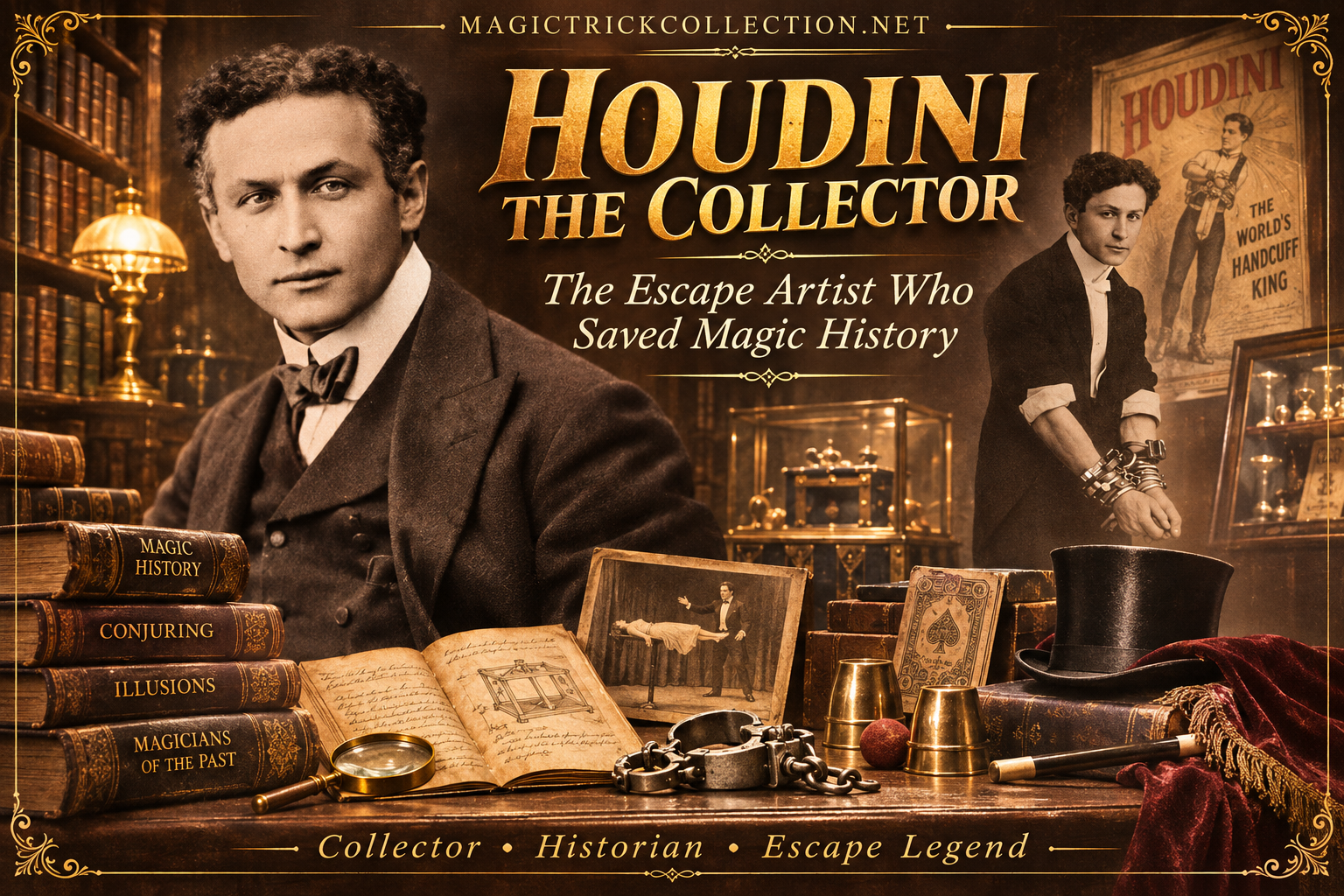
⚡ TL;DR: Houdini the Collector: The Escape Artist Who Saved Magic History built one of the great libraries of magic and spiritualism, and today his books and papers live at the Library of Congress and the Harry Ransom Center. We usually remember Houdini in chains. He also spent a fortune on old books, posters and letters, and that collection may be his most lasting gift to magic.
📋 What You’ll Learn
In this comprehensive guide about Houdini the Collector: The Escape Artist Who Saved Magic History we’ve compiled everything you need to know. Here’s what this covers:
- The Collector’s Habit: what he bought and why.
- The Unmasking of Robert-Houdin: the book his collection made possible.
- Fact vs Legend: was it really the largest magic library in the world?
- Where It Lives: the Library of Congress, the Harry Ransom Center and a new exhibition.
- Lessons for Collectors: four habits worth copying.
Meet the Legends, Part 4 of 10: a weekly series on the ten magicians in Amazing Famous Magician Answers for Kids.
1. The Escape Artist Who Couldn’t Stop Buying Books
You know Houdini the escape artist. Fewer people know Houdini the collector, and that side of him may matter more to magic history than any handcuff.
Houdini had little formal schooling. He made up for it with books. He bought magic books, theater programs, posters, letters and the papers of performers long dead. When he found a collection for sale, he often bought the whole thing.
A 1927 New York Times report listed some of the libraries he absorbed, including the magic books gathered by collector Hiram Stead and a mass of material on the Davenport Brothers, the spirit-cabinet act where Harry Kellar learned his trade.
For the full story of his life and death, see Houdini Fact vs Legend: 100 Years After His Death. This article focuses on what he saved.
2. Why He Collected
Houdini collected for three reasons, and each one shaped the archive he left behind.
- To learn the craft. Old books showed him methods, patter and stagecraft from centuries of conjurors.
- To write history. He wanted to be magic’s historian, not just its biggest star. From 1906 to 1908 he published the Conjurers’ Monthly Magazine.
- To fight fraud. In the 1920s he built one of the largest libraries on spiritualism anywhere, so he could expose mediums who claimed to speak with the dead.
3. The Book That Turned on His Hero
Houdini took his stage name from the French master Jean-Eugène Robert-Houdin, the subject of the first article in this series. As his research deepened, his admiration soured.
In 1908 he published The Unmasking of Robert-Houdin. Drawing on his collection, he argued that the Frenchman had taken credit for other men’s inventions. The book is aggressive and often unfair. It is also a working collector’s book: built from old programs, posters and papers that Houdini had tracked down himself.
The lesson is a good one for any collector. Your archive can support an argument, but it cannot make the argument fair.
4. Fact vs Legend: “The Largest Magic Library in the World”
Houdini liked to say that his collection had no equal. Here is what we can actually measure.
What the record supports:
- Houdini left his books on magic and spiritualism to the Library of Congress. They arrived in 1927, packed in sixteen large cases, and number roughly 4,000 volumes.
- His will split the material. The Library of Congress took the books. The American Society for Psychical Research was to receive spiritualism papers, and his wife, Bess, kept a share.
- His theater collection, including posters, playbills and correspondence, was sold after his death to collector Messmore Kendall. It reached the Harry Ransom Center at the University of Texas at Austin in 1958.
What cannot be confirmed: that it was the largest magic library in the world. It was certainly one of the great ones. But other collectors of his day kept large libraries too, and no one made a full count. “One of the greatest” is history. “The greatest” is publicity.
📜 History Check: Houdini’s Collection
Documented: About 4,000 of his books went to the Library of Congress in 1927. His theater collection is at the Harry Ransom Center.
Unconfirmed: That it was the largest magic library in the world. That was Houdini’s own claim.
Houdini’s chapter is the biggest in my book, Amazing Famous Magician Answers for Kids, with 22 questions. One of the illustrated pages is about his book collection.
5. Where His Collection Lives Today
If you want to see what Houdini saved, you have three good options.
- Library of Congress, Washington, D.C. His books sit in the Rare Book and Special Collections Division, alongside the McManus-Young Collection, a 20,000-item magic collection given in 1955 by two later collectors who followed his example.
- Harry Ransom Center, Austin, Texas. The exhibition Houdini’s Library runs through January 24, 2027, and admission is free. It is the first exhibition to focus on Houdini as a reader and collector.
- A new book. Curator Eric Colleary’s companion volume, Houdini’s Library (Abbeville Press, 2026), is the first book devoted to his personal collection.
6. What Houdini Teaches Today’s Collector
- Buy the paper, not just the props. Programs, letters and instruction sheets often survive when apparatus does not, and they carry the history.
- Record provenance as you go. Houdini’s archive is valuable partly because we know where it came from and where it went.
- Plan the next home. Houdini named the Library of Congress in his will, so his books stayed together. Most private collections scatter because no one made that plan.
- Be wary of the name. Houdini’s fame invites reproductions and loose attributions. Ask for documentation before you pay a Houdini premium.
Every collection starts small. Houdini’s started with a few books bought by a young performer who wanted to understand his craft.
Next Monday: Theo Hardeen, the brother who kept Houdini’s legend alive.
Sources
- Harry Ransom Center: Houdini’s Library exhibition
- The Art Newspaper: Houdini’s Library at the Harry Ransom Center (October 2026)
- Library of Congress: Great Escapes, the Houdini Collection
- The New York Times, May 8, 1927: Congress Library Gets Houdini Books (transcription)
- The New York Times, November 1926: Houdini’s will and library (transcription)
About MagicTrickCollection.net
At MagicTrickCollection.net, we celebrate the extraordinary history of magic, the legendary performers who shaped the art, and the rare and vintage apparatus that helped bring their illusions to life.
Discover the Magic. Preserve the History. Celebrate the Legends.

Houdini’s chapter has 22 questions. See the book, or view it on Amazon.
Amazing Famous Magician Answers for Kids is my own book. Book links go to its Amazon listing.