The Origami Illusion: One of Magic’s Most Copied Tricks
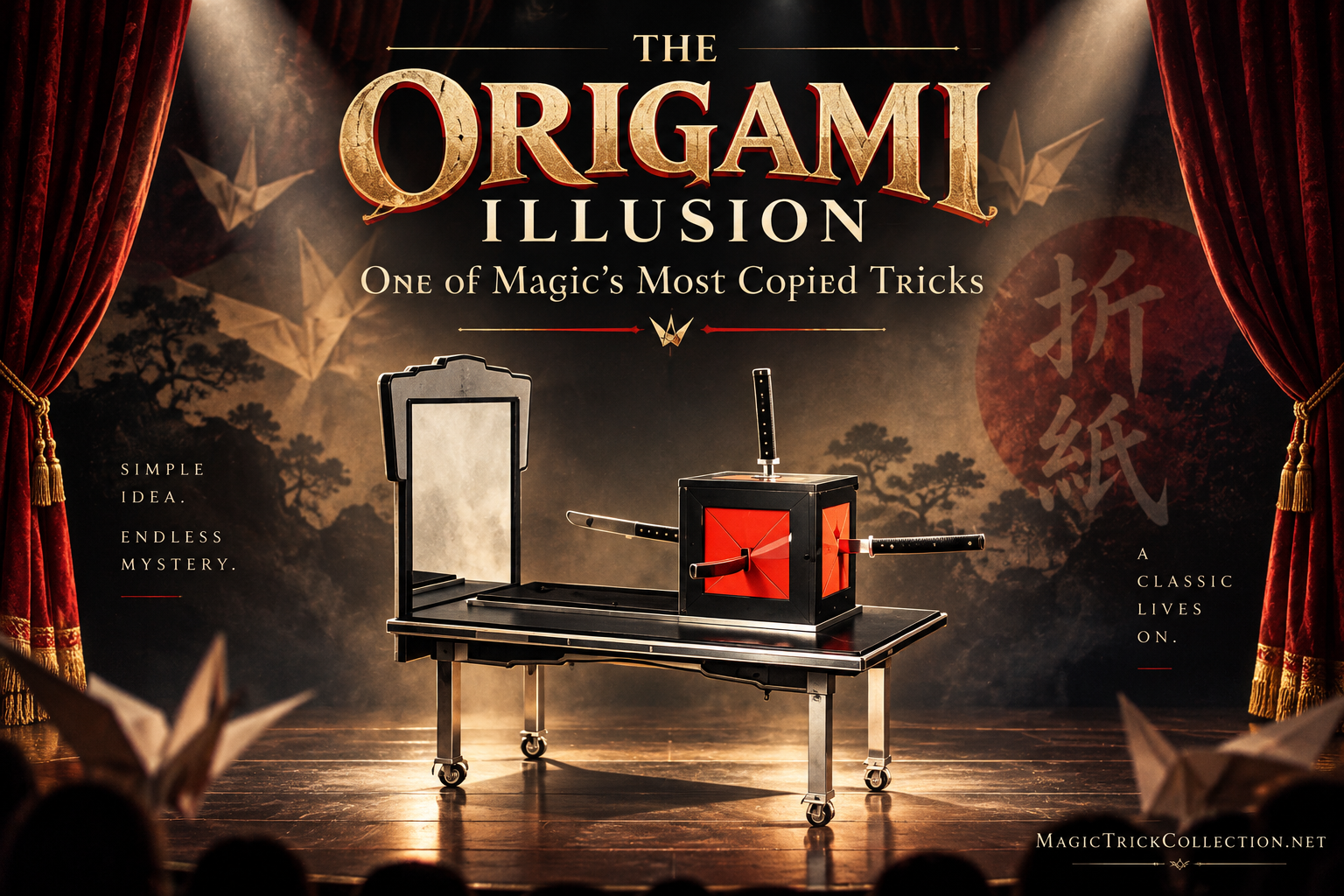
⚡ TL;DR: The Origami Illusion: One of Magic’s Most Copied Tricks. A 12-inch box folds open, swallows an assistant, folds back down to something too small to hold her, gets run through with swords — then unfolds her out again in different clothes. Jim Steinmeyer designed it for Doug Henning in 1986, and it’s since become one of the most bootlegged illusions in magic.
📋 What You’ll Learn
In this guide to the The Origami Illusion: One of Magic’s Most Copied Tricks, here’s what we cover:
- Meet the designer – Jim Steinmeyer, who built the effect around a real trick borrowed from Japanese paper folding.
- See how a box does something a body can’t – why a folding cube reads as “impossible” in a way a folding person never could.
- Learn how David Copperfield remade it – swapping in samurai swords, a red box, and a Peter Gabriel soundtrack in 1989.
- Understand why it’s magic’s most copied illusion – and what that says about the difference between owning a trick and owning the rights to one.
Quick Summary & Key Takeaways
- The Origami Illusion was designed by Jim Steinmeyer and built by illusion builder John Gaughan, then introduced by Doug Henning in 1986.
- A 12-inch decorated box unfolds to full size, an assistant climbs in, and the box folds back down to its original small size — seemingly too small to contain her.
- David Copperfield reworked the presentation in 1989 with a red box, three samurai swords, and Peter Gabriel’s “Mercy Street” as the soundtrack.
- Design patents have protected the prop since 1994, but the illusion is still described by builders as one of the most illegally copied effects in magic.
- Because authorized versions trace back to a specific patented design, provenance and licensing matter more with this illusion than with almost any other in modern magic.
Most classic magic illusions are decades, sometimes centuries, old by the time anyone bothers to write down who invented them. Origami is the rare exception: we know exactly who designed it, who built it, who performed it first, and even the patent numbers that protect it. And yet it’s still become one of the most copied — and most bootlegged — illusions on the market.
Here’s how a folding box became a modern classic, and why that clean paper trail matters more than you’d think.
A Different Kind of Vanish
The Origami Illusion was designed by Jim Steinmeyer, one of modern magic’s most respected illusion creators, and built by John Gaughan, whose workshop has constructed apparatus for some of the biggest names in the business. Canadian illusionist Doug Henning introduced it in 1986, with Steinmeyer working as his illusion consultant at the time.
By the mid-1980s, magic’s golden age of levitations and disappearing cabinets was a century behind it, and audiences had seen most of the standard tricks: people vanishing from boxes, reappearing in different places, floating in midair. Origami didn’t try to out-float or out-vanish those classics. Instead, it did something a body simply can’t do — it made an object fold itself down to a size that logic said couldn’t possibly still contain a person.
A Box That Folds Like Paper
The effect takes its name directly from the Japanese paper-folding art it visually imitates. The magician displays a decorated cube roughly a foot across, sitting on a narrow table with a mirror standing upright at the far end — positioned, as the presentation often points out, “so you can see the back of the box at all times.” The magician unfolds the box’s hinged panels, expanding it to roughly twice its original size. An assistant climbs inside and crouches down.
Then the box folds itself back down to that original 12-inch cube — with her seemingly still inside it. Swords are pushed through slits in the box from three directions: front to back, side to side, and top to bottom, with the magician sometimes standing on the table itself to drive the last one home. After the table is spun to prove there’s nothing hidden behind it, the swords come out, the box unfolds again to full size, and the assistant steps out — often in different clothing than she wore going in.
The Samurai Sword Makeover
Doug Henning’s original version leaned into its Japanese-print aesthetic, complete with a mask the assistant wore on her reappearance. In 1989, David Copperfield gave the illusion a full presentational overhaul, developed with choreographer Joanie Spina. His version swapped in a red box penetrated by three samurai swords instead of skewers, set the whole sequence to Peter Gabriel’s “Mercy Street,” and had the assistant emerge in a matching white costume from a white expanded box.
Other performers have kept building on the same mechanical foundation. Illusionist Greg Frewin created a variation that replaces the swords with a broken-and-restored mirror effect, driving actual mirror shards through the folded box instead of blades. The bones of the trick — Steinmeyer’s folding geometry, Gaughan’s construction — stayed the same underneath every version.
Magic’s Most Bootlegged Illusion
Origami’s popularity became its own problem. Steinmeyer has noted that the design is protected by U.S. patent, and it genuinely is — a design patent was issued in 1994, and a follow-up patent covering the current version issued in 2009 after the first one expired. Despite that paper trail, builders in the illusion trade still describe Origami as one of the most illegally copied effects ever made, with unlicensed knockoff versions circulating for decades.
It’s an unusual position for a magic trick to be in. Most classic illusions are old enough that nobody owns them anymore — the Broom Suspension and the Asrah Levitation, for instance, are both public domain, free for any performer to build. Origami is the opposite case: a legally protected design that keeps getting copied anyway, which tells you just how much demand there was for exactly this effect.
Why It Matters to Collectors
That patent history is exactly what makes Origami a different kind of collecting interest than most vintage apparatus. With a 19th-century suspension illusion or an early-1900s levitation, the questions collectors ask are about age, craftsmanship, and performance lineage. With Origami, provenance means something more specific: whether a piece traces back to an authorized builder like John Gaughan’s workshop or Wellington Enterprises, versus one of the many unlicensed copies that flooded the market once the effect took off.
For a modern illusion with this much documented history — a named designer, a named builder, a first performer, and actual patent numbers — that paper trail is part of the collectible’s value. If illusions with that kind of traceable pedigree interest you, it’s worth browsing what’s available through MagicTrickCollection.com, where pieces with genuine, documented history are treated with the respect they deserve.

Conclusion
Origami stands apart from most of the illusions in this series precisely because its history isn’t a mystery. There’s no dispute over who invented it, no century-old paper trail to untangle — just a designer, a builder, a first performer, and a patent office record. What it shares with older classics like the Aga Levitation and the Asrah Levitation is simpler: a genuinely good idea, once it’s out in the world, tends to get copied whether or not anyone gave permission.