Dai Vernon 7 Misdirection Habits That Make Tricks Foolproof
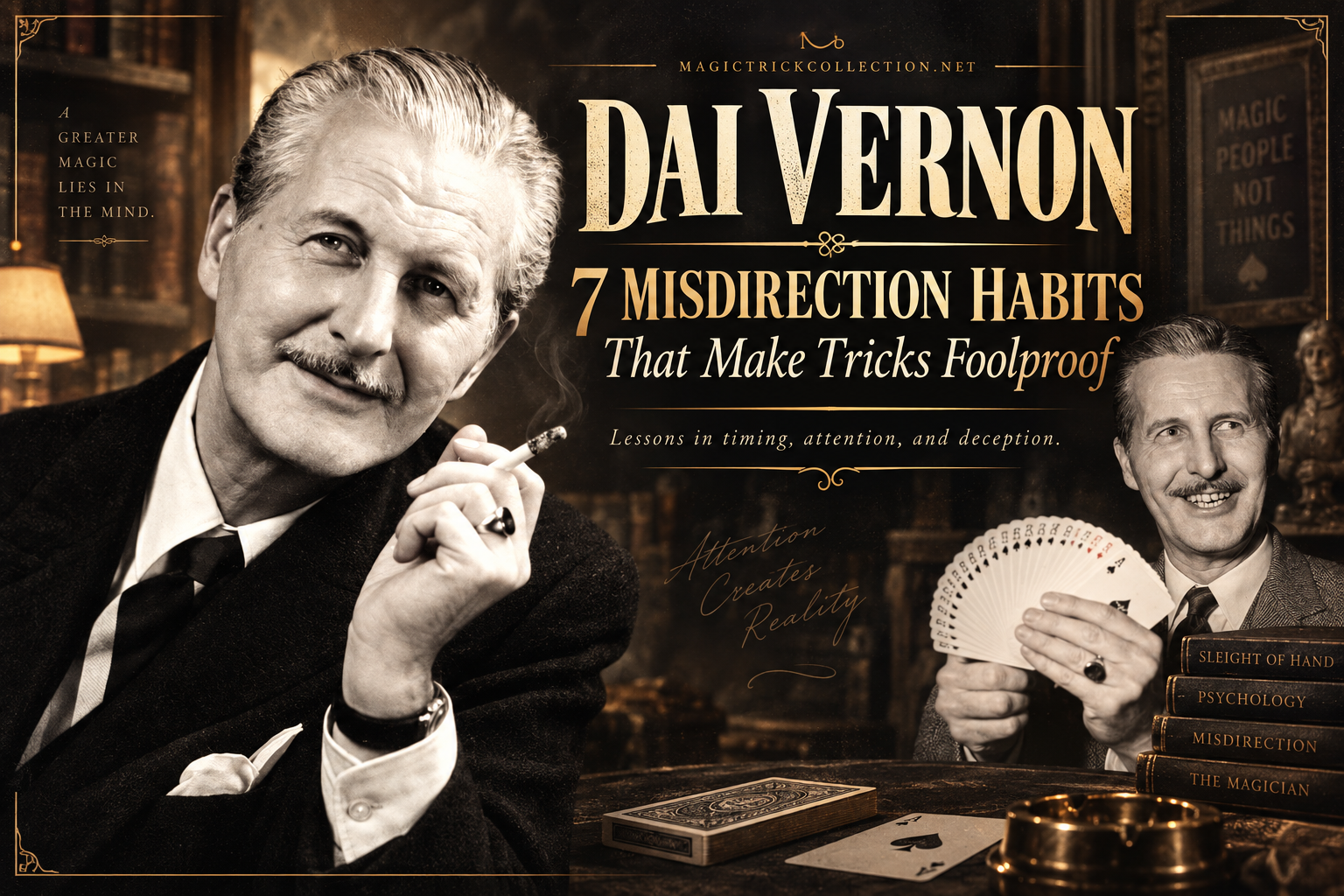
⚡ TL;DR: This guide explains how Dai Vernon 7 Misdirection Habits That Make Tricks Foolproof made misdirection foolproof by engineering attention with timing, motivation, and spectator tasking.
📋 What You’ll Learn
In this comprehensive guide about Dai Vernon 7 Misdirection Habits That Make Tricks Foolproof, we’ve compiled everything you need to know. Here’s what this covers:
- Learn the “audience management” model of misdirection – Dai Vernon’s approach treats misdirection as choreography and cognitive load control, not “look over there” distraction.
- Discover the seven repeatable misdirection habits that reduce method exposure – The framework emphasizes motivated actions, scripted offbeats, and gaze geometry to keep attention predictable across angles and cameras.
- Understand how to build “attention rails” with spectator tasking – Structuring constant micro-jobs (decide, verify, recall, answer) prevents spectators from defaulting to burning the hands.
- Master field-tested rehearsal protocols that hold up on video – Practical pressure-testing uses beat mapping, breath cues, silent playback review, and venue-specific blocking designed for modern phone filming.
Quick Summary & Key Takeaways
- Dai Vernon treated misdirection as audience management, not “look over there”: timing, posture, and task design do the heavy lifting.
- The seven habits here focus on repeatable behaviors—scripted offbeats, motivated actions, and gaze geometry—that reduce “method exposure” across angles and cameras.
- Modern working pros can pressure-test Vernon-style misdirection using video review, spectator tasking, and venue-specific blocking that anticipates phone filming.
- When paired with measurable rehearsal protocols (beats, breath cues, and error budgets), the habits become consistent—nightly, not occasionally.
Dai Vernon didn’t win reputations by hiding moves; he won them by designing moments where spectators didn’t feel the need to hunt. Put a modern close-up worker in a loud hospitality suite with three phones recording and the old “just be natural” advice collapses fast. What holds up is a system—and Dai Vernon built one that still feels unfair.
That system isn’t mystical. It’s behavioral engineering: when eyes move, when hands pause, when a laugh lands, when a question forces a micro-decision. Read the best accounts of Dai Vernon, and the through-line is habit: repeatable, practiced choices that make the method arrive late to the spectator’s brain. Even now, Dai Vernon remains the cleanest case study in making deception feel like clarity.
Advanced Insights & Strategy
Misdirection becomes reliable when it’s treated like choreography plus cognitive load management. The strongest Vernon-inspired work builds “attention rails”: spectators always have a job (decide, remember, compare, answer), while the hands do only what the script justifies. The goal isn’t distraction—it’s inevitability.
Attention Rails: Designing A Job For Every Second
One reason “burning hands” has become more common is that spectators have learned the modern meta-game: watch the fingers, catch the secret. The antidote isn’t faster technique; it’s structured tasking. In Vernon-style routining, spectators repeatedly get a job that’s easier and more rewarding than staring—naming a card, verifying a condition, recalling a sequence, confirming fairness.
Entertainment agencies that book strolling magic for corporate events often track performance notes like “crowd retention” and “repeat requests.” In 2026, Live Nation’s corporate events arm highlighted that audience “participation moments” correlated with higher satisfaction in its post-event survey work (published as part of their corporate insights blog, not magic-specific, but relevant to attention design). Even outside magic, the pattern is consistent: task beats out passive watching. For a comparable attention principle, see Nielsen’s 2026 coverage on engagement and attention economics: https://www.nielsen.com/insights/.
Offbeat Engineering: Timing As A Repeatable Mechanism
The “offbeat” gets discussed like folklore, but it can be built mechanically. A working approach: identify the exact cognitive peak—laughter, surprise, a fairness check, the instant a spectator answers a question—and schedule secret actions inside the recovery window right after it. That window isn’t long; it’s often under a second in live close-up, shorter on camera. The point is consistency, not hoping for a laugh.
For a research-backed lens on attentional blink and post-event processing that maps well to offbeat thinking, 2026 updates in cognitive science reporting have continued to cite attentional limitations in rapid serial tasks; Nature’s research index remains a reliable entry point for current coverage and papers: https://www.nature.com/subjects/attention. The performer’s translation is simple: do the dirty work when the spectator’s brain is filing the last moment.
Gaze Geometry: The Triangle That Controls The Room
Vernon-level misdirection often looks like nothing is happening because the performer’s gaze draws a map. Eyes to spectator, eyes to object, eyes back to spectator. That triangle tells people what matters without commanding them. It’s also the cleanest way to move attention without turning the show into a “look over here” maneuver that experienced audiences recognize instantly.
In modern conditions—tight circles, cocktail tables, wide phone lenses—gaze geometry can be rehearsed like blocking. Directors in live theatre use sightline planning as a formal discipline; the same logic applies in magic when hands must be “in frame” but not “in focus.” For practical stage sightline framing concepts that translate well, the Royal Shakespeare Company’s production notes and learning materials offer a credible overview of stagecraft fundamentals: https://www.rsc.org.uk/.
The Seven Misdirection Habits Of Dai Vernon
These habits are behavioral defaults, not one-off moves. They are the small choices—pauses, questions, posture shifts—that make the method land in a moment spectators don’t catalog as “the move.” Each habit can be drilled, measured on video, and adapted for modern walkaround conditions.
Habit 1: Motivation Before Method, Every Time
In Vernon’s best material, the hand doesn’t go somewhere “because it needs to.” It goes because the situation demands it: to square a deck after a spectator pushes it messy, to retrieve a pen because a signature is required, to cleanly place a card so the table becomes a “witness.” That motivation makes the action feel like housekeeping, not hiding.
In the magician industry, this is the difference between a pass that reads as a pass and a pass that reads as “resetting the deck.” Watch modern corporate workers who rely on signed-card plots: the signature is not just a convincer; it’s a reason to introduce a marker, cap it, pocket it, and steal on the offbeat created by the spectator’s own writing. That’s Vernon logic with a 2026 toolkit.
Habit 2: The Offbeat Is Scripted, Not Prayed For
Real-world audiences don’t always laugh where expected, and event noise can swallow punchlines. “Hoping” for the offbeat is a recipe for inconsistency. The Vernon habit is to create an offbeat with structure: a question that forces a decision, a fairness check that requires a nod, a call-and-response that produces a predictable rhythm.
In trade-show environments—where booth teams care about dwell time and lead capture—magicians often build a micro-funnel: stop, hook, qualify, amaze, handoff. The best “handoff” moments double as offbeats. A spectator turns to accept a branded card or scan a QR, and the performer takes the heat off the hands by making the audience’s next action the focus. That’s not distraction. It’s workflow.
Habit 3: Hands Freeze When The Brain Works
When the spectator is calculating (“Was it really my choice?” “Did I shuffle?”), hands moving reads as suspicious. Vernon’s approach often does the opposite: the hands go still at the moment of thinking. The mind gets a clean, quiet frame. Then, when the moment is resolved—when the spectator answers—the body can move again without looking like it’s doing something.
This habit is measurable. Film a routine and mark the frames where the spectator is asked to remember, decide, or verify. If the hands are in motion during those frames, the routine is begging to be reverse-engineered. Working pros increasingly do “silent playback” reviews—watching without sound—to spot telltale motion. The best takes often look almost boring. That boredom is camouflage.
Habit 4: The Dirty Work Happens Under A Social Contract
One of the most under-discussed Vernon habits is how often secret actions happen while the performer is making a spectator feel seen. Complimenting a shuffle, repeating their name, asking a clarifying question—these are social acts that pull attention to the face without feeling like a tactic. The spectator leans into the interaction. The hands become background.
In modern close-up, this habit matters because phones record hands relentlessly. Face time becomes the strongest misdirection tool available. A worker who can produce authentic, short social beats—“Say that again,” “What’s your name?” “You’re the one who’s going to catch me”—creates natural head turns and eye contact. It’s not manipulation; it’s conversation, used with timing.
Habit 5: Angle Management Is Built Into Choreography
Vernon material assumes bodies exist in space. The performer doesn’t “deal with angles” as an afterthought; the routine steers the audience to safe geometry. A step left, a handoff to the right spectator, a reason to look down at the table—these are choices that herd sightlines without announcing it.
Today’s magician industry adds a complication: the wide-angle phone camera. In weddings and corporate receptions, spectators film from the flank. A Vernon-style fix is to block routines so the “danger side” becomes the “job side.” Put the phone-holder in the role that requires participation—holding an object, verifying a seal, reading a serial number. Their camera may still record, but their attention (and framing) shifts to their task.
Habit 6: Clarity Is A Weapon—Not A Risk
Many performers muddy procedures out of fear that clarity will reveal method. Vernon’s habit is the opposite: clean conditions, clean language, clean displays. Clarity narrows the spectator’s hypothesis space. When everything is fair, the mind stops scanning for procedural loopholes and starts confronting the impossibility.
There’s also a business angle. Producers hiring for high-stakes private events often use “clarity under pressure” as an informal benchmark during auditions: can the performer keep procedures crisp while guests interrupt, talk over, or heckle? Clarity reads as confidence. And confidence keeps attention on the effect rather than the performer’s hands.
Habit 7: The Ending Is Designed To Break Reconstruction
The last habit is brutal: the routine ends in a way that destroys the audience’s ability to replay steps in a neat chain. Vernon endings often include a time-jump, a position change, or a final condition that retroactively reframes earlier moments. It’s not just a kicker; it’s a reconstruction trap.
In card work, that might be a final revelation that changes what the spectator thought the “important moment” was. In coin work, it might be an ending that leaves the hands undeniably empty at the exact time a hidden object would be suspected. Modern workers translate this into “post-method cleanliness”: if the spectator rewatches a clip, the last frames still don’t offer a neat explanation. The method arrives, if at all, too late to matter.
“The best misdirection is procedural: you give people something honest to do, and the secret rides in the margins.” – Jamy Ian Swiss, Author & Lecturer
What Most Get Completely Wrong About Dai Vernon
People treat Dai Vernon like a library of clever moves. That reading misses the point. The real artifact is the audience-control architecture: the way the room is guided into a single, satisfying interpretation of what just happened, while the method becomes the least interesting possibility.
They Copy The Sleights And Skip The Behavior
I’ve watched technically strong performers do Vernon material and still get caught because they imported the mechanics but not the human rhythm. The hands were correct; the body was wrong. The pauses were missing. The eye contact was absent. The spectator’s “job” was vague, so they defaulted to staring at the fingers like a security camera.
My hard rule now: if a secret action needs cover, the cover must be a scripted human moment, not a hand flourish. A spectator question, a name repeat, a laughter beat—something that exists even if no method is happening. That’s the difference between “I did the move” and “the moment made sense.”
They Confuse Stillness With Slowness
I used to think “Vernon is slow.” That’s not it. The pace can be brisk. The stillness is strategic. Stillness shows up when the spectator needs to process, and speed shows up when the action is motivated and ordinary—like squaring, dealing, or picking up a glass.
The fastest win I’ve seen with this mindset was a corporate walkaround set where the performer cut the visible fancy handling by half, then doubled down on frozen frames during decision points. The reactions got louder, not quieter. The audience didn’t feel “handled.” They felt respected.
They Overuse ‘Look’ Lines And Underuse Task Lines
I’m wary of any script built from commands: “Watch closely.” “Keep your eye on it.” Those lines invite combat. In Vernon-style construction, language assigns tasks: “Push the card in.” “Hold your hand flat.” “Say stop whenever you want.” A task line creates cooperation; a look line creates surveillance.
That one shift changes the entire temperature of a performance. It also makes hecklers less powerful, because the routine is built on participation rather than dominance. The show becomes a shared procedure that leads to a surprise, not a contest of attention.

Field-Tested Rehearsal For Misdirection That Holds Up On Video
Modern audiences don’t just watch; they record, replay, and group-chat. Misdirection has to survive multiple viewing contexts, including silent replays and wide-angle shots. The solution isn’t secrecy theater—it’s rehearsal that treats attention like a measurable variable and pressure-tests the routine like a product demo.
Step 1: Build A Beat Map With “Heat” Markers
Start by scripting beats, not patter paragraphs. Mark where attention is naturally hot (a selection, a signature, a reveal) and where it can cool (a recap line, a fairness check, a laugh). Then assign every secret action to a cool beat. If a move is currently living in a hot beat, the structure is wrong, not the performer.
In 2026, production teams in creator economies have standardized “beat sheets” for short-form video because retention drops at predictable points. While that’s a different domain, the discipline transfers cleanly: map moments where people lean forward. For current thinking on attention and retention mechanics in media, Pew Research Center’s 2026 reporting hub is a reliable place to track the year’s publications: https://www.pewresearch.org/.
Step 2: Run Silent Video Review For Tells
Record a rehearsal from three angles: front, 45-degree right, 45-degree left. Then watch without sound. Silent review strips away charm and forces the body to justify itself. If the hands do something that looks like “handling,” it will scream in silence. If the eyes dart, it will look like guilt.
Silent review also reveals a Vernon hallmark: motivated stillness. When the effect is framed properly, the body looks calm at the exact moment the spectator’s mind is busy. That calmness reads like innocence. On camera, it reads like professionalism.
Step 3: Add A Spectator Task That Forces A Head Turn
Engineered head turns are not hacks; they’re collaboration cues. A task like “Show it to your friend” forces a natural shift in attention that no one resents. Another is a verification step: “Read the name out loud.” These moves create a predictable offbeat that can be rehearsed down to timing.
In close-up restaurant work, a classic technique is to place the “task object” (marker, card box, coin purse) slightly off center so the spectator’s eyes travel. The key is that the travel is justified by the plot, not by the need to cover a move. That’s the Vernon difference in 2026 clothing.
Step 4: Establish An Error Budget For Live Conditions
Every working pro knows the performance environment will fight back—sticky tables, humid decks, loud music, intoxicated spectators. Build an error budget: decide which phases must be bulletproof and which can flex. Then choose methods that degrade gracefully. A move that fails catastrophically under pressure is not “advanced”; it’s fragile.
Event planners in the magician industry frequently share incident notes privately (missed cues, prop failures, sound issues). Treat those notes like QA logs. A Vernon-inspired routine isn’t just deceptive; it’s resilient. The audience never sees the contingency plan because the contingency plan is built into the choreography.
Making Dai Vernon Play For Modern Venues: Close-Up, Parlor, And Social
Dai Vernon worked in rooms where attention was earned, not granted—an oddly modern constraint. Today’s venues add phones, brand activations, and restless crowds, but the core problem is familiar: build focus without demanding it. The habits translate well when the blocking and scripting are updated with venue physics.
Dai Vernon For Strolling Sets: Reset Speed Without Sloppiness
Walkaround magic is logistics disguised as art: reset time, pocket management, repeatability, and spectator flow. Vernon’s misdirection habits help because they reduce the need for risky “in-between” handling. When actions are motivated, resets can happen invisibly as part of normal procedure—capping a marker, squaring a deck, returning a prop.
Long-tail variations show up naturally in pro discussions: “Vernon-style misdirection for walkaround,” “close-up misdirection habits,” and “how to make card tricks foolproof for corporate events.” The useful lens is operational: how many tables can be hit per hour without quality dropping? A routine that looks clean while staying reset-friendly is the one that survives a three-hour reception.
Dai Vernon For Parlor: Scaling Attention With Gaze And Framing
Parlor amplifies misdirection errors because more eyes means more independent camera angles—human ones. The Vernon approach scales by widening the attention rails: bigger, clearer tasks (hold a rope end, read a word, confirm a seal) and stronger gaze geometry. The performer’s eyes tell the room where the story is, while the hands do only what the story just earned.
Parlor also benefits from what could be called “procedural narration,” a staple in Vernon construction: the audience always knows what is happening and why. Confusion is not mystery; it’s a gap spectators fill with suspicion. Clear procedure buys trust, and trust buys time.
Dai Vernon For Social Clips: Editing-Proof Structure
Social media changes the threat model. Spectators will rewatch. They will scrub frame-by-frame. The answer isn’t to ban filming; it’s to build sequences that remain deceptive even when replayed. That means fewer “single-point-of-failure” moves and more layered construction: a motivated action plus a cognitive peak plus post-method cleanliness.
Creators who post magic regularly often adopt production workflows borrowed from digital marketing—A/B testing hooks, measuring drop-off, and analyzing comments for suspicion triggers. For an authoritative reference point on current-year marketing analytics practices (useful for creators treating content as a funnel), Gartner’s 2026 research portal is a strong baseline: https://www.gartner.com/en/marketing. The Vernon lesson remains intact: design the moment so the viewer never knows where to start looking.
Comparison Table: Habit-Driven Misdirection Vs Move-Driven Misdirection
This distinction matters because it determines whether a routine survives bad angles, loud rooms, and repeat viewings. Habit-driven misdirection builds a system that travels across venues; move-driven misdirection depends on ideal conditions and surprise. The table below shows how the two models behave under real working constraints.
| Dimension | Habit-Driven (Vernon-Inspired) | Move-Driven (Technique-First) |
|---|---|---|
| Audience Attention | Structured tasks and decision points guide focus without commands | Relies on spectators “not looking” at the wrong time |
| Camera Resistance | Works better on replay because actions look motivated and calm | Often fails on silent replay due to telltale handling beats |
| Angle Management | Blocking moves people; angles are designed into choreography | Angles are “managed” reactively after the fact |
| Performance Consistency | Repeatable because timing and pauses are scripted | Varies with crowd mood, laughter, and performer nerves |
| Business Utility | Scales to strolling, parlor, and branded activations with minor edits | Often stuck in one venue type; fragile under interruptions |
Conclusion
Dai Vernon treated misdirection as design: motivation that makes actions ordinary, offbeats built into language, and endings that poison reconstruction. Those seven habits turn “don’t look there” into “you never needed to look there.” For modern performers, the lasting lesson from Dai Vernon is simple and ruthless: if the audience is hunting, the structure failed.
The Dirty Secret: “More Skill” Often Makes Tricks Easier To Catch
Hyper-technical handling can add suspicious motion exactly where spectators least tolerate it. The cleaner path is behavioral: freeze hands during thinking, move only when the plot demands it, and script tasks that absorb attention honestly. When the routine looks like normal life, even strong technique becomes invisible.
A Real-World Example: The Magic Circle’s Close-Up Room Pressure Test
At London’s The Magic Circle, close-up performers routinely face a room built to detect method—tight sightlines, informed spectators, and little patience for procedural fog. The acts that play strongest often lean on Vernon habits: motivated handling, calm frames, and task-driven participation that keeps heat off the hands without ever asking for it.
The Core Rule: If An Action Needs Cover, The Plot Must Pay For It
Every suspicious movement is a bill, and the story has to cover the cost. When the plot earns the action—through a task, a verification, or a social contract—misdirection stops being a trick and becomes the audience’s natural path through the effect.

Find out more information about “Dai Vernon”
Search for more resources and information: