
Modern Art Illusion: Invented From Magic’s Most Copied Illusion
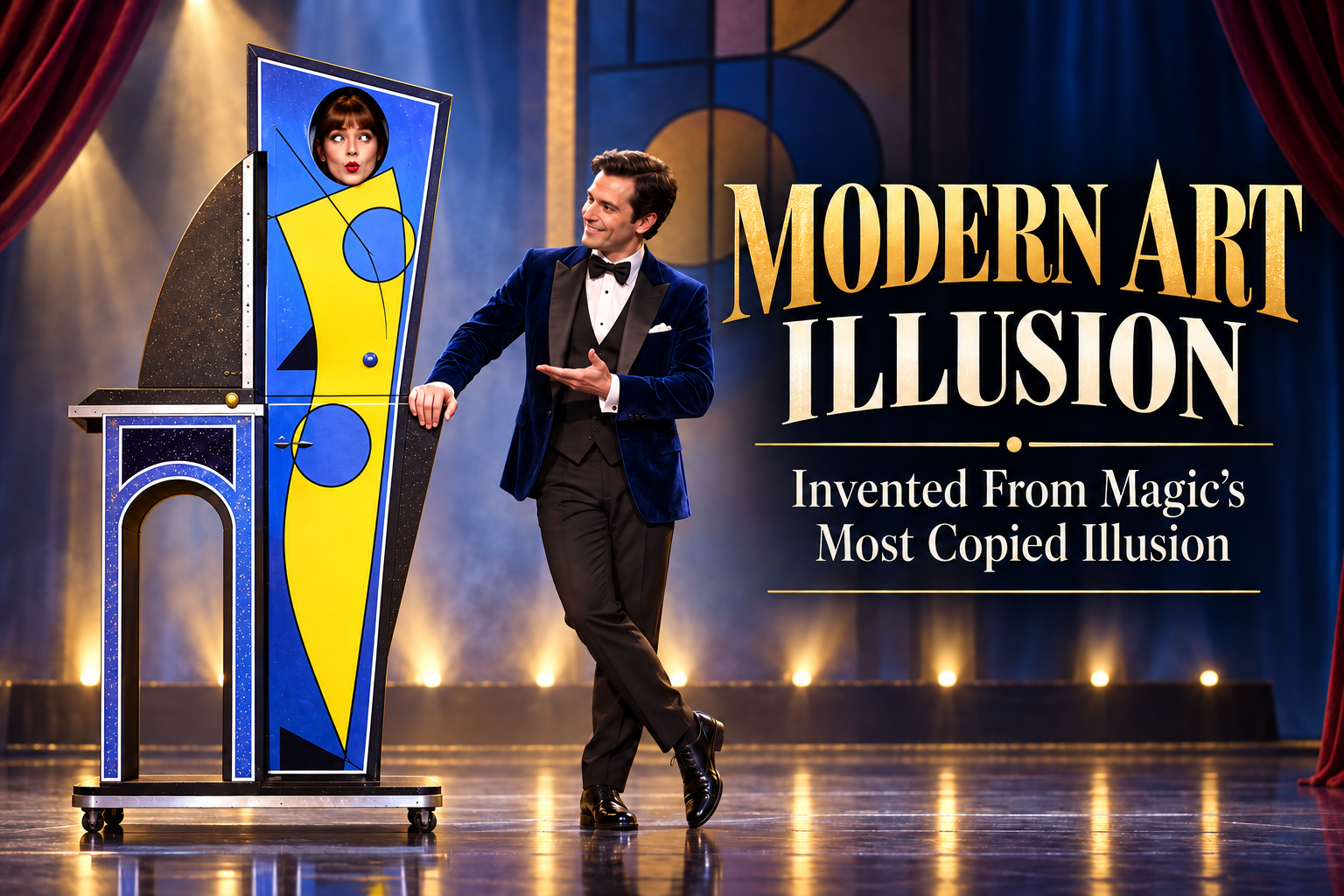
⚡ TL;DR: Modern Art Illusion: Invented From Magic’s Most Copied Illusion. An assistant stands upright in a narrow cabinet, face and hands and bare feet all visible the entire time. A sword goes through at the waist. The top half slides sideways, clean across the blade — and for a moment, the audience is looking at two separated halves of a person who is still very much smiling. Jim Steinmeyer built the first version in his basement in 1974 as an answer to a magic trick that had already been copied thousands of times over.
📋 What You’ll Learn
In this guide to Jim Steinmeyer’s Modern Art Illusion: Invented From Magic’s Most Copied Illusion, here’s what we cover:
- Meet the illusion it was built to answer – Robert Harbin’s Zig-Zag Girl, a 1965 trick so widely copied it landed in the Guinness Book of World Records.
- Follow the basement-to-Broadway path – how a 1974 prototype called “Splitting” went through five major revisions before it became Modern Art.
- See exactly what the effect looks like – the mechanics behind an illusion that works in full light, in the round, with no mirrors or black art.
- Learn who Jim Steinmeyer is – the illusion designer behind Copperfield, Henning, Siegfried & Roy, and some of Broadway’s biggest special-effects moments.
- Understand why it matters to collectors – what a documented, patent-era illusion means for provenance versus a two-century-old mystery.
Quick Summary & Key Takeaways
- Modern Art was designed by Jim Steinmeyer as an alternative to Robert Harbin’s 1965 Zig-Zag Girl, a trick so widely copied it was named the most-copied stage illusion in the Guinness Book of World Records.
- Steinmeyer built his first prototype, an early cabinet-free version called “Splitting,” in his own basement in 1974.
- The illusion went through at least five major revisions; magician James Royal performed the second version, and Doug Henning later purchased a version of it for a television special.
- The finished effect places an assistant in a narrow, wedge-shaped cabinet, drives a sword through at the waist, and slides the top half sideways across the blade — all with the assistant’s face, hands, and feet visible the entire time.
- Steinmeyer published the plans in 1995 in a booklet called “Modern Art and Other Mysteries,” alongside three other original illusions.
- Unlike centuries-old public-domain classics, Modern Art has a fully documented paper trail — designer, prototype date, revision history, and publication — which gives collectors something concrete to trace.
Most magic illusions either get invented once and stay roughly the same forever, or they’re so old that nobody agrees on who came up with them first. Modern Art is neither. It’s a trick that was deliberately built, over two decades and five major redesigns, specifically to fix the problems in a much more famous illusion — one that had already been copied so many times it hardly resembled an invention that a single person owned anymore.
That’s a strange position for a magic trick to be born into: not a mystery to solve, but a known flaw to correct. Here’s how it happened, and why the illusion designer behind it became one of the most important names in modern magic.
The Trick That Got Copied 15,000 Times
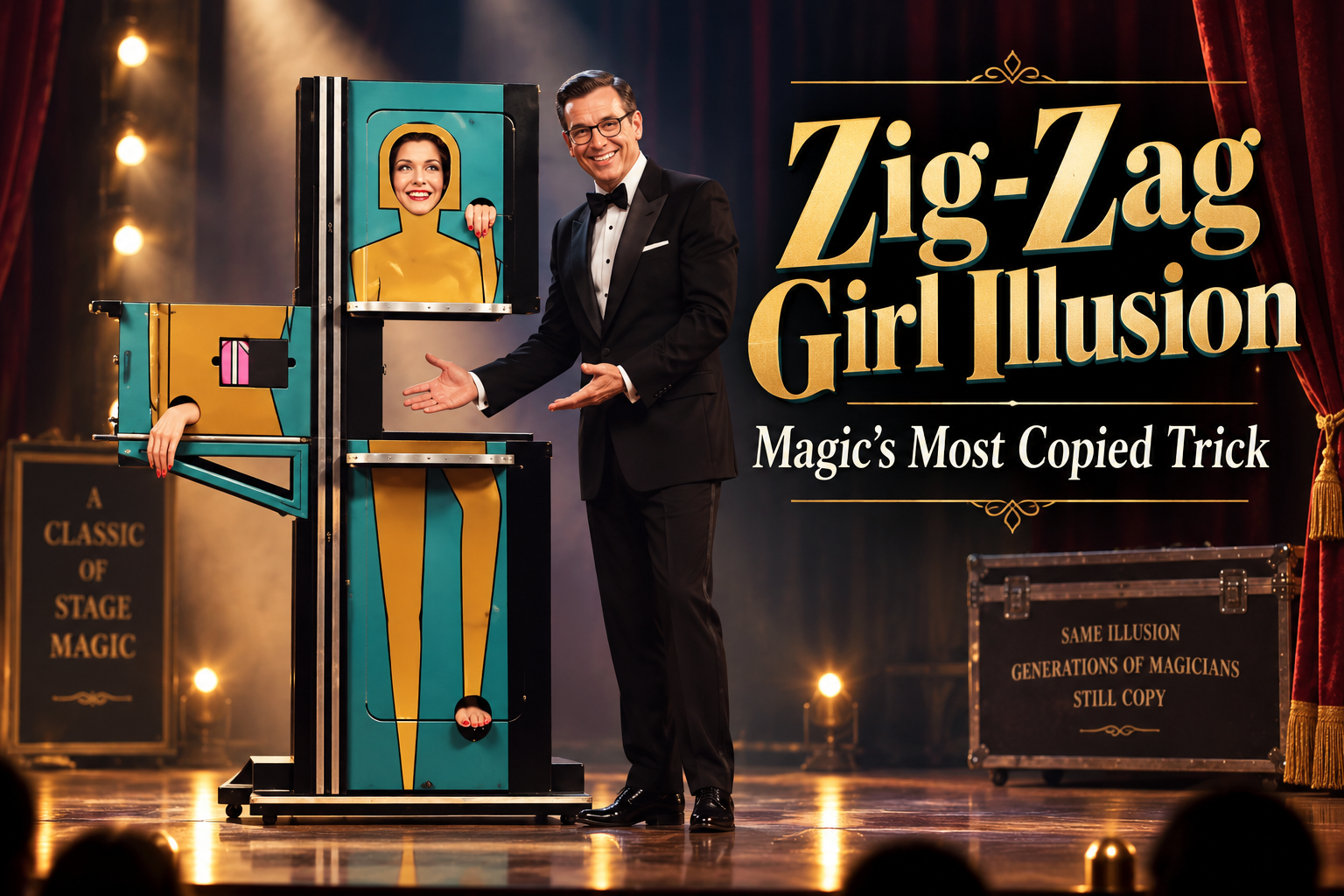
To understand why Modern Art exists, you have to start with a different illusion entirely: the Zig-Zag Girl. British magician Robert Harbin created it in 1965 and first showed it to the magic world at the Magic Circle’s banquet in London that October, later bringing it to television audiences on the show International Showtime. The effect was deceptively simple to describe — an assistant stands upright in a cabinet, the magician divides her into three sections, and the middle section is pushed sideways, seemingly leaving her waist offset from the rest of her body while she remains cheerfully unharmed.
It was an instant sensation, and also an instant target. Harbin published construction plans in a limited edition of just 500 copies in 1970, and that was more than enough to set off an explosion of homemade and commercially built versions. By the time the Guinness Book of World Records got around to naming it, in 2005, the Zig-Zag Girl was officially recognized as the most copied stage illusion ever made — with estimates suggesting more than 15,000 versions have been built worldwide from that one small print run.
But popularity came with a catch. The Zig-Zag Girl’s method placed real physical constraints on who could perform it — the illusion depended on an assistant within a fairly specific height and weight range, which limited who a magician could cast in the role. A trick that every working illusionist wanted to own turned out to be a trick not every illusionist could actually perform.
A Prototype Built in a Basement
That gap is where Jim Steinmeyer entered the picture, years before he’d become one of the most sought-after illusion designers in the business. In 1974, working in his own basement, Steinmeyer built an early prototype of what would eventually become Modern Art. At that stage it wasn’t even the cabinet illusion audiences know today — it was a bare-bones version called “Splitting,” built without any cabinet at all, testing whether the core mechanical idea of dividing a body while keeping the extremities visible could even work.
It’s worth sitting with that detail for a second: one of magic’s most respected modern illusion designers started this particular trick not with a fully formed concept, but with a rough basement experiment aimed at solving someone else’s design problem. Great illusions, it turns out, don’t always arrive whole. Sometimes they start as a private tinkering project that takes twenty years to become something an audience will ever see.
Five Revisions to Get It Right
Steinmeyer has said Modern Art went through at least five major revisions before it reached the form it’s known for today, and the illusion’s path through those revisions involved other performers along the way. Magician James Royal performed the second major revision of the effect — still without Steinmeyer’s eventual full cabinet design. Doug Henning, already established as one of the era’s biggest illusionists, later purchased a version of the trick for use in one of his television specials.
Along the way, Steinmeyer made a design decision that reshaped the whole project: he had been trying to minimize the cabinet, assuming a smaller, less obtrusive prop would make for a cleaner illusion. Eventually he concluded that instinct was wrong — that minimizing the prop actually worked against the effect rather than for it — and reintroduced a full, proper cabinet into the design. That reversal is what finally pushed Modern Art toward the version that got published and performed for decades afterward, including by acts like the Spencers.
What the Audience Actually Sees
The finished illusion is built around a compact, wedge-shaped cabinet just large enough to hold a standing assistant. Once she’s inside, doors close around her body, leaving her face, one hand, and her bare feet visible to the audience the entire time — there’s no moment where she disappears from view. The magician then pushes a sword horizontally through the cabinet at waist height, front to back.
Then comes the moment the whole design exists for: the top half of the cabinet slides sideways, sliding directly across the blade of the sword, visibly separating from the lower half — while the assistant’s face and hand, still on view above the divide, show no sign of distress. Doors open on both sections to reveal the separation directly: torso in the upper half, legs in the lower half, offset from one another with the sword still through the middle. The cabinet is then reassembled, the sword withdrawn, and the assistant steps out completely unharmed.
What makes the method notable, according to magicians who’ve reviewed the published plans, is what it doesn’t rely on. There’s no black art (concealment through carefully controlled lighting and dark backgrounds), no wedge-shaped hidden bases, and no mirrors — the standard toolkit for a lot of classic illusion design. Modern Art was built to hold up under ordinary stage lighting and even to be performed in the round, surrounded by spectators on all sides, which is a genuinely difficult standard for a cutting illusion to meet.
From Basement Trick to Published Classic
Two decades after that first basement prototype, Steinmeyer finally published the plans in 1995, in a booklet titled “Modern Art and Other Mysteries.” True to the title, it wasn’t a one-trick release — the same booklet included plans for three other original illusions: a fresh take on Sawing in Half, an effect called Hospitality (built around pouring an improbable number of different drinks from a single paper milk carton), and Shadow Theater, described as a new approach to vanishing an assistant entirely.
That publication is what turned Modern Art from a performer-to-performer trick, passed along informally the way Splitting and Royal’s second revision had been, into something any magician who owned the booklet could legitimately build and perform themselves. It’s a meaningfully different path to becoming a “classic” than something like the Zig-Zag Girl took — no accidental flood of 15,000 unauthorized copies, just a controlled, documented release two decades in the making.
The Designer Behind It
Jim Steinmeyer was born on November 1, 1958, in Oak Park, Illinois, and studied at Loyola University Chicago before building a career that would eventually make him one of the most consequential illusion designers of his generation. Over the following decades he served as illusion consultant for some of the biggest names to ever headline a magic show, including Doug Henning, David Copperfield, Siegfried & Roy, and Lance Burton.
Modern Art is far from his only credit. Steinmeyer also designed Origami, the folding-box illusion Henning introduced in 1986 and Copperfield later reworked with samurai swords, and he built the Vanishing Statue of Liberty for one of Copperfield’s television specials in 1983 — an illusion performed, famously, on a genuine national monument rather than a stage prop. He also designed Interlude, originally titled “Permeability,” which became a signature piece for the illusion duo the Pendragons.
Steinmeyer’s design work extended well past the magic world, too. He earned two Drama Desk nominations for his special-effects work on the Broadway productions of Merlin and Into the Woods, and designed stage illusions for Disney’s theatrical productions of Aladdin, Beauty and the Beast, and Mary Poppins. In 1991, at just 32 years old, he became the youngest person ever awarded The Magic Castle’s Creative Fellowship, and he went on to receive the Milbourne Christopher Award in 1996 and a Literary Fellowship in 2002. Across his career, he holds four U.S. patents for illusion designs — a reminder that, as with Origami, Steinmeyer’s work often comes with the kind of documented legal paper trail that older, folklore-era illusions simply never generated.
Why It Matters to Collectors
Modern Art sits in an interesting spot for anyone building a serious magic collection. It doesn’t have the centuries-old mystery of a suspension illusion or the disputed multi-inventor history of something like the Aga Levitation — instead, it offers the opposite kind of value: a complete, traceable record. A known designer, a documented basement prototype date, a named performer for an intermediate revision, a specific television-special buyer, and an actual publication date for the plans that made it legitimately reproducible.
That kind of paper trail matters for the same reason it mattered with Origami: when an illusion’s history is this well documented, provenance becomes part of what a piece is worth. A prop or set of plans that can be tied to Steinmeyer’s actual design lineage — rather than one of the countless unauthorized cutting illusions that followed in the Zig-Zag Girl’s wake — carries a different kind of collectible weight. If that sort of documented design history interests you, it’s worth browsing what’s available through MagicTrickCollection.com, where pieces with real, traceable provenance are treated accordingly.

Conclusion
Modern Art isn’t a trick that arrived out of nowhere, and it isn’t a trick anyone can honestly claim to have stolen. It’s the product of one designer’s two-decade argument with himself over how to solve a problem in someone else’s famous illusion — a basement experiment in 1974, a performer’s version in the years after, a television buyer, a wrong turn on minimizing the cabinet, and finally, in 1995, a published booklet that let other magicians build it the right way. Next to a trick like the Zig-Zag Girl, copied more than 15,000 times over from a single 500-copy print run, Modern Art is proof that a documented, deliberately built answer to a problem can become just as lasting an illusion as the accident of popularity that inspired it.





[…] Modern Art Illusion: Invented From Magic’s Most Copied Illusion […]