Houdini Fact vs Legend: 100 Years After His Death
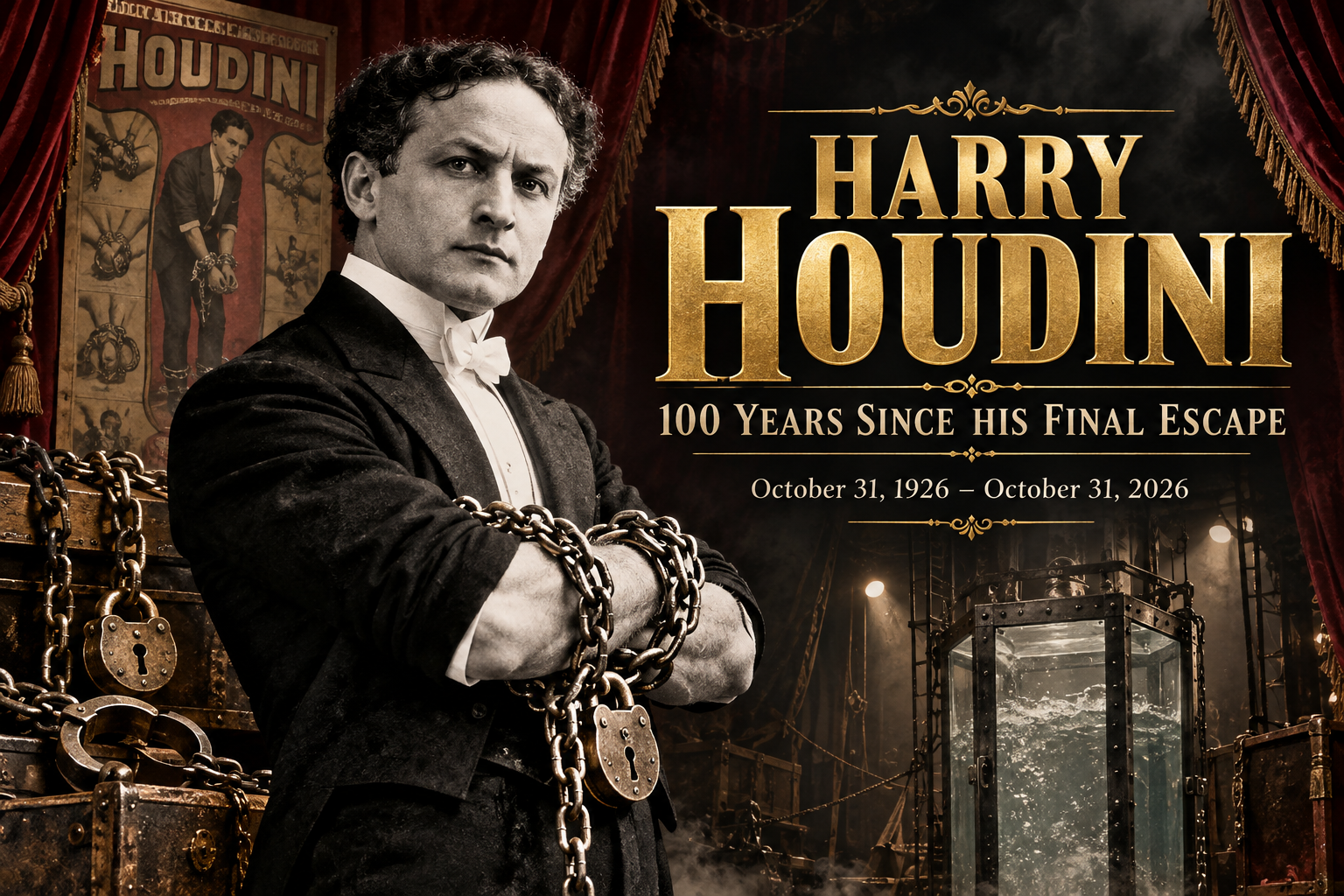
TL;DR: Harry Houdini Fact vs Legend: 100 Years After His Death, A Century of Magic, Mystery, and an Extraordinary Legacy
On October 31, 2026, the world marks the 100th anniversary of the death of Harry Houdini, arguably the most famous escape artist in history. Born Ehrich Weiss in Budapest, Hungary, in 1874, Houdini transformed himself from a struggling entertainer into an international sensation whose extraordinary escapes challenged the limits of human endurance.
His death on Halloween in 1926, at just 52 years old, created a mystery that continues to fascinate historians, magicians, and audiences worldwide.
A century later, Houdini remains an enduring symbol of courage, determination, illusion, and showmanship. Throughout 2026, museums, historians, professional magicians, and collectors are commemorating his remarkable life through exhibitions, performances, historical presentations, and special events.
From New York City and Detroit to Hollywood and beyond, the world is remembering the man who could seemingly escape anything—except death itself.
What You’ll Learn:
- The Man Behind the Legend: Houdini’s early life, rise to international fame, and greatest accomplishments.
- The World’s Greatest Escape Artist: How Houdini revolutionized magic and created some of history’s most memorable escapes.
- His Final Days: The events surrounding his last performances, hospitalization, and death on October 31, 1926.
- The Mystery of Houdini’s Death: Separating historical facts from the legends surrounding his fatal illness.
- 100 Years of Remembrance: Special events and exhibitions commemorating Houdini’s centennial in 2026.
- An Enduring Legacy: Why Houdini remains one of the most recognizable names in magic a century after his death.
📅 Updated: October
✍️ Author Expertise: Magic Trick Collector, Curator, and Steward of History
1. The Birth of a Legend: From Ehrich Weiss to Harry Houdini
Before he became the world’s most celebrated escape artist, Harry Houdini was a young immigrant determined to overcome poverty and establish himself as a successful entertainer.
Born on March 24, 1874, in Budapest, Hungary, Houdini entered the world as Ehrich Weiss, the son of Rabbi Mayer Samuel Weiss and his wife, Cecelia.
His family immigrated to the United States, eventually settling in Appleton, Wisconsin, in 1878.
Although Houdini frequently claimed Appleton as his birthplace, historical records establish that he was born in Hungary.
His childhood was marked by financial hardship, frequent moves, and an early fascination with physical challenges and entertainment.
As a young boy, he developed an interest in athletics, gymnastics, and magic. These interests would eventually form the foundation of his extraordinary career.
In his teenage years, Ehrich began performing magic professionally. He adopted the stage name Harry Houdini, inspired by the celebrated French magician Jean-Eugène Robert-Houdin.
In 1894, Houdini married Wilhelmina Beatrice Rahner, affectionately known as Bess.
Their marriage would become one of the most recognizable partnerships in entertainment history.
Bess served as Houdini’s stage assistant, traveling companion, and trusted partner throughout much of his career.
Together, they endured years of modest success before Houdini discovered the specialty that would transform his life: escaping from seemingly impossible restraints.
According to the PBS American Experience biography of Houdini, his determination to continually reinvent himself helped establish him as one of the world’s most successful entertainers.
2. The Handcuff King: Houdini Conquers the World
By the late 1890s, Houdini began developing an act centered on escaping from handcuffs, chains, ropes, and other restraints.
His performances combined exceptional physical conditioning, technical knowledge, misdirection, and an extraordinary understanding of publicity.
In 1899, theatrical impresario Martin Beck recognized Houdini’s potential and helped launch him into the major vaudeville circuits.
Within a few years, Houdini was performing throughout Europe, attracting enormous crowds and challenging local police departments to restrain him using their most secure equipment.
These public challenges became a brilliant marketing strategy.
Every successful escape generated newspaper headlines, strengthened his reputation, and increased demand for his performances.
Houdini understood something that remains essential to modern entertainment: the anticipation surrounding an extraordinary event can become as powerful as the performance itself.
The Escapes That Made Houdini Immortal
Throughout his career, Houdini introduced increasingly elaborate escapes that pushed the boundaries of theatrical entertainment.
The Milk Can Escape (1908)
Houdini allowed himself to be locked inside a large metal milk can filled with water.
The audience watched as assistants secured the container while Houdini attempted to escape before running out of air.
His advertising warned audiences that failure could mean drowning.
The Chinese Water Torture Cell (1912)
Perhaps his most famous theatrical escape, this illusion involved Houdini being suspended upside down, his ankles secured in stocks, before being lowered into a water-filled cabinet.
The apparent danger created extraordinary suspense.
The Suspended Straitjacket Escape
Houdini performed dramatic outdoor escapes while suspended high above city streets.
Thousands gathered to watch him struggle free from a straitjacket while hanging upside down from buildings and other elevated structures.
Underwater Escapes
Houdini escaped from restraints after being submerged in rivers, harbors, and other bodies of water.
These highly publicized challenges strengthened his reputation as a performer willing to confront extraordinary danger.
What distinguished Houdini was not simply his ability to escape.
It was his ability to transform each escape into an unforgettable public spectacle.
3. Beyond the Escapes: Houdini’s Other Remarkable Accomplishments
Although most people remember Houdini for his escapes, his accomplishments extended far beyond handcuffs and locked containers.
A Pioneer of Motion Pictures
Houdini recognized the growing influence of motion pictures and became involved in the emerging film industry.
He starred in several silent films, including The Master Mystery (1918), The Grim Game (1919), and Terror Island (1920).
His films combined mystery, physical danger, adventure, and elaborate escape sequences.
He also established film-production ventures, although his motion-picture career proved less commercially successful than his live performances.
An Aviation Pioneer
In 1910, Houdini made aviation history by completing a series of powered flights in Australia.
He is widely credited with making one of Australia’s earliest successful controlled powered flights, although competing claims complicate the distinction of being the country’s first.
His aviation accomplishments demonstrated the same adventurous spirit that characterized his escape performances.
An Author, Historian, and Collector
Houdini developed an extraordinary passion for collecting books, theatrical memorabilia, magic apparatus, and historical documents.
His library contained thousands of volumes covering magic, spiritualism, witchcraft, theatrical history, and related subjects.
He authored several books, including The Unmasking of Robert-Houdin (1908) and A Magician Among the Spirits (1924).
His research helped preserve historical information about magicians and performers whose contributions might otherwise have disappeared.
Today, portions of his remarkable collections reside in major research institutions, including the Library of Congress.
A Relentless Opponent of Fraudulent Spiritualism
During the 1920s, Houdini devoted considerable energy to exposing individuals who claimed supernatural powers.
He challenged spiritualist mediums who professed to communicate with the dead, particularly those he believed were exploiting grieving families.
His investigations brought him into public conflict with Sir Arthur Conan Doyle, the creator of Sherlock Holmes, who sincerely believed in spiritualism.
The disagreement eventually damaged their friendship.
Houdini’s campaign against fraudulent mediums became one of the defining missions of his later life.
Ironically, this fascination with communication beyond death would become closely associated with his own legacy.
4. October 1926: The Final Days of Harry Houdini
By October 1926, Houdini had achieved worldwide fame.
At 52, he continued performing a demanding touring show that combined magic, escapes, and demonstrations exposing fraudulent spiritualist practices.
Despite decades of dangerous performances, he remained determined to maintain an exhausting professional schedule.
However, events during the final weeks of October would bring his extraordinary career to an abrupt conclusion.
October 22, 1926: The Incident in Montreal
While performing in Montreal, Canada, Houdini received visitors backstage at the Princess Theatre.
Among them was a student named J. Gordon Whitehead.
According to historical accounts, Whitehead questioned Houdini about his ability to withstand powerful blows to the abdomen.
Houdini had previously demonstrated his abdominal strength by allowing individuals to strike him after preparing his muscles.
During this encounter, Whitehead reportedly delivered several punches before Houdini was properly prepared.
Houdini experienced considerable pain.
For decades, popular accounts have suggested that these blows directly ruptured his appendix.
However, historians and medical researchers have questioned that explanation.
The punches certainly occurred, but whether they caused or aggravated the appendicitis remains uncertain.
October 24, 1926: Houdini’s Final Performance
Despite worsening abdominal pain and illness, Houdini continued traveling to fulfill his professional commitments.
On October 24, he appeared at the Garrick Theatre in Detroit, Michigan.
This would become his final public performance.
Houdini was reportedly suffering from severe pain and fever.
Nevertheless, he attempted to complete the performance rather than disappoint his audience.
His determination, once an essential ingredient of his professional success, now placed his health in serious danger.
Following the performance, his condition deteriorated.
He was admitted to Grace Hospital in Detroit.
October 25, 1926: Emergency Surgery
Doctors diagnosed Houdini with appendicitis and performed surgery.
By that time, his appendix had ruptured, causing peritonitis—a serious infection involving the lining of the abdominal cavity.
In 1926, physicians lacked the modern antibiotics and advanced medical treatments available today.
The infection presented a life-threatening situation.
Despite surgery and subsequent medical care, Houdini’s condition continued to worsen.

October 31, 1926: The Final Escape
On Halloween morning, October 31, 1926, Harry Houdini died at Grace Hospital in Detroit.
He was just 52 years old.
His death was attributed to peritonitis resulting from a ruptured appendix.
The news spread rapidly across the United States and around the world.
Newspapers published extensive accounts of his life, performances, and final illness.
For millions of admirers, it seemed almost impossible that the man who had escaped chains, locked containers, underwater restraints, and countless dangerous situations could be defeated by an ordinary medical emergency.
His death on Halloween added another extraordinary dimension to an already remarkable legend.
A century later, the Library of Congress’s October 2026 centennial retrospective revisits the medical evidence and explains why the familiar story of a fatal punch is more complicated than popular legend suggests.
5. The Mystery of Houdini’s Death: What Really Happened?
Few aspects of Houdini’s life have generated more speculation than the circumstances surrounding his death.
The most familiar explanation suggests that a student punched Houdini in the stomach, rupturing his appendix and ultimately killing him.
However, the medical evidence does not establish such a direct connection.
Modern medical understanding indicates that appendicitis generally develops through inflammation and obstruction of the appendix.
Although abdominal trauma can occasionally contribute to appendices injury, such cases are uncommon.
The punches may have worsened an existing condition, but historians cannot conclusively establish their role in his death.
What is clear is that Houdini continued performing while seriously ill and delayed receiving appropriate medical treatment.
His determination to fulfill professional obligations likely contributed to the severity of his condition.
Houdini’s death illustrates a tragic contradiction.
The same relentless determination that made him famous may also have prevented him from recognizing the seriousness of his illness.
Did Houdini Believe He Could Return From the Dead?
One of the most enduring stories surrounding Houdini involves an agreement with his wife, Bess.
Although Houdini publicly challenged claims of communication with the dead, he and Bess reportedly agreed upon a secret message that could be used to authenticate any communication after his death.
Following Houdini’s passing, Bess participated in attempts to contact him through séances.
After years without convincing evidence, she eventually abandoned the effort.
Nevertheless, Houdini séances became an annual tradition among magicians and admirers.
These gatherings continue today, combining remembrance, historical storytelling, theatrical mystery, and Houdini’s enduring connection to Halloween.
The tradition is especially significant in 2026, as the world reaches the centennial of his death.
6. Houdini 100: How the World Is Commemorating His Death in 2026
As October 31, 2026, approaches, museums, professional magicians, historians, and collectors are organizing special events to commemorate the 100th anniversary of Houdini’s death.
From Budapest, Hungary, where Houdini was born, to Detroit, Michigan, where he died, these celebrations demonstrate the extraordinary international reach of his legacy.
Budapest, Hungary: HOUDINI100 — The Grand Houdini Centenarium
Dates: October 29 – November 1, 2026
Perhaps the most ambitious international commemoration is taking place in Budapest, Houdini’s birthplace.
The HOUDINI100 Grand Houdini Centenarium brings together historians, magicians, filmmakers, and enthusiasts for several days of special programming.
Planned activities include historical exhibitions, guided tours of the House of Houdini, magic performances, a film festival, and commemorative gatherings.
A particularly meaningful event is the October 31 symposium featuring George Hardeen, grandson of Houdini’s brother Theodore Hardeen.
The symposium explores the relationship between the two brothers, their early careers, and the preservation of Houdini’s secrets and apparatus.
The celebration also includes Houdini: The Midnight Message, a theatrical experience inspired by the continuing mystery surrounding communication with the famous escape artist.
For collectors and historians, Budapest’s centennial celebrations offer an opportunity to reconnect Houdini’s international fame with his Hungarian origins. HOUDINI100™
Detroit, Michigan: Houdini 100 — Magic & Mystery
Date: October 31, 2026 | 6:00–10:00 PM
Detroit holds a particularly important place in Houdini’s history.
It was here that he delivered his final performance, underwent emergency surgery, and died on Halloween morning in 1926.
Exactly one century later, the Detroit Historical Museum is hosting Houdini 100: Magic & Mystery.
The evening combines historical presentations, live magic, escape performances, and entertainment inspired by the vaudeville era.
Historian Brendan Roney will explore Houdini’s appearances in Detroit and the final days that forever connected the city to his legacy.
Magician and escape artist Anthony Grupido will present a performance inspired by Houdini’s legendary feats.
For those interested in Houdini’s final chapter, Detroit offers one of the most historically meaningful locations to commemorate the anniversary. Detroit Historical Society
New York City: The 100-Year Houdini Séance
Date: October 31, 2026
Perhaps no centennial event captures Houdini’s enduring mystery quite like the gathering planned inside his former Manhattan residence.
Located at 278 West 113th Street, the historic property will host three intimate séances commemorating the exact anniversary of his death.
The 100-Year Houdini Séance includes guided tours, historical presentations, and attempts to recreate the atmosphere surrounding Houdini’s famous agreement with Bess.
Magician Dorothy Dietrich is scheduled to lead a séance at 1:26 PM, corresponding to Houdini’s reported time of death.
Additional séances are scheduled for 6:30 PM and 9:30 PM.
Each gathering is limited to 13 participants, and proceeds are designated for cancer research and preservation of Houdini’s former home.
The event offers a fascinating contrast: a gathering honoring a man who spent his final years exposing fraudulent claims of supernatural communication. Houdini’s House
Hollywood, California: The Magic Castle Honors Houdini
Dates: October 19 – November 1, 2026
The internationally recognized Magic Castle in Hollywood is dedicating its Halloween programming to Houdini’s centennial.
Under the theme Houdini 100, the private magic club is presenting special performances, historical tributes, themed decorations, commemorative merchandise, and theatrical experiences inspired by Houdini’s career.
The celebration also explores his investigations into spiritualism and the competing beliefs surrounding communication with the dead.
Special late-night Houdini séances are among the scheduled activities.
For professional magicians, the celebration recognizes Houdini’s extraordinary contributions to the development of modern magical entertainment. The Magic Castle
Pittsburgh, Pennsylvania: A Death-Defying Escape
Date: October 31, 2026
Magician Lee Terbosic is preparing a spectacular tribute inspired by Houdini’s famous suspended straitjacket escapes.
During Houdini 100 — The Great Firetruck Ladder Escape, Terbosic plans to attempt an upside-down straitjacket escape while suspended approximately 100 feet above Pittsburgh’s Arts Landing.
A burning lifeline will add suspense to the performance.
The free public event is scheduled to begin at 7:00 PM, with the escape planned for 8:45 PM.
The tribute captures the public spectacle and anticipation that made Houdini’s outdoor escapes so successful.
Event information: Pittsburgh Cultural Trust — Houdini 100. Cultural District
London, England: Houdini Halloween 100
Date: October 26, 2026
London’s historic Hippodrome hosted a centennial tribute organized around Houdini’s remarkable career.
Presented by magician and entertainer Paul Zenon, Houdini Halloween 100 combined biography, theatrical performances, and recreations of famous Houdini effects.
The venue holds special historical significance because Houdini performed at the London Hippodrome during his rise to international fame.
The event demonstrated that Houdini’s influence extends well beyond the United States, particularly throughout Britain, where his early performances helped establish his worldwide reputation. HappeningNext
Montreal, Canada: Revisiting Houdini’s Final Tour
October 2026
Montreal played a crucial role in the events preceding Houdini’s death.
The McCord Stewart Museum published a centennial historical presentation on October 22, 2026.
The presentation revisits Houdini’s visits to Montreal, his career, and the circumstances surrounding his final tour.
It provides historical context for the events that unfolded before his last performance in Detroit. Musée McCord Stewart
Austin, Texas: Houdini’s Library Exhibition
Through January 24, 2027
The Harry Ransom Center at the University of Texas at Austin is presenting Houdini’s Library, an exhibition highlighting a lesser-known side of the famous entertainer.
Rather than focusing exclusively on escapes, the exhibition examines Houdini’s extraordinary dedication to collecting books, theatrical documents, and historical memorabilia.
The collection includes rare materials documenting centuries of magical entertainment.
For historians and vintage magic collectors, this exhibition illustrates Houdini’s importance not simply as a performer but also as a preservationist of magic history.
The exhibition continues beyond the centennial anniversary into January 2027. The Art Newspaper
7. Houdini’s Legacy: Why His Name Still Matters 100 Years Later
One hundred years after his death, Houdini remains one of the few entertainers whose name has become part of everyday language.
His influence extends across professional magic, popular culture, historical collecting, theatrical entertainment, and even modern marketing.
An Inspiration to Generations of Magicians
Houdini established an enduring standard for escape artistry and theatrical suspense.
His influence can be recognized in the performances of modern entertainers such as David Copperfield, David Blaine, and Criss Angel.
Although their performance styles differ considerably, each demonstrates elements of the showmanship, publicity, and apparent danger that Houdini helped popularize.
A Lasting Influence on Magic Collecting
For collectors of rare and vintage magic apparatus, Houdini represents an especially important chapter in the history of magical entertainment.
Original Houdini-related materials—including theatrical posters, photographs, correspondence, books, handcuffs, and documented performance equipment—remain highly desirable.
Authenticity and provenance are particularly important.
Because Houdini’s fame has encouraged reproductions, commemorative merchandise, and questionable attribution, serious collectors should carefully investigate an item’s history before purchasing.
Original Houdini artifacts represent more than entertainment memorabilia.
They provide a tangible connection to the development of modern magic.
Preserving the History of Magic
Houdini’s own passion for collecting helped preserve materials that might otherwise have been lost.
His extensive library, historical research, and theatrical archives continue to support historians studying the evolution of magic and illusion.
The Library of Congress preserves approximately 4,000 books from Houdini’s remarkable collection, including materials dating back centuries.
The institution’s 2026 centennial retrospective highlights the importance of this extraordinary historical resource. The Library of Congress
For anyone interested in collecting vintage magic tricks, Houdini’s dedication to preservation offers an important lesson:
Every piece of magic apparatus, every instruction sheet, and every historical document has a story worth preserving.
8. October 31, 2026: Remembering the Man Who Could Escape Anything
A century has passed since Harry Houdini took his final bow.
The world has changed beyond anything he could have imagined.
Entertainment has evolved from vaudeville theaters and silent motion pictures to television, digital media, and performances viewed by millions around the world.
Yet Houdini’s name remains instantly recognizable.
His remarkable achievements continue to inspire magicians, historians, collectors, and audiences who appreciate the extraordinary possibilities of human ingenuity.
Perhaps the greatest accomplishment of Harry Houdini was not escaping a locked container, breaking free from handcuffs, or surviving an underwater challenge.
It was creating a legacy powerful enough to survive long after the man himself disappeared.
On October 31, 1926, the world lost its most famous escape artist.
On October 31, 2026, the world remembers a legend whose influence has never truly escaped us.
One hundred years later, Harry Houdini is still making history.
About MagicTrickCollection.net
At MagicTrickCollection.net, we celebrate the extraordinary history of magic, the legendary performers who shaped the art, and the rare and vintage apparatus that helped bring their illusions to life.
From classic stage illusions and close-up magic to historical magic books and collectible apparatus, our mission is to preserve and share the fascinating world of magical entertainment.
Explore our collection of rare and vintage magic tricks, discover the stories behind legendary magicians, and experience the history of an art form that continues to inspire wonder.
Discover the Magic. Preserve the History. Celebrate the Legends.

Explore the book on our sponsor site, MagicTrickCollection.com, or go straight to the Amazon listing.