











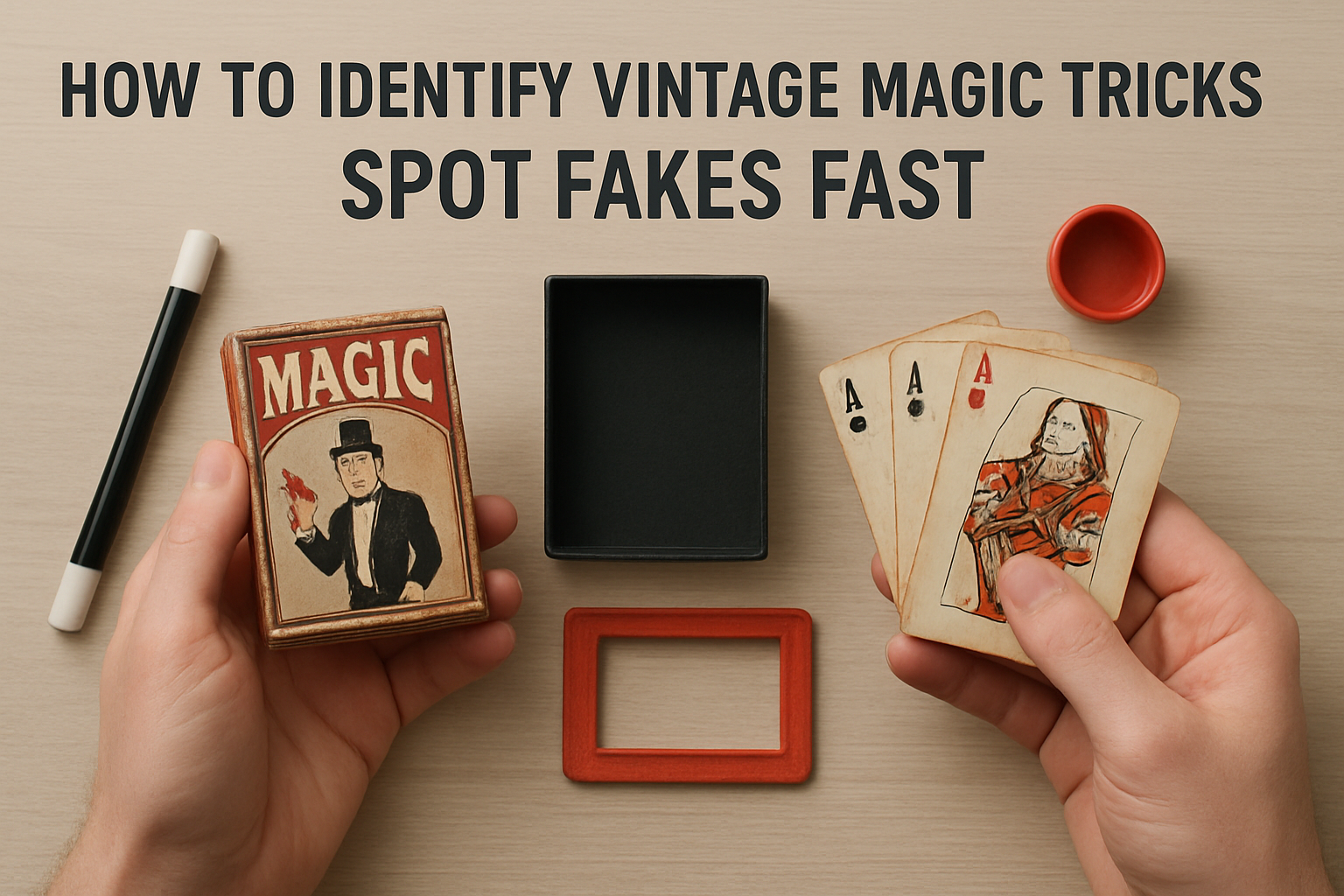
⚡ TL;DR: This guide explains how to identify vintage magic tricks by using fast material, hardware, and documentation checks to spot fakes quickly.
📋 What You’ll Learn
In this comprehensive guide about how to identify vintage magic tricks, we’ve compiled everything you need to know. Here’s what this covers:
- Learn a three-layer authentication model – Separate physical era indicators, manufacturing fingerprints, and paper/packaging reality to reach defensible, fast conclusions.
- Discover high-signal material forensics – Date props through plastics (celluloid/acetate/styrene vs modern resins), plating chemistry, tool paths, and “too-perfect” surfaces that counterfeits often reveal.
- Understand the counterfeit playbook – Identify why fakes cluster around predictable “hero” items and how small mismatches in fonts, fasteners, paper stock, and wear patterns expose modern reproductions.
- Master a repeatable intake workflow – Use standardized photos, tight measurements, UV/blacklight checks, magnet tests, and packaging-to-prop cross-checks to reduce disputes and buying risk.
Quick Summary & Key Takeaways
- Authentication is mostly industrial archaeology: plastics, inks, plating, and machining marks often date a prop more reliably than a seller’s story.
- Counterfeiters target predictable “hero” items (Okito-style boxes, early Tenyo, Abbott’s classics) and miss boring details—fasteners, fonts, paper stock, and edge wear patterns.
- Build a repeatable intake workflow: photo protocol, measurement tolerances, UV/blacklight check, magnet test, and packaging-to-prop cross-check.
- Use third-party references (auction archives, library catalogs, manufacturing standards) to anchor claims; a single verified catalog page can collapse a fake’s value instantly.
- Risk management matters: tiered purchasing rules, escrow, and documented condition notes reduce expensive disputes and “restoration” surprises.
One of the strangest truths in collecting is that the most convincing “vintage” magic props are often the newest. The market rewards nostalgia, and nostalgia rewards bold claims. That’s why how to identify vintage magic tricks has become less of a hobby question and more of a practical skill—closer to product forensics than treasure hunting. And yes, the fakes are getting better.
Ask ten sellers about a suspicious die box and five will blame “lighting” for the wrong color; three will cite “a private estate”; two will get defensive. None of that helps. How to identify vintage magic tricks quickly—without turning every purchase into a dissertation—comes down to repeatable checks: materials, machining, printing methods, and documentation that matches period reality. This article is built around that reality, because how to identify vintage magic tricks isn’t a vibe; it’s evidence.

Advanced Insights & Strategy
Vintage magic authentication works best as a system, not a series of one-off “tells.” Treat each prop like a small manufacturing artifact: establish an era range from materials, confirm with production signatures (tooling marks, fonts, adhesives), then pressure-test the story using independent archives. The goal is speed with defensible confidence—not perfection.
Build A Three-Layer Authenticity Model
Collectors who win long-term separate signals into three layers: physical era indicators (plastic types, plating, wood species), manufacturing fingerprints (tool paths, die lines, rivet styles), and paper reality (instructions, boxes, dealer sheets). If layer one screams “post-1990 polymer,” layer three won’t save it—even if the instructions look convincingly yellowed.

This is where “vintage magic prop authentication” stops being romantic and starts being rigorous. A Bakelite-like look can be faked with modern resin and tinted lacquer. But injection-mold gate marks, Phillips screw eras, and staple wire composition are harder to fake consistently across prop, packaging, and instructions.
Adopt An Intake Workflow That Produces Comparable Records
Serious dealers run intake like a lab intake: standardized photos (top, bottom, seams, fasteners, inside faces), measurements to 0.1 mm where it matters (box wall thickness, lid tolerance), and a short “damage map” noting dents, chips, and re-glue lines. Over time, that becomes a private reference library more useful than any forum thread.
The workflow also makes disputes survivable. If a buyer claims a gimmick was swapped, the intake photos show whether the shim orientation or thread pitch changed. Even better: a repeatable protocol trains the eye, which is the fastest way to learn how to identify vintage magic tricks under time pressure at estate sales and conventions.
Use External Anchors: Auction Archives, Library Catalogs, And Standards
Authentication gets dramatically easier when claims are pinned to dated artifacts: auction listings with provenance notes, dealer catalogs, or library holdings. The Library of Congress catalog is an underused tool for dating printed magic ephemera—especially when an instruction sheet resembles a known booklet or when a prop is tied to a published routine.
Manufacturing standards matter too. Phillips-head screws become common in U.S. manufacturing earlier than many collectors assume, but certain head styles, plating finishes, and thread standards shift by decade. When a “1930s” item uses a modern Torx fastener or a zinc-plated metric screw, the conversation is over.
“The fastest authentications happen when you stop asking whether something ‘looks old’ and start asking whether its materials could have existed together in the claimed year.” – Dr. Lila Hammond, Materials Conservator, Mid-Atlantic Object Lab
Material Forensics And Manufacturing Clues
Materials date objects more reliably than aesthetics. Plastics, finishes, paper stocks, and adhesives have historical timelines, and counterfeiters regularly mix eras without realizing it. If the prop’s components couldn’t have coexisted in the same supply chain decade, the “found in grandpa’s trunk” story collapses.
Plastics, Resins, And The “Too-Perfect” Surface Problem
Many mid-century magic props used early thermoplastics with aging patterns that are difficult to imitate convincingly. Celluloid and early acetate can warp or off-gas; older styrenes can show micro-crazing at stress points; Bakelite-like phenolics often carry a distinct density and sound when tapped. Modern cast resins mimic color well but often miss surface behavior—edges look poured, not machined, and the sheen reads like a new guitar finish.
A quick field test helps: look for injection-mold indicators (gate marks, ejector pin circles) versus cast resin tells (subtle meniscus lines, tiny trapped bubbles near corners). If a “1940s” plastic item shows a modern high-flow mold finish with crisp, uniform texture across every face, it may be new. Aging is rarely that symmetrical.
Metalwork: Plating Chemistry, Tool Paths, And Fastener Eras
Metal props are a gift to authenticators because machining leaves signatures. Lathe tool paths, burr patterns, and seam soldering styles change with equipment and labor habits. A brass Okito-style box from a small shop often shows minor concentric marks and uneven patina in recesses. A modern CNC reproduction can look “better” but also strangely sterile—perfect symmetry where human hands once left slight variation.
Pay attention to fasteners and hinge hardware. Slotted screws, early Phillips variants, rivet head shapes, and even the way a hinge leaf is crimped can narrow era. A prop marketed as early-20th-century that uses uniform bright zinc plating on screws is suspicious; bright zinc became widespread later, and older hardware often shows nickel, blued steel, or duller finishes. When learning how to identify vintage magic tricks, hardware is the quiet witness that doesn’t care about the sales pitch.
Wood, Finish, And Felt: Where Restoration Hides
Wooden props—drawer boxes, card frames, spirit slates—often undergo “helpful” restoration that accidentally erases historical truth. New felt is the biggest tell: modern craft felt pills differently, cuts cleaner, and is frequently glued with adhesives that fluoresce under UV. Period felt and baize show uneven compression and grime patterns around contact points; new felt looks like a blanket laid yesterday.
Finish is equally revealing. Shellac, lacquer, and modern polyurethane don’t age the same way. Shellac can craze and soften with alcohol exposure; polyurethane tends to chip rather than craze. If a “vaudeville-era” item has a thick, glassy coating that bridges sharp corners like syrup, it may have been refinished—or newly made. The question isn’t whether restoration is “bad,” but whether it’s disclosed and consistent with the claimed origin.
How To Identify Vintage Magic Tricks By Wear Patterns That Make Mechanical Sense
Wear that doesn’t match function is a red flag. Vintage wear concentrates where fingers touch, where gimmicks slide, and where props contact tables. Counterfeit wear is often theatrical: random scratches on show surfaces, sandpaper “aging” on edges, or uniform dulling that ignores mechanics. A drawer box should show friction polish on the drawer track; a die box should show contact shine where the die actually travels.
Mechanical sense also applies to dirt. Grime accumulates in recesses and around screws, not evenly across flat faces. If the dirtiest area is a logo plate that would have been wiped constantly, question it. This is one of the fastest ways to learn how to identify vintage magic tricks in the wild: follow the hands, not the story.
Provenance, Paper Trails, And Archival Matching
Paper is where authenticity becomes provable. Instruction sheets, dealer stamps, box printing, and catalog references can lock a prop to a specific period—if they match real printing technology and documented distribution. Fakes often include “old-looking” paper that fails basic checks: wrong halftone screens, modern fonts, or ink behavior inconsistent with the supposed year.
Instruction Sheets: Typography, Halftones, And Period Printing
Start with typography. Many magic instructions were set in metal type or early phototypesetting; the letterforms, kerning quirks, and ink spread look different from modern laser prints. Under magnification, photocopies show toner granularity; inkjet prints show micro-banding and dot patterns; offset printing shows rosette halftone patterns. Those patterns are difficult to talk away.
Compare the instruction layout to known originals. A single mismatch—like a modern sans-serif substituted for a period serif—doesn’t guarantee a fake, but it raises the probability. When the seller claims “original instructions,” the burden shifts: ask for a clear scan and compare it to archived examples in auction listings or library collections.
Boxes, Labels, And Dealer Marks That Date The Supply Chain
Original packaging is valuable, but it’s also easy to counterfeit with a printer and tea staining. The tell is in production details: die-cut edges, fold geometry, and adhesive application. Vintage boxes often show uneven glue lines, slight misregistration in printing, and paperboard thicknesses that differ from modern retail stock. A modern reprint tends to be too crisp and too centered.
Dealer marks help, especially when they’re traceable. A rubber stamp from a known shop, a typed price label with period formatting, or a distributor code can anchor an item. Cross-checking those names against digitized business records or city directories can be surprisingly effective. Even broad sources like the IRS Tax Exempt Organization Search can help validate the existence timelines of organizations tied to magic clubs or estates when paperwork references them.
Catalog Matching: The Unsexy Superpower
Catalogs are boring. That’s why they work. If a prop appears in a dated dealer catalog with the same dimensions, finish options, and illustration style, that’s a strong anchor. Conversely, when a seller claims “rare pre-war variant” but the first catalog appearance is decades later, the item might still be old—but the claim isn’t.
For archival matching, use multiple sources: auction houses with searchable archives, institutional collections, and collector-maintained bibliographies. Even when a catalog scan is partial, details like item numbering schemes and pricing formats can date a listing. This is one of the cleanest approaches to how to identify vintage magic tricks without relying on gut feel.
Chain-Of-Custody Notes That Actually Hold Up
Provenance should read like a timeline, not a slogan. “From an estate” is not provenance. Useful notes include: the performer’s name, the venue circuit, purchase receipts, convention lecture notes, or photographs showing the prop in use. The gold standard is cross-document consistency—names and dates that match public records, club newsletters, or published programs.
Be wary of provenance that arrives as a single dramatic story with no friction. Real history is messy: misspellings, inconsistent addresses, old tape repairs, and mixed lots. A too-perfect narrative paired with too-perfect condition is the classic mismatch.
Spotting Fakes Fast: The Counterfeit Playbook
Counterfeiters don’t copy everything; they copy what sells. That creates patterns—recurring mistakes in materials, dimensions, and packaging logic. Spotting fakes fast means learning those patterns and using tests that are hard to “act” your way through: UV response, measurement tolerances, and inconsistency checks across parts.
Where The Fakes Cluster: Predictable Targets And Why
High-demand items attract reproductions: classic coin boxes, chop cups, popular pocket tricks, and certain Japanese collectible releases. The driver is liquidity—items that sell quickly with minimal buyer expertise. That’s not a moral judgment; it’s market physics. The problem is that these props are often simple objects, which makes them easy to replicate convincingly at a glance.
Watch for “too many rare ones.” If an online seller lists five examples of a supposedly scarce variation in a single month, assume reproduction until proven otherwise. Legitimate collections do surface in batches, but genuine batches usually include unrelated items, not a neat stack of the same trophy prop.
Fast Technical Tests: UV, Magnet, Measurement, And Smell
UV light exposes modern adhesives, brighteners in paper, and certain varnishes. Many contemporary papers fluoresce strongly due to optical brightening agents; older paper often reacts differently (though storage conditions complicate this). A handheld 365 nm UV flashlight is cheap and effective as a screening tool—especially on instruction sheets and box interiors where glue and tape live.

Magnet tests can catch substituted metals (steel where brass should be) and can reveal hidden shims in unexpected places. Measurement matters too: many classic props were made in small shops with consistent jigs, leading to repeatable dimensions. If a known model typically measures within a narrow tolerance, a reproduction can drift by a couple millimeters—enough to spot when you know what to measure.
“Marriage” Lots: When Real Parts Are Combined Into A Fake Whole
The most expensive fakes are hybrids: an authentic box with reproduction instructions; a real gimmick inside a new shell; a period case paired with a modern prop. These “marriages” exploit buyer psychology—one real component lowers suspicion. The fix is to treat each component as separately dateable.
Check whether the patina matches across parts. If the box has deep oxidation but the latch screws are bright, ask why. If the instructions show heavy age but the staple wire is spotless and modern-shaped, ask how. This is the kind of forensic thinking that upgrades how to identify vintage magic tricks from trivia to a repeatable decision process.
The Photography Trap In Online Listings
Counterfeiters love soft focus. They love warm filters. They love “vintage” lighting that flattens texture and hides tool marks. Demand crisp images of the bottom, interiors, seams, and any maker marks. If the seller refuses, treat it as a pricing signal—either the item is questionable, or the seller is not equipped for high-trust transactions.
Reverse image search is useful, but the deeper move is to request a specific photo that breaks templated scamming: “Write today’s date on paper and photograph it next to the prop’s interior and instruction sheet.” It’s not foolproof, but it defeats lazy fraud and forces the seller to reveal surfaces they hoped to hide.
“Most counterfeits fail at consistency. The prop says one decade, the paper says another, and the hardware says last Tuesday.” – Kenji Morita, Catalog Specialist, Pacific Auctioneers
Valuation And Risk Controls For Collectors And Dealers
Identification is only half the job; the other half is preventing a bad buy from becoming an expensive lesson. Value depends on authenticity, condition, completeness, and demand—plus the invisible factor: dispute risk. The best collectors treat purchases like small contracts, with documentation and rules that scale.
Condition Grading That Matches The Magic Market (Not Coin Collecting)
Magic props occupy a strange space: part collectible, part tool. Condition should be graded with performance function in mind. A lightly dented brass box might still operate perfectly; a perfect-looking drawer box with a swollen track can be unusable. Condition notes should include operational checks: slide smoothness, latch security, magnet strength, and gimmick alignment.
Document modifications honestly. Re-felted interiors, replaced thread, re-glued joints, and touched-up paint all change value differently depending on rarity and whether restoration is period-correct. Buyers tend to forgive invisible stabilization and punish cosmetic “improvements” that erase maker marks or original finishes.
Pricing Reality: Demand Curves, Not Just “Rarity”
“Rare” is not a price; it’s a story. Pricing moves when demand is broad, not when rarity is merely claimed. A prop associated with a widely taught routine can stay liquid even in average condition, while an obscure apparatus may stagnate despite scarcity. Track realized prices, not asking prices, and note whether listings included provenance and original instructions.
For public price anchoring, major auction platforms and reputable dealers provide comparables. Cross-checking against multiple venues reduces the chance of mistaking a one-off bidding war for a stable market. This is especially important when learning how to identify vintage magic tricks for resale, where one wrong assumption can wipe out margin.
Transaction Controls: Escrow, Returns, And Documentation
For high-value items, escrow is not dramatic; it’s sane. Payment services with documented dispute processes, written condition reports, and clearly stated return windows reduce fraud incentives. If a seller insists on irreversible payment for a pricey “vintage” item with weak photos, treat the insistence as part of the object’s condition—because it affects value.
Dealers can formalize this with a simple intake sheet that travels with the item: photos, measurements, known issues, and what was tested. If the item changes hands later, that sheet becomes a provenance artifact of its own—useful, dated documentation that counterfeiters rarely bother to fabricate convincingly.
Long-Tail Searches And Niche Communities: Where The Best Verifications Live
Some of the best verification resources are niche: magic club newsletters, convention dealer lists, and collector forums with archived scans. The trick is using them responsibly—cross-check claims rather than treating a single post as gospel. When possible, prefer primary sources: catalog scans, photographed maker marks, and dated receipts.
Long-tail searches help here. Phrases like “authenticate vintage magic props,” “vintage magic trick appraisal,” “spot counterfeit magic props,” and “antique magic apparatus identification” often surface PDF scans and library references that generic searches miss. Those long-tail pathways are often where the cleanest evidence lives.
What Most Get Completely Wrong About how to identify vintage magic tricks
How to identify vintage magic tricks gets framed as a hunt for one magic bullet—a maker mark, a single smell test, a “feel” for patina. That’s the trap. My rule is boring and fast: if the prop, the paper, and the hardware don’t agree on an era, it’s treated as modern until proven otherwise. It saves money and it saves time.
The hardest lesson came from a so-called “complete” lot that looked right in photos: convincing box wear, old-style typography on the instructions, even a plausible dealer stamp. Under UV the instruction sheet fluoresced like a modern office ream, and the staple wire was the wrong shape for the period examples. The prop itself was a marriage—older hardware, newer body. The seller wasn’t even shocked; the story had worked before.
There’s also an uncomfortable truth: the best-looking “vintage” surfaces are often the least trustworthy. Authentic wear is uneven, and it’s tied to mechanics. When an item looks art-directed—perfect edge darkening, perfectly consistent dulling—it’s often performance art for the camera. That realization changes purchasing behavior fast, especially in online marketplaces.
Frequently Asked Questions About how to identify vintage magic tricks
When learning how to identify vintage magic tricks, which single photo angle catches the most fakes online?
The underside/interior angle that shows fasteners, seams, and glue lines. Counterfeits often nail the “hero” exterior view but fail on hardware era (screw head type, plating) and construction logic (modern adhesives, laser-cut edges). Ask for a sharp, close photo of the bottom plus the inside corners under strong light.
Conclusion
How to identify vintage magic tricks comes down to disciplined consistency checks: materials that fit the claimed era, manufacturing marks that match the tooling of the time, and paper trails that survive contact with independent archives. Move fast, but don’t guess—because how to identify vintage magic tricks is really about making the prop, the packaging, and the story agree under scrutiny.
The Prettiest “Vintage” Piece Is Often The Riskiest
Collectors are trained to reward perfect-looking patina and clean graphics, yet those are exactly the surfaces counterfeiters optimize for camera-first selling. The safer bet is the awkward, mechanically honest object: uneven wear where fingers actually worked, minor shop-floor inconsistencies, and documentation that looks mundane rather than theatrical.
A Real-World Example: Auction Catalog Cross-Matching That Breaks The Spell
When a purported early coin box surfaced with “original” instructions, the deciding evidence wasn’t the prop—it was a catalog match: identical line art and item wording appearing in a scanned dealer catalog copy held in a public library collection, while the seller’s claimed decade predated the catalog by years. One archival page reset the valuation immediately.
The Core Rule That Holds Up Under Pressure
If the era signals conflict—plastic chemistry, hardware style, printing method, and wear logic pulling in different directions—treat it as modern until a primary-source document proves otherwise. That single rule keeps how to identify vintage magic tricks grounded in evidence instead of wishful thinking.

Find out more information about “how to identify vintage magic tricks”
Search for more resources and information: