






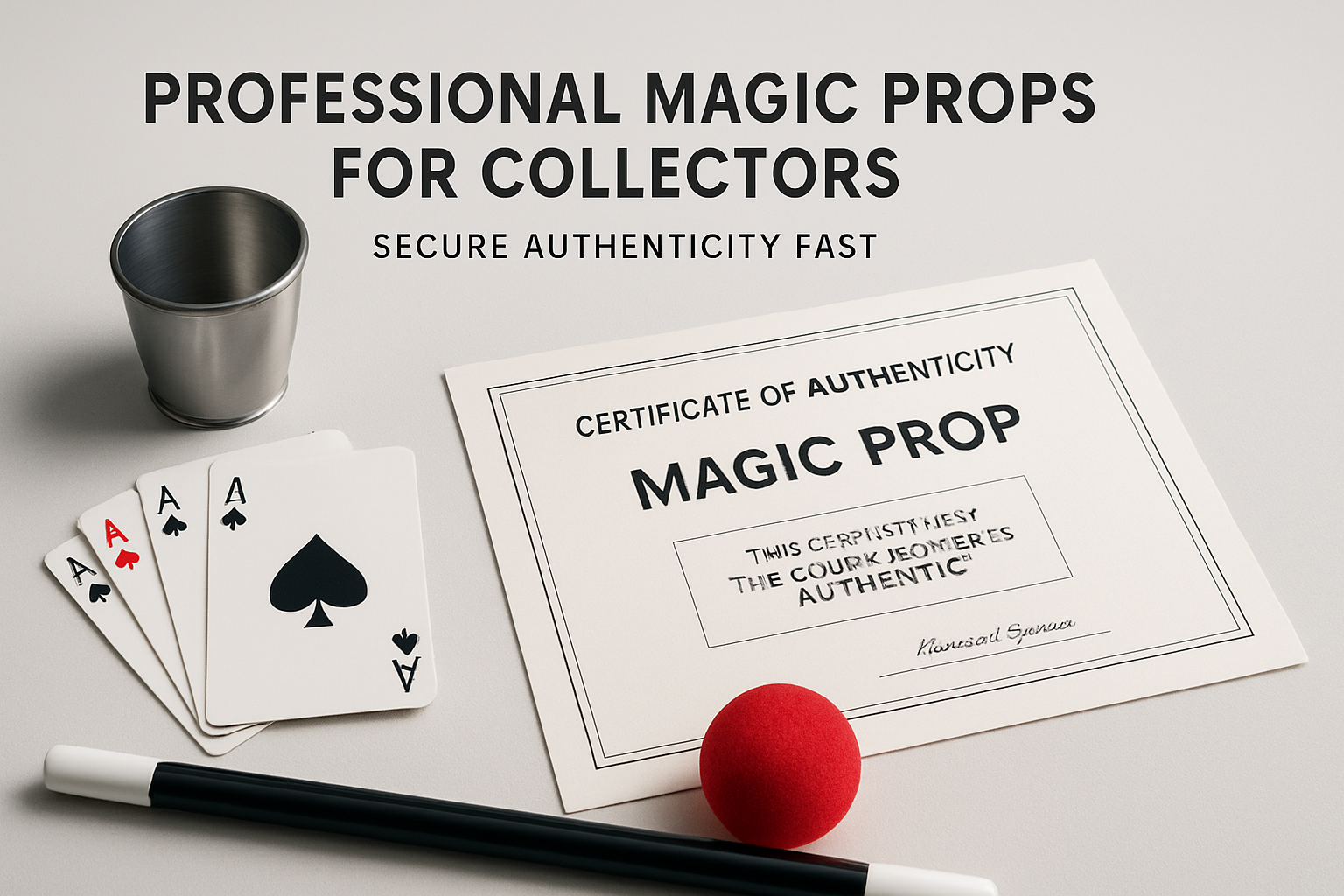
Professional Magic Props For Collectors: Secure Authenticity Fast — A Field Guide To professional magic props for collectors
⚡ TL;DR: This guide explains how to authenticate professional magic props for collectors fast using forensics-first checks, maker signals, and chain-of-custody proof.
📋 What You’ll Learn
In this comprehensive guide about professional magic props for collectors, we’ve compiled everything you need to know. Here’s what this covers:
- Fast authentication workflow – Learn why the winning sequence is materials forensics first, maker provenance second, and documented chain of custody third to avoid story-driven misbuys.
- Collector-grade “prop passport” documentation – Discover how photo baselines, micro-mark mapping, component-level manifests, and conservation-style condition grading speed up verification and resale.
- High-risk purchase patterns and pricing uncertainty – Understand why “parts-built” illusions, re-skinned gimmicks, and undocumented estate lots concentrate fraud risk, and how to apply a consistent risk multiplier to price unknowns.
- Care, restoration, and insurance that protect value – Master why fine-arts conservation methods, reversible repairs, and restoration documentation preserve authenticity, insurability, and long-term collectible value.
Quick Summary & Key Takeaways
- Fast authenticity checks hinge on a tight triad: materials forensics, maker provenance, and a documented chain of custody—run in that order, not the other way around.
- Collector-grade verification is increasingly operational: photo baselines, micro-mark mapping, component-level manifests, and condition grading that reads like a conservation report.
- High-risk buys cluster around “parts-built” illusions, re-skinned gimmicks, and undocumented estate lots; the smartest buyers price uncertainty explicitly.
- Insurance and restoration can destroy value if handled like theater maintenance; fine-arts methods and conservator documentation keep collectibles collectible.
One of the strangest frictions in the magician economy is that professional magic props for collectors can trade like fine art, but they’re still judged like stage gear. That mismatch creates fast money for the wrong people: re-skins, Frankensteined gimmicks, and “replicas” sold with just enough lore to pass a late-night DM negotiation. For professional magic props for collectors, authenticity is less a vibe than a workflow—and the buyers who win are the ones who can authenticate professional magic props for collectors in minutes, not weeks.
The trade has also become more document-driven than many performers admit. A single high-resolution underside photo of a Thayer baseboard, the rivet spacing on an Owen cabinet hinge, the exact silk-screen dot pattern on a Johnson Products label—those can settle arguments faster than any story about “a guy in Vegas.” Collectors pursuing professional magic props for collectors are increasingly building internal “prop passports,” borrowing techniques from museum cataloging, luxury resale, and even supply-chain auditing. It sounds clinical. It’s also how authenticity gets secured fast.

Advanced Insights & Strategy
Speed comes from pre-commitment: define what “authentic” means for each category (apparatus, close-up gaffs, mentalism electronics, posters, ephemera), then apply a repeatable verification stack. The stack starts with physical signals, moves to documentary proof, and only then considers seller reputation. That order prevents charisma from overriding evidence and keeps fast decisions defensible.
Build A Two-Layer Authenticity Stack: Forensics First, Narrative Second
Collectors who move quickly tend to run a two-layer stack. Layer one is “object truth”: materials, tooling marks, construction logic, and component genealogy (which parts could plausibly exist together). Layer two is “market truth”: invoices, builder correspondence, lecture notes, old ads, and ownership transfers. When layer one fails, layer two becomes a red flag—not a rescue.

This is how luxury authentication scaled: rely on repeatable object-level cues before seller stories. The same mental model applies to props. A Mak Magic cabinet with hardware from a modern big-box hinge line is not “restored”; it’s materially inconsistent unless documented as a sanctioned rebuild. Treat those inconsistencies the way a watch collector treats a swapped dial: not automatically worthless, but priced and labeled differently.
Adopt A “Component Manifest” Mindset (Borrowed From Aviation MRO)
Serious collections increasingly track component manifests: what is present, what is replaced, and what is reversible. For complex apparatus—Sub Trunks, Blammo-style production boxes, levitation bases—manifesting matters because “complete” is not binary. A missing key, shim, thread path guide, or original blackout cloth can change the method, not just the display value.
In aviation maintenance, MRO logs are value. In magic collecting, a simple manifest can function similarly: parts list, materials notes, photos, and condition grades. It also makes insurance straightforward and reduces disputes when selling. When a buyer can see the exact magnet placement, latch brand, and internal baffle geometry, negotiation becomes calmer—and faster.
Price Uncertainty Explicitly Using A Risk Multiplier
High-end magic is thinly traded; that makes it emotional, and emotions tend to ignore risk. A practical counterweight is a risk multiplier: a percentage discount applied to the price based on unknowns. Unknown builder? Discount. Unverifiable chain of custody? Discount. Repaint with no restoration photos? Discount. The multiplier turns suspicion into a number, which turns arguments into math.
In parallel markets (fine art, collectibles, luxury handbags), pricing uncertainty is routine. The trick is consistency: apply the same multiplier rules whether the seller is a friend, an auction house, or a legend’s estate. That’s the difference between a collector and a fan with a storage unit.
“In collectibles, speed doesn’t come from trusting people faster. It comes from reducing the number of unknowns you tolerate per transaction.” – Dr. Lena Harrow, Director Of Collections Systems, Northbridge Museum Services
Authentication Fast Lane For Professional Magic Props For Collectors
Fast authentication is a repeatable triage: identify the maker signal, verify era-correct construction, and confirm the method-critical geometry. The goal isn’t to become a forensic lab; it’s to eliminate the common fakes and misattributions quickly, then escalate only the rare edge cases. That’s how professional magic props for collectors get vetted at the speed of modern deals.
Professional Magic Props For Collectors: Maker Signals That Survive Time
The best maker signals are the ones restorations don’t erase. On vintage apparatus, look for joinery and internal blocking rather than paint. Thayer pieces often reveal consistent interior bracing logic; Owen Magic Supreme builds tend to show disciplined cabinetry and hardware alignment; Nielsen’s work often has a distinct utilitarian precision. Even when exteriors are repainted, interior construction tells on the maker.
Close-up gaffs have their own tells. Johnson Products and Tango-style coin work can sometimes be differentiated by edge profiles and finishing patterns under magnification. For precision-machined props, measure diameters and tolerances—cheap reissues frequently miss the “feel” because they miss the numbers. A $25 digital caliper and a jeweler’s loupe outperform most seller stories.
Professional Magic Props For Collectors: Materials Forensics Without A Lab Coat
Materials analysis can be simple and still decisive. UV light reveals overpainting and adhesive residues. A magnet test helps detect hidden steel where brass should be, especially on gimmicked latches or shells. Wood identification is often overlooked: plywood era, veneer thickness, and staple types can narrow a build period. Even the smell of certain finishes (shellac vs. modern polyurethane) can be informative—then documented with photos and notes rather than treated as folklore.
For printed ephemera—posters, instructions, labels—paper and ink clues matter. Under magnification, modern digital printing has a different dot structure than older offset and letterpress. That difference is not subjective; it’s visible. A cheap USB microscope can document it. Collectors who build a reference gallery of known-original print textures can validate new acquisitions in under five minutes.
Method-Critical Geometry: When Measurements Beat “It Plays Great”
Some props are faked by building something that looks right but cannot function with the original method. That’s where method-critical geometry comes in: dimensions, clearances, load paths, and sightline management. In a production cabinet, interior baffle spacing and trap alignment matter. In a substitution trunk, lid geometry and hinge placement determine whether the switch can be executed under performance timing.
Quick checks: measure the diagonals to see if a box is square; misalignment can indicate a non-original rebuild. Photograph hinges and latches at close range; compare screw head styles and spacing to period-correct examples. If a prop’s method depends on a specific weight distribution (common in self-contained electronics and mechanical gimmicks), do a careful weigh-in and note it in the prop passport.
Provenance, Chain Of Custody, And Paperwork That Actually Matters
Provenance is not “a cool story.” It’s a set of verifiable claims: who built it, who bought it, who used it, and how it moved between hands. For collector-grade pieces, paperwork that doesn’t connect to the object’s physical reality is decoration. The fastest authenticity wins happen when documents and object-level evidence reinforce each other tightly.
Prop Passports: The Collector Document That Stops Future Disputes
A prop passport is a single record that travels with the item: high-res images of all sides, interiors, and mechanics; measurements; weight; known repairs; and a timeline of ownership with evidence. Keep it digital (PDF + photo folder) and print a summary sheet for storage. The goal is to prevent the classic “it came from an estate” fog from swallowing value over time.
For working pros who also collect, prop passports do double duty. They simplify touring logistics, customs declarations for international travel (where relevant), and claims if theft occurs. They also make resale cleaner. Buyers of rare professional illusion equipment increasingly expect this level of documentation, the same way watch buyers expect service records.
Letters, Invoices, And Build Sheets: What Counts, What Doesn’t
Invoices from known builders (Owen, Chalet, Bill Smith Customs, Wellington Enterprises) are high-signal, especially when they include specs. Builder correspondence—emails, letters, workshop notes—can be strong if it references identifiable marks on the piece. “Certificate of authenticity” cards without cross-references are weak; they’re easy to print and rarely anchored to the object.
A practical test: can the document be used to predict something verifiable about the object? If a build sheet says “brass corner guards, 1/2-inch birch ply, magnetic lock,” and the object matches, confidence rises. If paperwork makes claims that can’t be checked—“one of one,” “special build,” “museum quality”—it’s marketing copy.
Chain Of Custody Like A Supply Chain: Timestamps Or It Didn’t Happen
Chain of custody is easiest when treated like supply chain. Each transfer should have a timestamped record: invoice, auction lot sheet, shipping label, or at minimum a dated email thread that includes identifying photos. That’s not paranoia; it’s standard in high-value collectibles where disputes and chargebacks exist.
For 2026 context on how authentication and provenance are being operationalized in adjacent markets, the broader resale economy has pushed hard toward verification workflows. The U.S. Federal Trade Commission’s 2026 enforcement posture on deceptive online commerce is summarized in its consumer protection updates at https://www.ftc.gov/, a useful barometer for why sellers are being forced to document claims more carefully across categories.
“Documentation that doesn’t attach to a physical identifier is just a story with letterhead.” – Marcus Vellum, Senior Appraiser, Carroway Collectibles & Estate Services
Where The Risk Actually Lives: Marketplaces, Auctions, And Private Rooms
The same prop can be safe in one channel and radioactive in another. Risk is not only about dishonesty; it’s about incentives, inspection access, return policies, and how quickly a bad item can be flipped. Understanding market structure—auctions vs. forums vs. private brokered sales—helps buyers of professional magic props for collectors decide when to move fast and when to slow down.
Auctions: The Comforting Theater Of Catalog Copy
Auction listings often read confident even when attribution is thin. That’s not always malice; consignors provide information, and auction houses compress it into a story that sells. The issue is that “Attributed to” and “From the collection of” can be interpreted as certainty by a bidder scanning at speed. Condition reports can also be light on method-critical internals, because the catalog is built to be legible to non-magicians.
For high-value lots, request additional images of interiors, undersides, and joins—specifically the places restorations hide. Ask whether the auction can provide provenance documents as digital files prior to bidding. If the answer is “available upon request after the sale,” treat that as a risk flag and adjust bids accordingly.
Forums And Social Groups: Fast Deals, Thin Recourse
Private sales in magician groups and collector forums are efficient: fewer fees, faster negotiations, and insider access to rare pieces. They also tend to run on informal trust systems—vouches, reputation, and years of presence. That works until it doesn’t, and then the recourse is social, not contractual. In 2026, payment platforms and chargeback policies still matter; structure the deal to keep proof trails intact.

Use a written bill of sale that includes identifying marks and an explicit statement of what is original vs. replaced. Attach photos in the same thread as the agreement. If the item is being sold as builder-original, specify that in writing. The goal isn’t hostility; it’s clarity. Clarity keeps communities healthy and protects legitimate sellers from future misunderstandings.
Dealers And Brokers: When Paying A Premium Buys Process
Specialist dealers can be worth the premium when they provide process: pre-sale inspection, documented restorations, and a return window. The best dealers behave like professional resellers in other verticals—grading standards, detailed photos, and consistent terminology. The worst simply repackage private-sale sourcing with a markup and a glossy web page.
A quick dealer litmus test: ask for the prop passport or an equivalent. Ask what their inspection checklist includes (hardware verification, electronics testing, internal photo set). If the answer is fuzzy, the premium is mostly for convenience, not reduced risk. For buyers focused on stage-used magic collectibles, reduced risk is what should be purchased, not just access.
Care, Restoration, And Insurance For High-Value Apparatus
The collector value of a prop is often destroyed by “improvements.” Repainting without documentation, swapping hardware for modern convenience, or re-wiring electronics without preserving original routing can turn a historically important piece into a pretty unknown. Conservation-grade care keeps professional magic props for collectors stable, insurable, and liquid.
Restoration Vs. Conservation: The Decision That Changes Everything
Restoration aims to return an object to a prior look; conservation aims to stabilize while preserving evidence of age and original work. In magic collecting, conservation tends to protect value better because it keeps maker signals intact: paint layers, tool marks, period hardware, and original fabric choices. A flawless new coat may read “professional” onstage but can read “erased history” to a collector.
If restoration is necessary—for example, structural repair or safety—document it like a museum treatment report: before photos, materials used (brand and type), dates, and who performed the work. Keep removed parts when practical, labeled and bagged. That documentation becomes part of the prop’s provenance and can prevent value compression at resale.
Insurance That Understands Magic Props (And Doesn’t Treat Them Like Party Supplies)
Standard homeowners riders often under-describe specialty property. For high-value apparatus, seek scheduled coverage with itemized descriptions and valuation support. Provide the prop passport, purchase records, and independent appraisal where needed. Insurance adjusters move faster when the file looks like a fine-arts submission rather than an anecdote.
Claims also hinge on proof of existence and condition prior to loss. A dated photo set stored offsite (cloud + local) is simple and effective. If pieces are toured, keep travel logs and venue contracts; they can support location-based risk and theft claims. This is boring work—right up until it’s the only work that matters.
Storage And Handling: Small Habits That Preserve Big Value
Humidity and temperature swings can warp wood, loosen joints, and degrade adhesives. Use stable shelving, avoid direct contact with concrete floors, and store textiles in acid-free materials. Label cases and components so parts don’t get “organized” into oblivion. For electronic mentalism props and vintage illuminated signage, remove batteries and document wiring before any change.
Handling protocols protect finishes and reduce accidental damage. Cotton gloves are not always ideal (they reduce tactile feedback); clean hands can be safer for certain tasks, while nitrile gloves help around metals and oils. What matters is consistency and documentation: note condition changes, photograph wear, and treat the collection like a cataloged system, not a closet of surprises.
What Most Get Completely Wrong About professional magic props for collectors
I’ve watched smart buyers lose money because they chased “rarity” before they nailed identity. My hard rule: rarity is a multiplier, not a foundation. If the builder attribution is shaky, the method can’t be verified, or the internals don’t match the claimed era, “rare” becomes a sales tactic—and the price floats free of reality.
One deal still sticks: a supposedly maker-original close-up gaff set offered at a premium because it “came from a respected performer’s circle.” The exterior looked perfect. Under magnification, the machining marks and edge finishing were inconsistent with the claimed maker’s known runs, and the weight was off by a few grams per piece. Passing saved weeks of drama and a resale haircut that would have been brutal.
Another trap is confusing stage readiness with collector correctness. I’ve seen props “upgraded” with modern latches, new velvet, and reinforced corners—great for touring, terrible for historical integrity. When the goal is professional magic props for collectors, the win is not the shiniest cabinet; it’s the cabinet that still tells the truth about who built it, when, and why.
Frequently Asked Questions About professional magic props for collectors
How can professional magic props for collectors be authenticated quickly when the exterior has been repainted?
Prioritize interior construction and hardware: brace patterns, hinge hole spacing, latch geometry, and screw head styles. Use UV light to spot layered paint and adhesive residues, then photograph joins and underside boards. Repainted exteriors can hide everything; interiors usually can’t—especially if the prop’s method required fixed clearances.
Conclusion
professional magic props for collectors reward the same discipline found in other high-trust collectible markets: object-level verification, documentary proof that attaches to physical identifiers, and a clear pricing model for uncertainty. The fastest authenticity wins come from repeatable triage—materials, maker signals, then provenance—so professional magic props for collectors stay liquid, insurable, and historically legible instead of becoming expensive mysteries.
The Contrarian Truth: “Stage-Ready” Often Means “Collector-Damaged”
The market still overpays for glossy refurbishments, even though heavy restoration can delete the very evidence that proves maker and era. A slightly worn original finish with intact internals can be worth more than a flawless repaint that erased labels, swapped hardware, and blurred method geometry. Clean isn’t the same as correct.
A Real-World Pattern: How Serious Buyers Close Fast On Documented Pieces
When builders and dealers provide interior photo sets, invoices with specs, and a component manifest, negotiation compresses dramatically because the buyer is no longer buying a story. That same pattern shows up across adjacent verification-heavy markets tracked by regulators like the FTC (https://www.ftc.gov/): documentation lowers friction, reduces disputes, and makes price discovery less emotional.
The Core Rule: Verify The Object Before You Believe The Lore
If the physical evidence can’t support the attribution, treat provenance claims as unpriced risk. Authenticate construction logic, materials, and geometry first; then let documents raise confidence. That one rule keeps collectors from paying museum money for theater-grade replicas.

Find out more information about “professional magic props for collectors”
Search for more resources and information: