





⚡ TL;DR: This guide explains vintage card magic by showing how story-driven “fairness cues,” tight pacing, and fast resets win any crowd in seconds.
📋 What You’ll Learn
In this comprehensive guide about vintage card magic, we’ve compiled everything you need to know. Here’s what this covers:
- Learn conviction-compression set design – Structure vintage card magic into an instant hit, a proof phase, and an impossible closer to generate belief fast in noisy, real-world venues.
- Discover high-clarity fairness cues that survive scrutiny – Use bounded choices (cuts, piles, controlled dealing) that feel expansive to spectators while protecting method reliability and sightlines.
- Understand why “vintage” is a memory strategy, not a prop filter – Prioritize legible conditions, repeatable moments, and provenance-style framing so spectators can retell the effect accurately seconds later.
- Master operational performance for working conditions – Engineer a 20-second reset, pocket workflow, and intentional failure modes so vintage card magic plays consistently across strolling, hospitality, trade shows, and parlor.
Quick Summary & Key Takeaways
- vintage card magic wins fast when the “prop” is a story: period-correct pacing, framing, and fairness cues matter more than antique-looking pasteboards.
- Design sets around reset time, sightline reliability, and spectator memory—not just method strength.
- Use a three-layer structure: instant hit (10–20 seconds), proof phase (30–60 seconds), impossible closer (60–120 seconds).
- Authenticity is a brand asset, but ethics and handling risk are real; protect originals and perform with replicas when needed.
- For working pros, the “vintage” angle performs best as a positioning system across promo, scripting, and sequencing—not as a single trick.
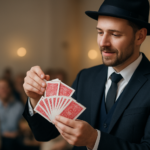
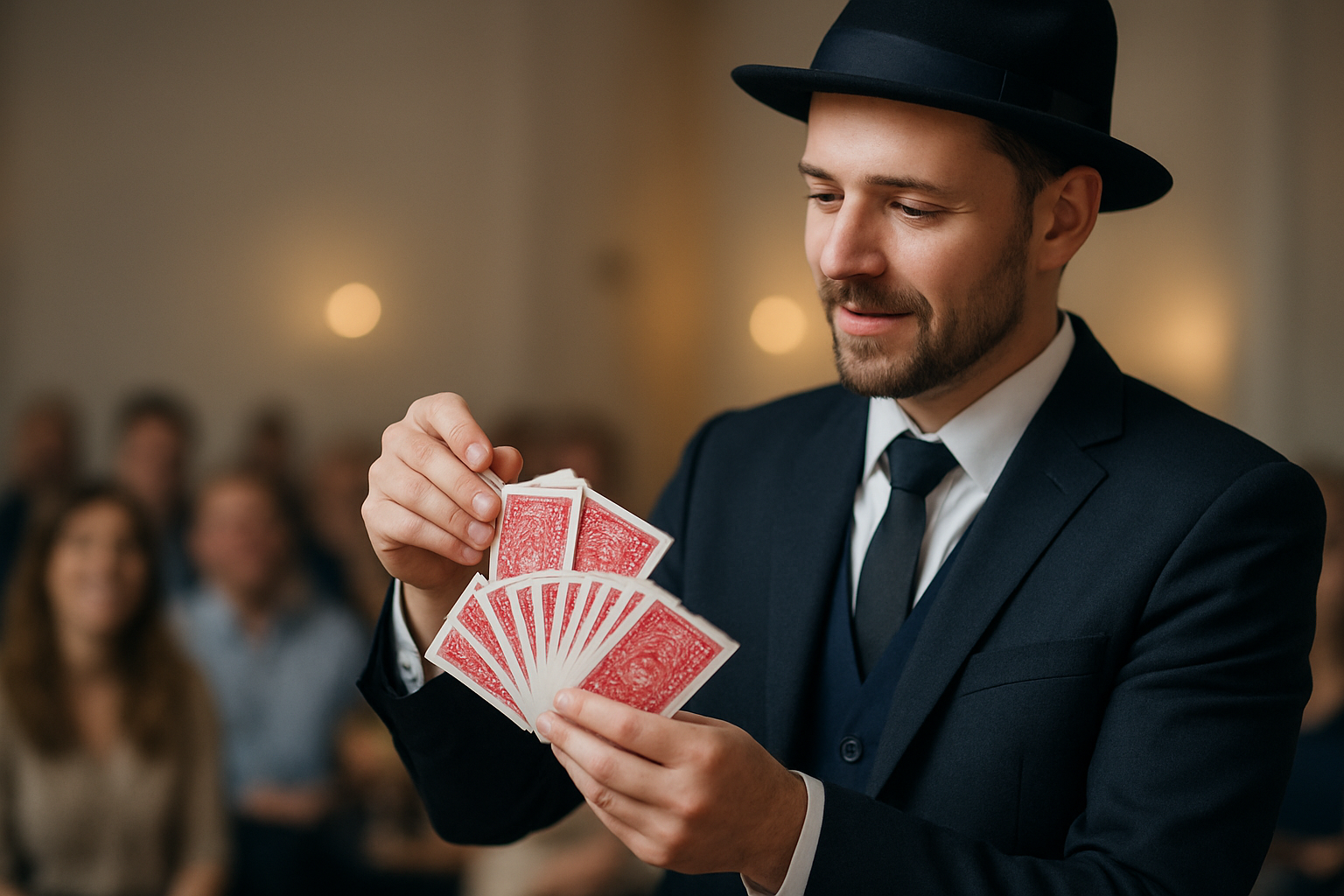
A late-night hospitality suite at a convention: the table is sticky, the lighting is cruel, and the audience has seen every flashy Instagram flourish known to modern cardistry. The act that lands isn’t neon-fast cuts—it’s vintage card magic, performed as if the deck has lived a life. vintage card magic creates an instant social contract: “This is going to be fair, close, and strangely personal.” In under a minute, vintage card magic can feel less like a puzzle and more like an artifact doing something it shouldn’t.
The surprising part is how well it sells in 2026 rooms that supposedly want only high-speed visuals. Modern audiences still reward clarity. They reward legibility. They reward moments that can be repeated accurately when retold at the bar. That’s the hidden advantage of vintage card magic: the strongest beats read clean even when spectators don’t know a double lift from a door handle, and they scale from strolling gigs to parlor without begging for camera angles or a “look over here” gag.

Advanced Insights & Strategy
Winning “in seconds” is rarely about speed; it’s about compressing conviction. This section breaks down how vintage card magic reliably creates belief under noisy real-world conditions—cocktail parties, trade-show aisles, banquet rounds—by stacking fairness cues, memory anchors, and reset logic into a tight performance architecture.
Conviction Compression: A Three-Layer Set Architecture
Working magicians often talk about “strong openers,” but the most bankable sets behave like layered proof. Layer one is the instant hit: a visual or verbal hook that takes 10–20 seconds and can survive interruptions. Layer two is the proof phase: 30–60 seconds where spectators make choices and the performer quietly removes escape hatches. Layer three is the impossible closer: 60–120 seconds where the audience’s earlier decisions pay off in a way that feels pre-locked.

That architecture is tailor-made for vintage card magic because it mimics the pacing of older demonstrations: simple conditions stated plainly, then tightened. It’s also the same logic behind modern conversion funnels—attention, qualification, commitment—without turning the performance into marketing. On the floor, it means fewer “wait, what happened?” reactions and more “no—do that again” reactions, which is the only metric that matters if the goal is to win a crowd fast.
Fairness Cues That Read Without Explanation
Vintage-styled routines thrive on fairness cues that don’t require technical talk. “Shuffle as much as you want” is a cue, but it’s also a trap if the method can’t survive aggressive handling. Better: offer a bounded freedom choice that still feels expansive. For example, spectator cuts the deck into three piles and chooses which pile is used. Or the participant deals a small packet face down and stops anywhere. The conditions sound clean, and the performer maintains control of the risk surface.
In the magician industry—especially corporate strolling—clarity beats cleverness. Trade-show leads don’t stop for knuckle-busting. They stop for a moment that makes sense from ten feet away, in bad audio, with a drink in hand. vintage card magic is a format where the language can be period-flavored (“old gambling demonstration,” “mail-order miracle,” “parlor test”) while the underlying fairness cues remain modern and robust.
Operational Design: Reset Time, Pocket Management, And Failure Modes
Fast crowd capture is an operational problem as much as an artistic one. Reset time is the silent killer of “good on YouTube” routines. A working set built for vintage card magic should reset invisibly while walking, ideally in under 20 seconds, and should have an obvious failure mode that still looks intentional (for instance, a near-miss that becomes a secondary effect).
To engineer that, treat your close-up case like a production line: one pocket for clean decks, one for in-play, one for “dirty” items, and a small index of outs. Magicians who work high-volume hospitality (200–450 interactions a night) often build this with a simple Kanban-style flow—ready, in-progress, retired—so nothing accidentally returns to the “ready” state. This is unglamorous. It’s also what lets a “vintage” persona land as controlled rather than chaotic.
What Most Get Completely Wrong About vintage card magic
Most performers treat the “vintage” label like a filter: sepia patter, an old tuck case, maybe a reference to Erdnase, and the job is done. That approach misses the actual engine. The engine is spectator memory—how an audience reconstructs what happened 30 seconds later—and vintage card magic works when the memory is clean, short, and unfair in your favor.
The Hard Rule I Learned About “Old-Timey” Props
I used to think the deck had to look antique to sell the premise. It didn’t. The night that changed everything was a corporate afterparty where the “aged” deck got soft from humidity, corner-flashed during a clean-up, and suddenly the mood shifted from wonder to suspicion. The room didn’t care about the patina; it cared that the handling looked effortless.
Since then, the rule has been simple: if a prop increases handling risk by even a small amount, it’s not “authentic,” it’s fragile. The aesthetic can live in the script, the rhythm, the choices you allow, and the way spectators touch the cards. A standard modern deck, treated with restraint, can still feel like vintage card magic—and it won’t betray you when the air-conditioning fails.
Why “Slower” Often Wins Faster
I’ve watched flashy openers die because nobody knew what to applaud. With vintage framing, the applause line becomes obvious: “You shuffled, you cut, you chose, and it still happened.” That’s not slow; that’s legible. The room catches up to the effect while it’s still happening, which is the real definition of “winning in seconds.”
The strangest part is how this changes crowd physics. When the conditions are spoken clearly, people lean in earlier. They self-organize a semicircle. They hush their own friends. That social compression makes the final reveal hit harder, even if the method is less technically complex than modern, hyper-layered routines.
The Only “Vintage” Detail That Consistently Matters
I’ve tested a lot of cosmetic choices—period fonts, wax seals, antique envelopes. The only one that consistently pays off is the premise of provenance: the sense that the trick existed before this moment and will exist after it. “This was taught to me by a retired pit boss.” “This was printed in a 1930s correspondence course.” “This is a parlor test older than radio.”
That single detail changes how spectators interpret procedure. Deals and cuts feel like rituals, not instructions. And rituals are sticky. People remember them accurately, which is why the story of the effect spreads cleanly across the room—exactly what a working magician wants when trying to build a crowd mid-event.
The Psychology Of vintage card magic Under Fire
Audiences don’t evaluate card magic like engineers; they evaluate it like jurors. They look for motive, opportunity, and tampering. This section maps the “jury logic” behind vintage card magic and shows how to build routines that keep suspicion low even in harsh environments: loud music, skeptical spectators, and phones pointed at your hands.
Attention Is A Budget, Not A Spotlight
Modern close-up often assumes full attention, as if a spectator’s mind is a theater seat. In working conditions, attention behaves like a budget with competing expenses: social status, conversation, notifications, drinks, and the ever-present urge to heckle. vintage card magic performs well because it can be structured as short “payments” of attention that yield immediate returns.
That’s why older plots—think transpositions, poker deals, predictions—still print money for pros. Each phase has a clear question (“Where is the card now?”) and a clear answer. No one needs to understand technique to feel the turn. A good vintage-styled sequence pays the audience back every 10–15 seconds, keeping them invested without demanding they become card experts.
Fairness Signaling And The “No-Edit” Feeling
The strongest psychological advantage of a vintage frame is that it implies no edits. It feels live, unproduced, and slightly risky. That impression matters more in 2026 than it did a decade ago because audiences are saturated with cut-heavy short-form video. Live performance is now competing against a mental model shaped by jump cuts and CGI accusations.
A useful reference point is how platforms have talked about authenticity in creator economies. For instance, YouTube’s official Inside YouTube commentary in 2026 has repeatedly emphasized viewer trust signals (creator transparency, unbroken demonstrations) as key retention drivers. The parallel in magic is direct: spectators reward routines that look like they could not have been “edited” in the hands.
Memory Engineering: The Retell Test
A routine “wins any crowd” when it passes the retell test: can a spectator explain it accurately to someone else without you present? vintage card magic is naturally retellable because its plots are old for a reason—they are narratively efficient. “He never touched the deck. I cut and still found it.” “My signed card ended up in an envelope.” These are sentences, not dissertations.
Memory researchers have long documented how narrative structure improves recall; the 2026 update is that the average spectator now records and replays moments, which punishes routines that rely on fleeting micro-moves. If the effect only exists at 0.25x playback, it’s not a closer—it’s a liability. Vintage construction keeps the “moment of impossibility” broad enough to survive both human memory and phone cameras.
“The market keeps rewarding clarity under distraction. The acts that scale are the ones built for retelling—clean conditions, clean payoff, minimal procedural noise.” – Celeste Rourke, Programming Director, Northbridge Magic Expo
Repertoire Design: vintage card magic That Plays Big In Small Rooms
Repertoire isn’t a list of tricks; it’s an operating system. The best vintage card magic sets are built like a magazine feature: a strong lede, a rising tension line, and a final paragraph that recontextualizes everything that came before. Here’s how to design material that hits hard in tight spaces—banquets, suites, VIP lounges—without relying on angle-dependent gymnastics.
Openers: The “Old Gambling Demonstration” That Doesn’t Drag
A vintage gambling premise can die quickly if it turns into a lecture on false deals. The fix is to use gambling framing as texture, not curriculum. An opener should be a single, crisp claim: “In the old rooms, the tell wasn’t the hands—it was the timing.” Then demonstrate timing: a selection lost, a brief shuffle, and the card appears at a named position with no visible struggle.
In magician-industry terms, this is a “stopper”: something that causes bystanders to pause. Openers built on position revelation or transposition work well because the effect is readable from the perimeter. The internal mechanics can be classic—controls, key cards, jogs—because the perceived method is social: spectators feel they were included, not excluded.
Middle Phases: Proof Without Procedure Creep
Most sets fail in the middle. The performer adds a “convincer,” then another, then a subtlety, and suddenly the audience is watching paperwork. The vintage solution is to build proof into the plot: handwriting, sealed paper, a matchbox, a simple envelope. Those props aren’t decoration; they externalize the conditions so the spectator’s brain stops litigating your hands.
For strolling, the sweet spot is a two-phase middle: first a clean selection/reveal with audience control, then a prediction that was in view the whole time. This keeps the rhythm tight and prevents the dreaded “procedure creep” where spectators forget what they were supposed to be amazed by.
Closers: When The Object Becomes The Evidence
The most reliable closers in vintage card magic turn an object into evidence: a signed card in an envelope, a folded card inside a wallet, a prediction inside a diary-style notebook. The “vintage” aura helps here because it makes paper feel important again. A sealed item doesn’t feel like a gimmick; it feels like a record.
In small rooms, closers must also be angle-forgiving. Effects that end with spectators holding the evidence do two things: they reduce heat on your hands and they create a physical souvenir of impossibility. That souvenir fuels social spread—people show it to others—building your next crowd before you even start the next set.
A Practical Comparison: Three Vintage-Style Closers By Working Constraints
Not all closers are equal when the venue fights back. The table below compares three common “vintage-feeling” closers by the constraints that actually matter: reset time, pocket footprint, spectator handling, and camera resistance. The goal is not to crown a universal winner; it’s to help working performers match method to room.
| Closer Format | Reset Speed | Pocket Footprint | Spectator Handling | Best Venue Fit |
|---|---|---|---|---|
| Signed Card To Envelope (in jacket pocket) | Fast if pre-loaded; medium if folded on the fly | Low to medium (envelopes + deck) | High (spectator can open/remove) | Strolling, VIP mingling, hospitality suites |
| Diary/Notebook Prediction (page indexed) | Fast if indexed; slow if page hunting | Medium (notebook + index) | Medium (spectator reads aloud) | Parlor corners, branded corporate sets |
| Card To Wallet (classic style) | Medium (depends on wallet system) | Medium to high (wallet bulk) | Medium to high (spectator removes card) | Formal close-up, seated tables |
How To Build A vintage card magic Set You Can Reset In 20 Seconds
Yes, this topic warrants procedure—because reset discipline is what keeps a “seconds-to-win” approach from collapsing after the third group. This implementation section lays out a field-tested build process for a compact vintage card magic set: one deck, two small paper props, zero dead time, and a reset that happens while you’re already shaking hands.

Step 1: Choose A Plot With Built-In Fairness Language
Pick an effect whose conditions can be spoken in one breath and repeated word-for-word when asked. “You shuffle, you cut, you deal, you stop.” This kind of procedural sentence is gold because it’s portable across noise levels and audience types, and it sits naturally inside a vintage frame (“This is how they tested new dealers”).
Technically, favor methods that survive imperfect handling: controls that tolerate uneven cuts, forces that don’t require perfect timing, and revelations that don’t hinge on a single fragile beat. The more the trick relies on micro-precision, the more it will feel like modern “hands-only” card work—often impressive, but less aligned with the emotional promise of vintage card magic.
Step 2: Engineer A Two-Beat Opener That Can Be Interrupted
Build the opener in two beats: a quick first hit (color change, instant revelation, transposition), then a second beat that locks in the fairness (“You could have stopped anywhere”). If someone interrupts after beat one, the moment still lands. If they stay, beat two turns curiosity into belief.
Keep the handling chest-high when possible. In real venues, tables are unreliable and lighting is worse than you remember. A vintage-style opener benefits from “dealer’s posture”—the hands behave like they belong at a card table—so spectators interpret your movements as normal, not suspicious.
Step 3: Add A Paper Trail (Without Adding Bulk)
A paper prop is a credibility amplifier because it turns your claim into a record. The key is choosing something thin and standard: a small envelope, a billet, or a period-styled calling card. This is where “retro close-up card routine” becomes more than patter; it becomes a physical storyline.
Operationally, batch-prep in sets of 12–18 before a gig, stored in a slim case. Many working magicians use close-up pouches from brands like TCC or Vanishing Inc. for exactly this reason: the best prop is the one that doesn’t snag, crumple, or telegraph itself when you walk.
Step 4: Build A Reset Loop You Can Execute While Walking
The reset loop should be a repeatable micro-sequence: deck squared, one prop reloaded, one prop discarded, everything returns to a consistent pocket. The moment to do it is not “after the applause,” it’s during the social transition—handshake, compliment, “thanks for having me,” stepping away.
If the set can’t reset while walking, it will eventually create a bottleneck where you stand alone at the edge of the room “fixing” your deck. That reads like failure even when it’s just logistics. Tight reset is the invisible backbone of a vintage card magic brand that feels effortless.
Step 5: Stress-Test With A Camera And A Hostile Angle
Before the gig, record the routine from two bad angles: low and to your strong side (where flashes are most likely). Use a phone at 0.5x zoom to mimic how spectators actually film in cramped spaces. This is not about making the method “camera-proof” in theory; it’s about catching the one unintentional tell that will destroy your perceived fairness.
Also test under bright overhead lighting, which exaggerates finger movement and makes some classic sleights look “too perfect.” A vintage performance style tolerates a bit of messiness—natural handling sells the period feel—so aim for moves that look like card handling, not choreography.
Gear, Ethics, And Branding: The Real Cost Of Looking Authentic
“Vintage” can be an artistic choice or a marketing claim. In the magician industry, it’s often both—which makes ethics and brand consistency unavoidable. This section covers the real-world tradeoffs: using collectible decks, respecting intellectual property, building a coherent visual identity, and keeping the look authentic without increasing risk or cost.
Original Decks Vs. Replica Stock: Protecting Props And Reputation
There’s a temptation to perform with genuinely old cards—especially when clients pay premium fees for “unique” experiences. The problem is that real vintage stock can warp, split, or handle unpredictably under humidity and oils. If a performance fails because the prop fails, the audience doesn’t blame cellulose; they blame you.
A more professional approach is to use modern replicas or custom runs that evoke the era while handling like contemporary USPCC or Cartamundi stock. Keep a true collectible deck as a display artifact—something to show, not to grind through 40 sets a night. The vibe stays intact, and the performance stays reliable.
Ethics: Credit, Exposure, And The “Antique Method” Myth
Vintage framing can accidentally encourage a bad habit: implying ownership over public-domain ideas or muddying credits with “I found this in an old book.” In a community where lineage matters, that’s a fast way to lose trust—especially among bookers, consultants, and other pros who care about provenance.
Credit doesn’t have to be a lecture. A simple line does the job: “This plot traces back to early gambling literature,” or “It’s a classic handling with a modern beat.” For public-facing writing and marketing, avoid suggesting that an old method is automatically free of rights. When in doubt, consult the publisher’s terms or the creator’s estate, and keep your marketing focused on performance value rather than secret ownership.
Brand Systems: Making “Vintage” A Cohesive Client Experience
The highest-earning themed acts treat “vintage” as a brand system: wardrobe, typography on business cards, the style of close-up pad, the language used in introductions, even the music between sets for parlor shows. This is where vintage card magic becomes a sellable package rather than a trick category.
In corporate contexts, this system can be mapped to client goals. Product launches want memorability; hospitality wants warmth; trade shows want foot traffic. The vintage aesthetic can support each—if the brand touchpoints are consistent. A 1920s premise paired with a modern neon logo creates cognitive dissonance. A consistent system reads as intentional, and intentional reads as premium.
What 2026 Attention Metrics Imply For Live Magic Branding
Even live acts are now booked with digital outcomes in mind: social shares, brand recall, post-event video clips. That doesn’t mean turning your set into content marketing; it means understanding the environment your client lives in. In 2026, attention economics are shaped by short-form and algorithmic distribution, and clarity wins.
For a credible benchmark on audience behavior, Pew Research’s 2026 updates on social platform usage and video consumption are routinely used in event planning decks and sponsorship briefs; see Pew Research Center: Internet & Technology. The implication for vintage card magic is straightforward: build effects that read in a 12-second clip, but still feel complete and fair in person. That dual readability is now a booking advantage.
“Clients don’t buy ‘old tricks.’ They buy a coherent atmosphere that photographs well and makes guests feel clever for watching.” – Martin Shea, Creative Producer, Candlewick Live Events
Frequently Asked Questions About vintage card magic
How can vintage card magic be structured so a spectator’s phone recording doesn’t expose the method?
Prioritize effects where the “proof” lives in spectator actions (cuts, deals, opens an envelope) rather than fragile fingertip moments. Keep key moments chest-high, avoid knuckle-busting color changes as climaxes, and design reveals that remain impossible even when replayed. Treat 0.5x playback as a normal viewing mode, not an edge case.
Conclusion
vintage card magic wins crowds quickly because it compresses conviction: clean conditions, spectator agency, and a payoff that survives noise, cameras, and retelling. The best vintage card magic isn’t cosplay—it’s operationally tight, psychologically sharp, and built for real venues where attention is scarce and resets must be invisible.
The “Vintage” Look Isn’t The Advantage—The Editing-Free Feeling Is
Most performers chase antique props and miss the true edge: spectators want a moment that feels uncut and unaided. A modern deck, handled naturally with strong fairness cues, will beat a fragile collectible every night—because authenticity is judged by conditions and confidence, not by patina.
A Named Example Of The System Working In The Wild
At Blackpool Magic Convention, the close-up jam rooms often reward the most legible plots—signed-card endpoints and prediction objects—because they play through chatter and shoulder-surfing. Performers who frame those effects as parlor-era demonstrations routinely build a ring of onlookers in minutes, even when flashier material is happening a few feet away.
The Core Rule That Keeps It Bulletproof
If the audience can state the conditions in one sentence, and the evidence ends in their hands, the routine will travel—across rooms, across phones, across memory. Build every vintage card magic set around that rule and the crowd follows fast.

Find out more information about “vintage card magic”
Search for more resources and information: