






⚡ TL;DR: This guide explains how vintage close up magic tricks outperform modern gimmicks at real tables using ordinary-looking props, fast resets, and a proven three-phase set structure.
📋 What You’ll Learn
In this comprehensive guide about vintage close up magic tricks, we’ve compiled everything you need to know. Here’s what this covers:
- Conditions-first set design – Learn how to select vintage close up magic tricks by scoring real venue constraints (lighting, noise, angles, contamination, and reset time) to increase reliability and reduce failures.
- Three-phase table set architecture – Discover how an opener → impossibility → souvenir structure boosts retellability, drives “applause substitutes” (phones out, chairs turning), and supports premium walkaround bookings.
- Analog credibility and prop coherence – Understand why period-correct, ordinary-looking objects (coins, matchbooks, softened decks, brass boxes, cups) create stronger conviction in a post-deepfake audience and photograph better for event marketing.
- Operational discipline for working pros – Master the practical factors that book repeat gigs—museum-grade prop handling, controlled patina, standardized pocket management, and instant resets that scale across restaurants, weddings, and trade shows.
Quick Summary & Key Takeaways
- Vintage close up magic tricks outperform “flashy” modern props at real tables because they read as social proof: familiar objects, short plots, and clean resets.
- Build a set around conditions (lighting, noise, angles, grabby spectators) rather than around “best tricks,” then choose classics that survive those constraints.
- Use a museum-grade approach to props: period-correct materials, controlled patina, and repeatable handling—especially for cups, shells, thread work, and gaffed coins.
- A three-phase structure (icebreaker → impossibility → souvenir) consistently increases perceived value in walkaround bookings and helps justify premium rates.
At the loud end of a banquet hall, a coin and a paper napkin still beat a Bluetooth gizmo. That’s the hidden advantage of vintage close up magic tricks: they look like “real life,” not an app demo. When the table is skeptical, vintage close up magic tricks borrow authority from everyday objects—half dollars, matches, a deck with softened edges—so the audience relaxes into the plot instead of hunting for a mechanism.
There’s also an economics angle most performers ignore. The market is crowded with identical Instagram flourishes, while vintage close up magic tricks are under-supplied at the professional level—especially those built for restaurants, trade-show aisles, and wedding cocktail hours. A set of vintage close up magic tricks that resets instantly and packs flat can outperform bigger stage pieces because it scales across tables without burning time, pockets, or attention.

Advanced Insights & Strategy
Forget the “best tricks” debate. The winning strategy is matching classic methods to modern venue constraints: LED lighting, phone cameras at 0.5x, and audiences primed to heckle. A workable framework treats close-up like operations: control inputs (space, sightlines, hands), standardize resets, and measure what gets reactions, not what looks clever in rehearsal.
Use A Conditions-First Framework (Not A Tricks-First List)
In the Magician Industry, set design fails most often at the interface between effect and environment. Restaurants have cramped two-top tables and sticky surfaces; corporate mixers have no table at all; weddings have champagne flutes and high emotion. A conditions-first framework assigns each venue a “friction score” across five variables: lighting, noise, angle sensitivity, prop contamination (food, condensation, crumbs), and reset time.

Once friction is scored, classics snap into place. Thread work drops in harsh downlights. Card effects with tabled spreads suffer on cocktail rounds. But coins across, ring-on-string, the classic “torn and restored” family, and pocket management pieces can thrive. This is where vintage close up magic tricks quietly dominate: many were designed for pubs, parlors, and dining tables long before DJs and uplights took over the room.
Adopt A Three-Phase Set Architecture Used In Top Walkaround Programs
Table magic is not a highlight reel. It’s a controlled escalation. The most bookable structure is three phases: (1) a fast, low-risk opener that earns attention without requiring silence, (2) a middle effect that feels impossible even under heat, (3) a closer that leaves a physical or emotional “receipt” (a signed card in an impossible location, a bent coin, a souvenir slip).
That architecture shows up repeatedly in high-end close-up theory (Tommy Wonder’s thinking on construction, Eugene Burger’s emphasis on conviction, and the practical restaurant work lineage). The point is commercial: guests should be able to summarize the set in one breath while the performer is already gone. Classics work because their plots are compact—transpositions, penetrations, restorations—built for retellability.
Measure Applause Substitutes: The Metrics That Matter At Tables
Close-up rarely gets applause on command. So the right KPIs are behavioral: phones coming out, guests turning their chairs, spectators calling others over, and the number of “do it again” demands (a mixed blessing, but a measurable one). Working pros often track these in post-gig notes: which phases triggered filming, which moments caused the table to go quiet, and which produced the line “wait…what?”
For industry context, attention measurement has become a serious discipline in adjacent fields. Nielsen’s 2026 attention measurement coverage and cross-platform standards discussions underline how messy “attention” is to quantify, even with sensors and panels (https://www.nielsen.com/). Close-up’s analog version is simpler: track repeatable audience behaviors, then tune material accordingly—especially when building a signature set around vintage close up magic tricks.
“The closer isn’t the strongest effect. It’s the most portable story.” – Joshua Jay, Magician & Founder, Vanishing Inc.
The Tablework Renaissance: Why Vintage Close Up Magic Tricks Still Win
Classic close-up is having a quiet resurgence because the audience’s media diet has changed. People now expect edits, filters, and camera tricks. When an effect happens with borrowed objects, under a spectator’s palm, it feels like a relief—almost like a trustworthy analog signal in a world of digital noise.
Analog Credibility In A Post-Deepfake Room
Modern spectators are trained to doubt what they see. Not because they’re cynical, but because they’re literate. AI-generated video and social feeds have made the public fluent in deception as a medium. That shifts the burden of proof onto performance conditions: the more “ordinary” the props, the more extraordinary the moment reads.
This is the psychological edge of vintage close up magic tricks. A copper coin, a worn deck case, a matchbook—these objects signal “no app, no battery, no QR code.” They also signal history. A trick that looks like it could have been done in 1947 gets a different kind of respect than a trick that looks like it shipped from a pop-up ad.
The Material Culture Effect: When Props Become Part Of The Story
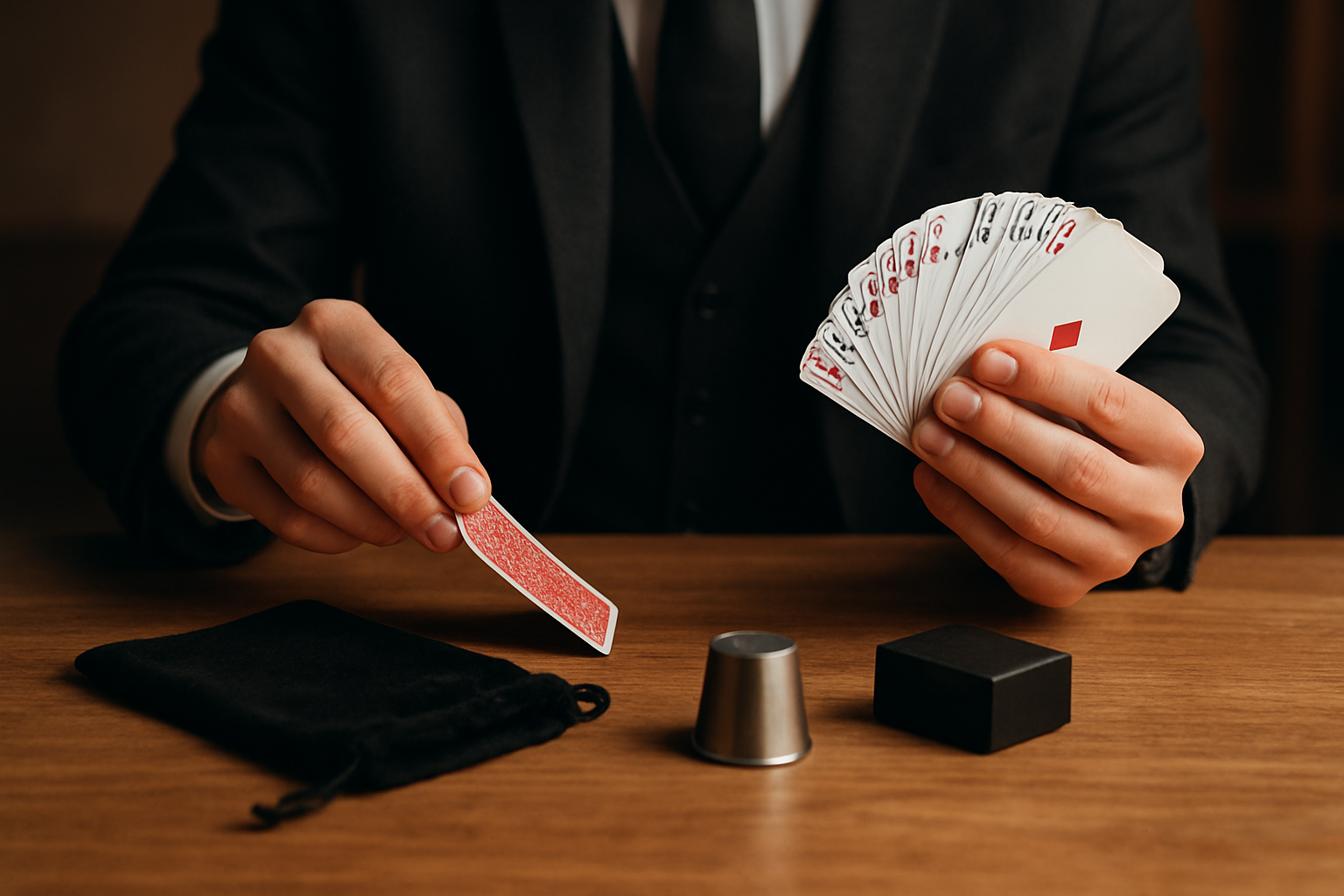
Vintage doesn’t have to mean expensive. It means coherent. A brass Okito box feels like a tool, not a toy. A set of cups with honest weight changes the entire soundscape of a routine—clinks, taps, and the soft scrape that tells the brain something physical is happening. Those sensory details create conviction before the method even starts.
In the pro market, that conviction translates to bookings because it photographs well. Event planners want assets. A close-up set that looks “classic” produces better candid images for corporate recaps and wedding galleries. That matters when performers are evaluated not only on reactions, but on the content the event produces for the client’s own marketing channels (LinkedIn, internal newsletters, venue reels).
Why Restaurants And Trade Shows Still Pay For Classics
Restaurants and trade shows don’t buy “magic.” They buy flow. A performer who can hit six tables in 25 minutes without a reset bottleneck is solving an operational problem: keeping guests happy while the kitchen catches up, keeping booth traffic dense, or smoothing awkward networking.
That’s where old-school walkaround magic shines. Many close-up classics were engineered for exactly these constraints: pockets, minimal setup, and methods that survive interruptions. The long-tail variations clients ask for—classic sleight-of-hand table magic, old-school card and coin miracles, retro bar magic routines, 1930s-1950s close-up effects—all point back to the same demand: reliable astonishment under pressure.
A Working Repertoire Of Vintage Close Up Magic Tricks That Plays Big
A professional repertoire isn’t a list of famous tricks; it’s a set of tools with different failure modes. The goal is coverage: something that works standing, something that works surrounded, something that withstands grabby hands, and something that can end clean when the emcee taps a glass.
A Pocketable Core Of Vintage Close Up Magic Tricks
Start with effects that were already “venue tested” before modern venues existed. Coins Across (classic palm and shuttle pass structure), a simple Copper/Silver transposition, and a one-ahead bill switch are durable because they don’t require a table. Add a ring-and-string sequence (or ring-and-shoelace, if borrowed objects are part of the brand), and the set can run in a hallway as easily as at a linen-covered round.
Cards still belong, but the selection should be deliberate. A short ambitious card sequence, a spectator-loses-spectator-finds plot, and a clean closer like Card to Wallet (in the LePaul lineage) are “vintage” in the sense that the methods are time-proven and the props are normal. The trick is resisting bloat: three phases beat nine, especially when the audience has appetizers arriving mid-routine.
Cups And Balls: The King That Still Reigns
No piece announces “serious close-up” like cups and balls. It’s also one of the oldest plots in magic, which means it carries an invisible prestige. For table crowds, it offers something modern magic often lacks: audible punctuation. The rhythm of loading and revealing creates a micro-drama that cuts through room noise.
In the Magician Industry, the commercial cups set is not the 12-minute museum piece; it’s the 4–6 minute worker. Two cups can be enough. Final loads should match the venue—small fruit in restaurants, branded foam balls at trade shows, or even wrapped chocolates for weddings. The method can be classic while the final reveal is tailored to the client’s context, which is exactly how vintage close up magic tricks earn modern fees.
Thread, Matches, And Micro-Props That Read As “Impossible”
Some classics are brutally strong because they create a visual that can’t be explained away as finger skill. Animated match effects, haunted deck plots, and certain thread miracles can feel like physics breaking. The risk is lighting and angles, so these pieces belong in a conditional slot: used when the environment is friendly, skipped when it’s not.
When done professionally, micro-props become brand signatures. A matchbook penetration looks like a relic from mid-century bar culture; it photographs like a film still. That “retro bar magic routine” energy is a differentiator for performers working lounges, whiskey tastings, or venues styling themselves as speakeasies.
Prediction Plots With Vintage Presentation
Prediction effects existed long before smartphone apps, and the best versions feel like a wager with fate. A classic sealed prediction in an envelope, a bold one-ahead routine with billets, or a confabulation framework can all be framed with period sensibility—typewritten slips, wax seals, fountain-pen ink.
The point is not cosplay. It’s coherence. When the entire aesthetic is consistent—props, language, pacing—the audience stops noticing “moves” and starts watching a story. That’s the moment when a table crowd leans in, and the camera phones appear without being prompted.
Prop Authenticity, Handling, And Reset: The Unsexy Stuff That Books The Gig
Vintage material wins only when it behaves like a professional system. Clients don’t care whether a shell is hand-aged; they care whether the performer can work three hours without fumbling. Reset discipline, prop durability, and pocket choreography are where reputations are made—quietly, repeatedly.
How To Make Vintage Props Look Real Without Looking Like Costume Jewelry
Audiences can smell novelty. A “new vintage” prop that’s shiny in the wrong way reads like a gift shop item. The fix is material literacy: brass patinas differently than plated steel; leather ages at stress points; paper yellows unevenly. A performer who understands those textures makes the props disappear into the environment.
For working pros, the most practical approach is controlled wear. Use real carry. Store metal against fabric, not plastic. Avoid artificial patina solutions that rub off onto hands under hot lights. If the aesthetic leans mid-century, even the deck choice matters—standard Bicycle is fine, but a consistent color story and a broken-in case can shift the entire perception of authenticity.
Reset Engineering: The 14-Second Rule
In walkaround, reset is the hidden tax on every effect. If a routine takes 70 seconds to reset, it will eventually fail under real conditions—someone calls the performer over, the captain announces speeches, a guest wants a photo. The practical target many workers use is a reset that happens while walking, often under 14 seconds, with no table required.
This is where classics outperform many modern packet tricks. Coins re-stack. Balls re-pocket. A ring goes back on a keychain. Even a deck can be restored with a jog shuffle if the material is structured properly. The “best vintage magic for restaurants” is usually just the material that respects reset economics.
Angle Management And The Phone-Camera Problem
Phone cameras changed close-up, not because they expose methods, but because they freeze moments. A flash of a double, a weird grip, or a suspicious pause becomes a frame-by-frame artifact. The solution isn’t to avoid filming; it’s to build routines with natural cover and justified actions—classic misdirection principles, but executed with 2026 realities.
Strategies include staging the spectator’s hands as the focal point, using objects with natural occlusion (napkins, envelopes, cups), and shifting the “dirty work” to off-beat moments triggered by laughter or by a question. The point is not to fight the camera; it’s to choreograph the moment so the camera sees what the audience should remember.

Performance Rights, Ethics, And The Modern Vintage Market
Vintage material comes with a responsibility: credits, permissions, and honesty about provenance. Some classics are in the public domain as plots, while specific routines, presentations, and gimmicks are not. Professionals treat this like any creative industry: licensing, attribution, and respecting creators keeps the marketplace healthy.
For context on how creative IP is handled in broader industries, the U.S. Copyright Office’s 2026 guidance and updates remain a baseline reference point for practitioners who sell recordings or publish instructional material (https://www.copyright.gov/). Live performance norms are different from publishing, but the ethical line is consistent: don’t sell what isn’t yours, and don’t claim invention where there’s lineage.
What Most Get Completely Wrong About Vintage Close Up Magic Tricks
Most performers treat “vintage” as a filter: sepia props, old-timey jokes, maybe a vest. That misses the commercial engine. In my experience, the real power of vintage close up magic tricks is that they are built around tight plots and high conviction, not around novelty. The method is often simpler than modern releases—so the performer has more attention left for timing, eye contact, and controlling hands.
My hard rule: if a classic trick needs a modern “upgrade” to get a reaction, it’s usually being performed with the wrong emphasis. The upgrade is almost always theatrical, not mechanical. Sharpen the conditions. Slow down the moment of impossibility. Let the spectator say what happened before rushing to the next beat. When the room is noisy, that pause reads like confidence, and confidence sells.
Why “Proving Skill” Kills The Trick
The temptation with old-school sleight-of-hand table magic is to show competence: fancy cuts, rapid-fire productions, constant movement. It looks impressive to magicians and invisible to clients. Tables don’t want a demonstration; they want a shared event where the impossible lands clean.
When hands never stop moving, spectators assume the method is “in the fingers,” and the effect collapses into admiration rather than astonishment. The classics were designed to avoid that trap. Their genius is often the opposite: simple actions that lead to a shocking outcome.
Why Copying Vintage Patter Sounds Like Bad Theater
Mid-century scripts can read like radio plays—charming on paper, awkward in a modern ballroom. Copying them verbatim can make the performer sound like a character trapped in a costume, which triggers distance rather than connection.
The better approach is to keep the structure and replace the language. Preserve the beat where the spectator makes a decision. Preserve the moment where the object is isolated. Update references so the rhythm feels current. Vintage methods, modern mouth.
The Booking Reality: Clients Pay For Smoothness, Not Obscurity
A common mistake is chasing obscure vintage plots because they feel “rare.” Clients don’t buy rarity; they buy reliability and social proof. A flawlessly executed classic—done fast, friendly, and clean—gets remembered, photographed, and recommended to planners.
That recommendation loop is the engine of premium close-up work. The performer who makes the room feel taken care of gets rebooked. The performer who makes the room feel like an exam does not.
Step-By-Step: A Table-Ready Set Built From Classic Methods
A step-by-step set is useful here because table work is repeatable labor. The objective is a modular routine that survives interruptions, resets instantly, and scales across ten tables without becoming stale. The following sequence is structured for restaurants, cocktail hours, and trade-show aisles where attention is scarce and conditions change fast.
Step 1: Open With A Borrowed-Object Hook (10–25 Seconds)
Use something already on the table: a ring, a bill, a sugar packet, a pen. The opener’s job is to establish fairness and pace. A classic quick penetration (coin through napkin, ring on string) works because it doesn’t require a “magic stance” or a cleared table.
Technically, keep hands above the table edge and avoid deep pocket dips. The audience should feel the effect happens in their space, not in the performer’s workspace. This is also where a short line about “keeping it simple” earns trust without begging for it.
Step 2: Transition Into A Strong Middle With A Signed Object
Move into a signed card or marked coin sequence. Signing is a psychological lock: it closes the “duplicate” escape hatch. A two- or three-phase Ambitious Card, or a coin transposition where the spectator initialed the coin, is enough. Avoid over-proving; keep the phases distinct and escalating.
Operationally, this is where pocket management matters. Keep the marker clipped in the same location every time. Keep duplicates, if used, separated by a hard physical barrier (a different pocket or a wallet compartment). Consistency prevents errors when fatigue hits in hour three.
Step 3: Hit A Visual Impossibility That Reads From Two Seats Away
Choose a moment that plays larger than its footprint: a coin bend, a ring appearing on a keycase, a haunted-style movement with a deck, or a cups-and-balls mini-sequence with a final load. This is the “people at the next table notice” beat.
For vintage close up magic tricks, this is where classic apparatus can shine without feeling like a prop show. A small brass box, a set of cups, or a simple pull effect can create a clean visual under bad conditions—provided the handling is rehearsed to look like nothing happened.
Step 4: Close With A Souvenir Or A Clean Reset
Closers should leave either a souvenir or a memory anchor: a signed card from a sealed envelope, a coin left bent in the spectator’s hand, or a branded giveaway integrated into a classic production. For corporate work, the souvenir can be on-message without feeling like an ad if it’s earned through impossibility.
Immediately after the reveal, reset while the table reacts. Don’t wait. Reset is part of choreography: hands move naturally while eyes are on the object. The set ends with the performer already “clean,” ready for the next group without a backstage moment.
Frequently Asked Questions About vintage close up magic tricks
How can vintage close up magic tricks be made “camera-proof” when guests record in 0.5x wide-angle?
Favor plots with built-in occlusion (cups, envelopes, napkins) and structure dirty moments on off-beats triggered by laughter or spectator speech. Wide-angle exaggerates hand tension, so keep grips relaxed and actions justified. If filming is constant, avoid angle-sensitive thread work under downlights and choose signed-object routines that survive replay.
What’s the fastest reliable reset strategy for a restaurant set built on vintage close up magic tricks?
Design resets that occur while walking: coins stacked and oriented in-pocket, marker clipped consistently, and decks restored via a brief overhand control rather than table spreads. Avoid packet tricks requiring sorting. A practical benchmark used by many workers is a sub-15-second reset with no table and no “back turned” moment.
Which vintage props tend to fail first under real gig conditions, and how are they reinforced?
Thread setups fail under heat and LED glare; cheap shells deform; plated items lose finish and stain hands. Reinforce with higher-grade materials (sterling or clad coins, quality elastics, strong wax/thread where appropriate) and store metal away from moisture. Use fabric-lined cases to reduce abrasion and uncontrolled patina transfer.
How do working pros keep cups-and-balls final loads practical at a moving cocktail hour?
Downsize the routine and treat final loads as venue-specific: wrapped chocolates for weddings, branded foam items for trade shows, or small fruit only when tables are stable. Loads are staged in a dedicated pocket with consistent orientation. The close should end instantly clean—no rummaging—so the performer can step to the next cluster.
What’s the best way to price a vintage-leaning close-up act for corporate events without sounding niche?
Sell outcomes, not aesthetics: smoother networking, higher booth dwell time, and better recap content. Package deliverables (e.g., 2×45-minute rotations, VIP table coverage, branded souvenir closer) and position the “classic” look as premium and photogenic. Corporate buyers respond to predictable logistics more than they respond to rare trick names.
How can vintage close up magic tricks be adapted for trade-show lead capture without turning into a sales pitch?
Use a classic plot with a branded object as the “impossible” endpoint (logo token appears in a sealed envelope; branded card rises to top). Keep the script about the spectator’s choices, not product features. The handoff is operational: staff scans badges during reaction, then the performer exits cleanly.
Which card material feels vintage without looking gimmicky or suspicious to modern spectators?
Use standard decks with natural wear: softened edges, a broken-in case, and consistent handling that avoids flashy displays. If choosing retro backs, keep them mainstream-adjacent so they don’t read like novelty. The most believable “vintage” signal is restraint—short phases, clean shuffles, and minimal table sprawl.
What are the safest vintage close up magic tricks when spectators are grabby or intoxicated?
Favor routines where the spectator’s hands are occupied constructively: holding a coin, covering an object with a napkin, gripping a ring on a string. Avoid fragile gimmicks and angle-sensitive setups. Signed coin effects, ring-and-string sequences, and simple transpositions are resilient because the props are durable and the plots are easy to follow.
How do performers keep crediting and ethics straight when working from classic books and public plots?
Separate plot from specific method and script. Many plots are old; specific routines and presentations may be protected or ethically tied to creators. Keep a written credit log for each piece (source book, creator, publication) and avoid publishing or selling explanations without permission. When in doubt, consult creator policies and reputable publishers.
Conclusion
Vintage close up magic tricks endure because they solve the real table problem: noisy rooms, limited space, skeptical audiences, and zero setup time. The strongest programs treat vintage close up magic tricks as an operating system—tight plots, durable props, fast resets, and a three-phase escalation that leaves a souvenir-level memory without turning the table into a stage.
The “New” Stuff Often Makes Magic Look More Fake
High-tech props and overly engineered gimmicks can reduce credibility at close range because they advertise the possibility of hidden mechanics; classic methods paired with ordinary objects often feel riskier—and therefore more impossible—under real-world scrutiny.
A Real-World Example Of Classic Structure Winning A Modern Room
At a 2026 hospitality showcase at McCormick Place, several exhibitors hired roving magicians; the sets that held crowds longest were the ones built around signed-object transpositions and a short cups-and-balls closer, because reactions created foot traffic waves that nearby booth staff could convert into badge scans without interrupting the performance flow.
The Core Rule That Keeps Table Magic Bookable
Choose material that survives bad conditions: if an effect can’t be done standing, half-surrounded, mid-interruption, and reset while walking, it doesn’t belong in a professional table set—no matter how beautiful the method looks on a trailer.

Find out more information about “vintage close up magic tricks”
Search for more resources and information: