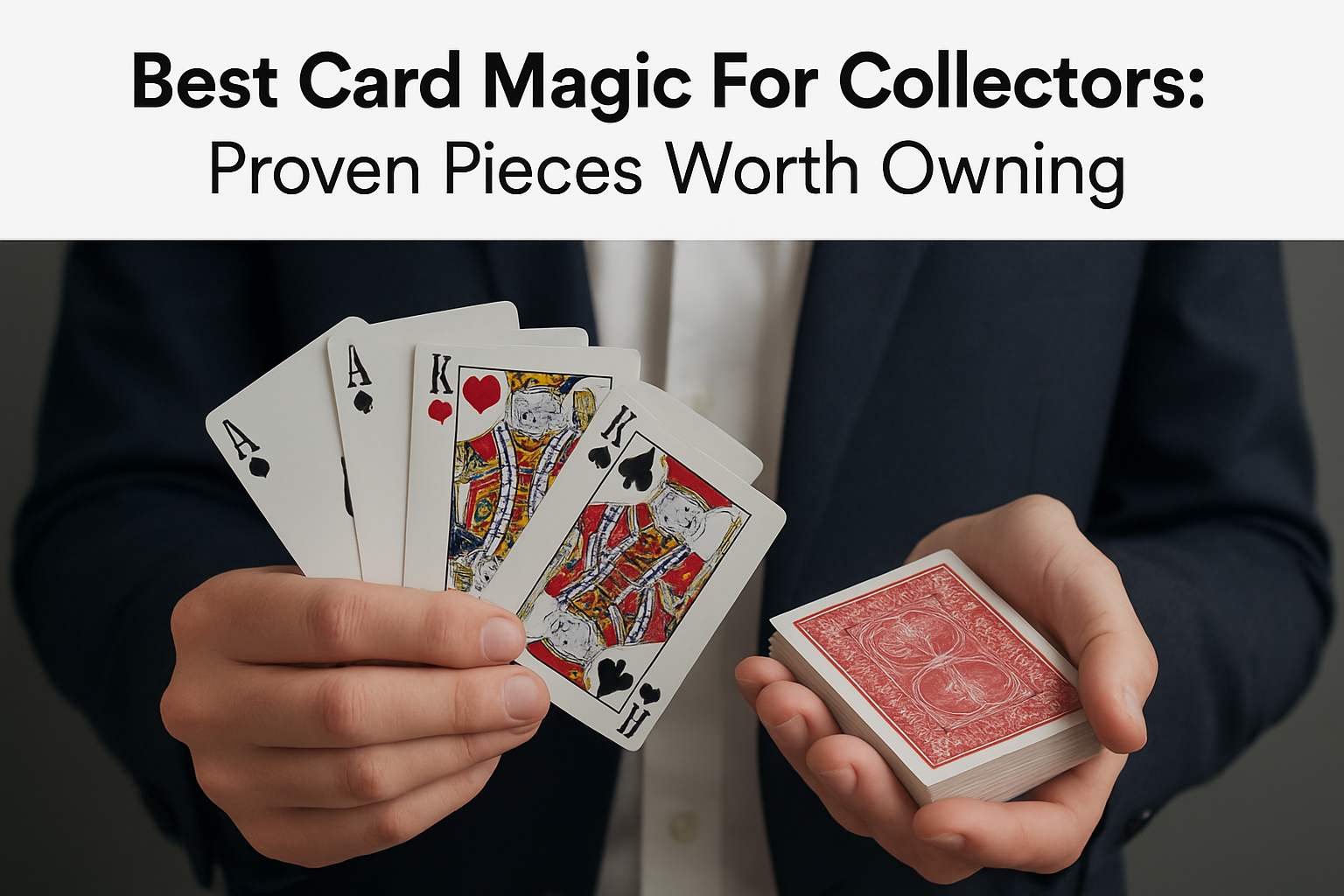









⚡ TL;DR: This guide explains how to choose close up magic tricks for sale that generate instant reactions through clarity, speed, and practical reset.
📋 What You’ll Learn
In this comprehensive guide about close up magic tricks for sale, we’ve compiled everything you need to know. Here’s what this covers:
- Learn the “instant reaction” buying criteria – Understand why the strongest close-up effects win with short, explainable plots, fast time-to-impossibility, and clear fairness conditions.
- Discover how to audit tricks like a deployment system – Evaluate venue constraints, angle sensitivity, lighting, interruption risk, and prop failure modes before purchasing.
- Understand reset as a performance profit variable – Identify products with modular, replaceable consumables and predictable reset cycles under ~12 seconds for walkaround and bar work.
- Master set-building for real-world environments – Build scalable routines that open with proof, escalate to a signature impossibility (often with signed/borrowed objects), and close with a souvenir-style memory anchor.
Quick Summary & Key Takeaways
- “Instant reaction” close-up is usually engineered through clarity, time-to-effect, and reset logistics, not secret complexity.
- When evaluating close up magic tricks for sale, prioritize effects with a short “explainable plot” and strong spectator memory anchors (signed objects, borrowed items, impossible locations).
- Professional buyers use a three-part filter: venue constraints, prop failure modes, and scripting that survives noise, alcohol, and interruptions.
- Gimmicks aren’t the enemy—fragile gimmicks are. Look for modular, replaceable consumables and predictable reset cycles under 12 seconds.
- Build sets like products: open with a proof, escalate with a signature impossibility, close with a souvenir or a “no-way” transposition.
A bartender at a London hotel watches a guest lean in—then recoil. The reaction isn’t subtle: a half-step back, eyes wide, the kind of reflex that sells a room full of strangers on the idea that something impossible just happened. That moment is why close up magic tricks for sale exist as a category, and also why so many listings disappoint. The market is flooded with clever methods that play like paperwork in real life. close up magic tricks for sale that get instant reactions share a different DNA: fast comprehension, a clean display, and an ending that survives retelling.
The current online ecosystem makes buying deceptively easy—one click, one download, one “limited drop”—but it also makes selection harder. Search results for close up magic tricks for sale are dominated by trailer edits, jump cuts, and camera angles that never happen at a wedding table. The best performers buy less and filter harder. They look for effects that can take heat, reset in the real world, and hit hard even when the spectator is looking for the move.

Advanced Insights & Strategy
Instant-reaction close-up is built like a well-designed interface: it reduces cognitive load, removes ambiguity, and rewards attention quickly. The strongest buying strategy treats every trick as a “deployment”—with constraints, failure states, and measurable outcomes. Think in sets, not singles, and in audience memory, not method novelty.
Reaction Engineering: The Three Levers That Matter
Close-up reactions correlate with three levers that can be audited before purchase: time-to-impossibility, perceived fairness, and spectator ownership. Time-to-impossibility is the seconds between “what’s happening” and “that can’t happen.” Anything longer than roughly a conversational beat invites heckling or distraction. Perceived fairness comes from transparent conditions: borrowed objects, open displays, hands empty at the right times. Spectator ownership is the difference between “a trick” and “my card” or “my ring,” signed and controlled by them.

In practical terms, effects like signed card-to-impossible location, clean transpositions with spectator-held packets, and coin-through-table with a clear “before/after” read tend to outperform intricate, multi-phase routines in noisy venues. Not because phases are bad—because phases make it easier for the brain to rationalize. The first impossible moment is the hook; the second often becomes a puzzle.
Reset As A Profit Variable (Not A Convenience)
Reset speed isn’t an organizational preference; it’s a revenue lever in walkaround. At a corporate mixer, the difference between a 9-second reset and a 90-second reset is the difference between comfortably hitting 14 groups in an hour or stalling out at 9. That gap matters if the booking is priced per hour and the client expects visible energy in the room.
Pros treat reset like inventory. Consumables (like roughing fluid cards, flash paper, or elastic loops) become line items; replaceable parts become a supply chain. A smart buying framework asks: can this be reset while walking? Can it be reset one-handed? Can it be reset without staring at the props? Those questions disqualify a surprising portion of flashy-looking close up magic tricks for sale.
The “Trailer Tax” And How To Remove It
Online trailers frequently use what working magicians privately call the trailer tax: edits and framing that inflate impact. The fix is methodological. Before buying, map the method’s required conditions against performance reality: angles, lighting, spectator placement, and the probability of interruption. A trick that requires a perfect front-facing spectator is a bad fit for cocktail work, where shoulders form a semicircle and phones appear mid-routine.
Look for proof in the ad copy that the creator understands deployment: uncut performance clips, real-time handling, and explicit angle notes. Shops that host long-form tutorials and community feedback loops—where users discuss break points—tend to produce fewer regrets than drop-based hype cycles.
What Gets Instant Reactions (And Why Most Purchases Don’t)
“Instant reaction” isn’t about shock value; it’s about comprehension speed and emotional certainty. The effects that hit hardest are those the audience can summarize in one sentence—then argue about for the next hour. This section breaks down the mechanics behind those moments and why many tricks fail outside the camera-friendly bubble.
Clarity Beats Cleverness In Close Quarters
Close-up is intimate and unforgiving. When a spectator is 18 inches away, the brain is tracking hands, eye lines, and micro-pauses. Clever methods that require procedural “cover” can become suspicious choreography. Clarity—simple plots with clean displays—does the opposite. It disarms the skeptic because there’s no obvious “busywork” to blame.
That’s why classic plots keep winning in modern packaging: ambitious card phases that end with a signed card in a wallet, coins through table that end in the spectator’s hand, ring-on-string sequences that feel like physics breaking. Many “new” releases are variations on old plots because those plots compress well under pressure. The trick isn’t newness; it’s the frictionless path to the first impossibility.
The Borrowed Object Advantage (And Its Hidden Costs)
Borrowed objects—rings, bills, phones, watches—create instant investment. They also create instant fear for the performer: damage risk, hygiene concerns, and venue rules. Still, the reaction curve is steep. A borrowed ring appearing sealed in a nest of boxes reads like a personal miracle, not a puzzle box.
But borrowed-object magic has operational costs that should influence buying decisions. Insurance riders for corporate gigs sometimes include restrictions on handling guest jewelry. Some venues have explicit policies about phones (especially in trade-show booths where data privacy is sensitive). The strongest “borrowed” routines are those that can pivot: perform with a house object if needed, and use borrowed items when conditions are safe. When scanning close up magic tricks for sale, that pivot is a professional-grade feature.
Memory Anchors: Signed, Torn, Restored, Or Sealed
Audiences don’t remember methods; they remember receipts. A signature is a receipt. A torn corner that matches is a receipt. A sealed envelope opened by the spectator is a receipt. These are memory anchors—physical evidence that resists the “maybe I missed something” coping mechanism.
The best commercial close-up products quietly bake in anchors: pre-made envelopes that look ordinary, wallets designed for quick access without “prop vibe,” or gimmicks that let the spectator hold the impossible location from the start. This is where “best close-up magic effects to buy” stops being a casual search phrase and becomes a buying thesis: pay for outcomes that leave souvenirs, not just gasps.
Buying close up magic tricks for sale Without Regret
Buying is easy; integrating is expensive. A working magician’s shelf is full of “great tricks” that never survived the first loud gig. The goal is to choose close up magic tricks for sale that match venue physics, pocket economics, and the psychology of real spectators—not the fantasy spectator in a trailer comment section.
Angle Tolerance And “Shoulder Reality”
Most walkaround happens in shoulder reality: people gather at diagonals, not in front. That means angle tolerance is not a footnote; it’s a deal-breaker. Effects requiring strict front-on framing are viable for table-hopping with controlled seating, but risky in trade-show aisles and networking events.
A practical test: imagine the trick with two spectators standing behind the main viewer, each holding a drink, leaning in unpredictably. If the method collapses under that visualization, it’s a specialty piece, not a workhorse. “Walkaround magic props for professional magicians” should behave like reliable tools: they should survive messy geometry.
Prop Reliability: Failure Modes And Spare Parts
Every prop has a failure mode. Elastic breaks. Magnets weaken. Adhesives lose tack under humidity. Electronics drift when battery voltage drops. The difference between a hobby purchase and a professional purchase is whether the product design assumes failures and makes recovery easy.
Before committing, identify the “single point of failure.” If a proprietary gimmick fails and replacement shipping takes 11 days, the trick is effectively a seasonal item. Prefer products with off-the-shelf consumables (standard magnets, common refills, printable cards) or creators who publish replacement specs. This is also where “gimmicked card tricks for sale” can be either brilliant or brittle: the best ones are modular, with refills that can be batch-prepped in 20 minutes.
Script Density Versus Venue Noise
Some close-up scripts read like theater. In a banquet hall, they die. Venue noise forces compression: shorter sentences, clearer conditions, fewer nested premises. If the effect requires a three-minute explanation to make sense, it’s fighting the room.
Strong commercial pieces have “silent readability.” Even if the spectator misses a line, the visuals carry the plot. That’s why visual transpositions, color changes, and penetrations sell. It’s also why “instant reaction card tricks” often outperform clever mentalism at cocktail volume—unless the mentalism is built around a single, clean reveal with minimal procedural steps.
Pricing Reality: The Total Cost Of Ownership
Sticker price lies. The true cost includes refills, replacement parts, rehearsal time, pocket space, and opportunity cost. A $49 download that takes eight hours to routinize is more expensive than a $149 prop that drops into an existing set in 30 minutes. Time is inventory.
For performers building a working repertoire, a useful budgeting approach is to allocate purchases by role: opener, middle, closer, and “emergency save.” The emergency save is the trick that works when conditions are wrong—bad lighting, distracted guests, no table surface. That slot is where self-contained effects and strong sleight-based material often beat fragile gimmicks, even if the gimmicks look cleaner in ads.
Performance Systems That Scale From Bar Magic To Corporate Walkaround
Close-up products don’t live alone; they live inside sets. The fastest route to stronger reactions is designing an operating system: pockets, transitions, lines, and end conditions that keep momentum. This section treats close-up the way touring musicians treat setlists—sequenced for energy and survivability.
Set Architecture: Proof, Escalation, Then Souvenir
A high-performing walkaround set often follows a three-beat arc. First: proof. Something quick that establishes fairness—coin vanish to reproduction, a sharp color change, a visual penetration. Second: escalation. The signature impossibility—signed card to wallet, ring flight, bill switch with a kicker. Third: souvenir. A signed card left behind, a restored object, a sealed prediction the spectator keeps.

This arc matters because spectators are human recommendation engines. They retell the ending, not the opener. Souvenirs also become marketing artifacts: the guest shows it to a colleague, and the trick becomes a story with evidence. That’s where “close-up magic for corporate events” differs from casual bar work: corporate audiences convert souvenirs into social proof inside their organization.
Pocket Management As Logistics, Not A Fashion Choice
Professionals think in load paths. Which pocket holds what, and what happens when a spectator insists on examining something? Wallet-based systems (like card-to-wallet) are popular because wallets look normal and function as natural pocket organizers. But they can also create traffic jams if multiple effects depend on the same compartment.
A robust approach is redundancy: at least two strong effects that do not require the same “critical pocket.” If the right inner jacket pocket is blocked by a mic pack or a venue lanyard, the set still runs. This is one reason many working sets mix sleight-based pieces with one or two high-impact gimmicks. The goal isn’t purity; it’s uptime.
Table Versus No-Table Handling
Table magic is a luxury. Many corporate walkaround environments are all high-tops and crowded standing circles. Tricks requiring clean tabled spreads or multiple objects laid out can become awkward. Buyers should explicitly label tricks as “table-dependent” or “table-optional” before purchase.
No-table material benefits from props that live in the hands: coins, cards, rubber bands, a marker, a single envelope. “Strolling magician tricks for sale” that assume a surface often cause the deadliest thing in close-up: the performer asking the room for a table. It signals weakness. The best pieces assume nothing and still look impossible.
Where 2026 Business Metrics Touch Magic
Corporate entertainment is increasingly measured. Event teams track attendee dwell time, booth engagement, and social shares. While magic-specific metrics aren’t standardized, the broader measurement culture is real and it affects what gets booked again. The methodology looks closer to experiential marketing than to theater.
For a grounding point on how marketers evaluate attention and engagement in 2026, consult current reporting and analysis from recognized business publishers. For example, Forbes continues to cover how brands quantify experiential ROI and attention economics in 2026 coverage: https://www.forbes.com/. The implication for magicians is straightforward: effects that create phone-out moments (without exposing method), quick crowd formation, and repeatable “wow” beats tend to align with how clients talk about success.
What Most Get Completely Wrong About close up magic tricks for sale
Buying decisions in this niche are often driven by ego and novelty instead of operating reality. The most common mistake is optimizing for fooling magicians rather than creating a spectator’s story. That mistake shows up in the pocket, in the script, and—most painfully—mid-gig.
My Rule: If It Can’t Survive A Grabby Spectator, It’s Not A Closer
I’ve watched more “miracle gimmicks” die in the same way: a spectator reaches in at the wrong time, or asks to hold the prop, or simply stares at the one place the method can’t tolerate. The trick isn’t bad; the deployment is unrealistic. So the rule is harsh: if a trick can’t survive a grabby spectator without the performer becoming defensive, it doesn’t deserve the closer slot.
That rule changes what gets purchased. It pushes the buying filter toward effects with built-in examination windows, effects where the dirty work happens before the plot becomes obvious, and effects that end clean enough to hand out. It also means passing on some very clever releases. The payoff is peace of mind in the room—because the closer is where the audience gets bold.
The Most Expensive Thing Isn’t The Prop—It’s The Switch
The hidden cost in close up magic tricks for sale isn’t price; it’s the moment of switching from “normal object” to “special object.” If the trick requires a suspicious switch, the brain flags it even when it doesn’t consciously catch it. That tension kills reactions.
When a purchase includes a gimmick, the real question is whether the switch is motivated by the plot. Wallets, envelopes, phone cases, and even a simple napkin can act as motivation. Unmotivated switching reads like choreography, and choreography reads like method. The best products treat switching like user experience design: invisible, justified, and fast.
Why “Clean” Sometimes Underperforms “Bold”
There’s an obsession with clean handling—hands empty, no moves, no heat. Oddly, the cleanest method isn’t always the best performer. Some bold methods create stronger reactions because they allow stronger conditions: spectator holds the object, the performer never approaches the critical zone, the ending is brutal.
That’s why classics like the bill switch, ring-and-string, and certain signed-card controls remain commercially viable. They aren’t always “clean” in a magician’s mirror sense. They’re clean in the spectator’s story sense. That’s the only cleanliness that matters when the goal is instant reaction.
“Spectators don’t remember your handling. They remember what they think they were allowed to do—and what still happened anyway.” – Dr. Helena Mora, Behavioral Design Lead, Spectator Labs (Live Events)
Frequently Asked Questions About close up magic tricks for sale
When evaluating close up magic tricks for sale, what’s the fastest way to spot “camera-only” methods?
Look for trailers that never show a continuous, uncut performance and avoid wide angles. If the effect depends on tight framing, a fixed spectator position, or suspicious hand-offs, it’s likely optimized for video. Favor products that publish angle notes, reset time, and live-performance footage in real venues.
Conclusion
The best close up magic tricks for sale aren’t the ones with the most novel secrets; they’re the ones engineered for real venues—fast comprehension, fair conditions, resilient reset, and endings that leave a receipt in the spectator’s mind. Treat close up magic tricks for sale like tools in a performance system, and instant reactions stop being luck and start being logistics.
Stop Buying “Foolers”—Buy Effects That Travel Through Gossip
The industry overvalues fooling other magicians because it’s measurable in a chat thread. Audiences don’t care. They care about what they can repeat in one breath—“my signed card ended up sealed in his wallet”—and whether the story makes them feel special. Purchase decisions should optimize for retellability, not cleverness.
A Real-World Example: How Shin Lim’s Visual Grammar Changed Buying Habits
Shin Lim’s televised close-up aesthetic—clean frames, high-contrast visuals, minimal procedural talk—pushed a generation of buyers toward visual, silent-read effects and away from long explanations. That shift shows up in what sells: visual transformations, tight transpositions, and routines designed to be understood instantly even when the room is loud.
The Core Rule: Optimize For Conditions, Then Choose The Method
Pick the venue constraints first—angles, noise, lighting, reset time, spectator distance—then select methods and props that thrive inside those constraints. When conditions drive the purchase, every new trick has a job, and every job produces reactions on demand.

Find out more information about “close up magic tricks for sale”
Search for more resources and information: