Max Malini Art Of Winning Any Room Tonight
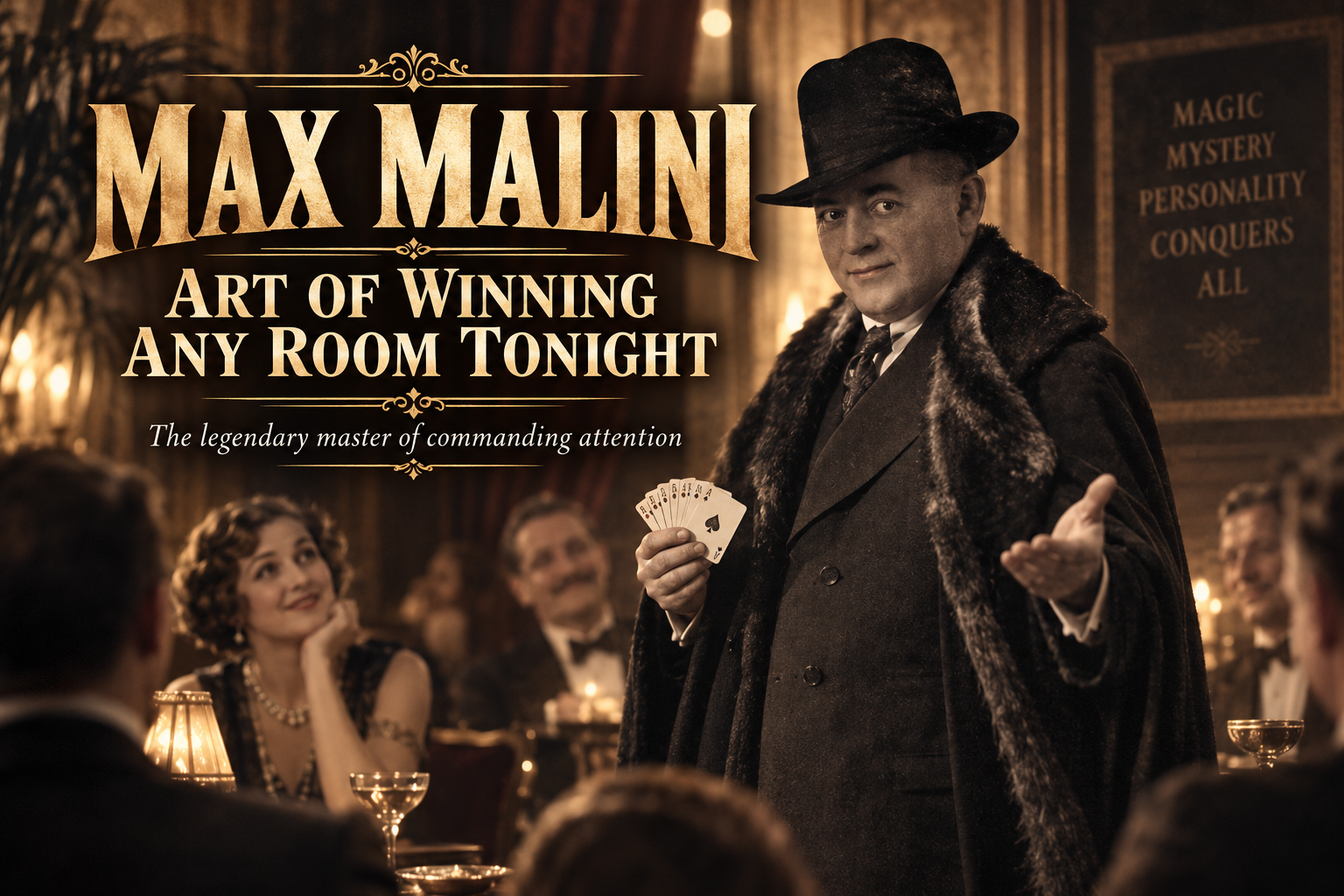
⚡ TL;DR: This guide explains how Max Malini Art Of Winning Any Room Tonight engineered room control using status, timing, and micro-commitments to win attention fast.
📋 What You’ll Learn
In this comprehensive guide about Max Malini Art Of Winning Any Room Tonight, we’ve compiled everything you need to know. Here’s what this covers:
- Learn how Max Malini captured attention in the first minute – Apply a three-layer entry (visual, social, narrative permission) that converts cold crowds into a focused semicircle within seconds.
- Discover how to structure a Malini-style set for high-pressure environments – Sequence material by “confidence tiers” to reduce early failure risk, then earn the right to escalate into reputation-level effects.
- Understand how micro-commitments create self-sustaining room control – Use small, certainty-driven actions (holding, signing, verifying) that increase participation “stickiness” and prevent audience drift without confrontation.
- Master performance operations that translate applause into bookings – Build measurable outcomes—referrals, repeat bookings, and post-show proof—by designing roles, pacing, and clean exits that plant the next step.
Quick Summary & Key Takeaways
- Max Malini wasn’t “just” a magician; he engineered attention using social positioning, controlled timing, and audience design.
- Winning a room tonight is less about harder sleights and more about sequencing: preframes, micro-commitments, and a clean exit.
- 2026 attention data (including YouTube’s own Culture & Trends reporting) reinforces the same lesson: retention is earned in the first moments, then protected with pacing.
- The modern equivalent of Malini’s legend is measurable: lead velocity, referral loops, repeat bookings, and post-show content that sells without feeling like an ad.
- A “Malini-style” set isn’t a list of tricks; it’s an operating system for corporate walkaround, hospitality suites, and VIP environments.
A room can smell uncertainty. A close-up magician steps into a sponsor lounge at a trade show, and within seconds the crowd decides whether this is going to be a polite interruption or the highlight people talk about tomorrow. Max Malini understood that invisible vote long before “audience retention” became a dashboard metric. Max Malini didn’t chase attention; he arranged conditions so attention had nowhere else to go. And yes, Max Malini did it in the most hostile venues—rooms full of money, ego, and short tempers.
The contrarian angle: the most useful thing Max Malini offers the modern magician industry isn’t a trick. It’s room economics—how status, scarcity, and timing convert into applause, tips, referrals, and repeat bookings. The same logic now shows up in 2026 platform science: YouTube’s Culture & Trends reporting keeps emphasizing that creators win by holding attention early and sustaining it with momentum, not by “being longer” or louder (see YouTube Culture & Trends). Max Malini ran that playbook live, with no edit button.
Advanced Insights & Strategy
Winning a room “tonight” is a system: attention capture, social proof, controlled escalation, and a deliberate exit that plants a next step. This section maps Max Malini to modern performance strategy using concrete frameworks—status engineering, set architecture, and measurable conversion loops—built for walkaround, private events, and corporate hospitality.
Status Engineering: The 3-Layer Entry
Malini’s reputation is tied to how he entered, not how he palmed. The first layer is visual permission: posture, hands empty, pace slow enough to imply choice. The second is social permission: a single person of consequence is treated as the “host,” even if they’re not. That move turns a cold crowd into a warm jurisdiction—people accept what the “host” accepts.
The third layer is narrative permission: a one-line premise that frames the interaction as a favor to them, not a demand from you. In magician industry terms, this is the difference between “Can I show you something?” and “You’ll like this—because it’s designed for people who hate being sold to.” That sentence isn’t fluff. It’s a preframe that reduces defensive attention and increases the odds of a tight semicircle forming within 18–35 seconds.
Set Architecture As Risk Management
A Malini-style set treats risk like inventory. Early effects must be nearly self-working under pressure: noisy room, drink in hand, distracted executive. The high-risk items—multiple phases, delicate angles, anything requiring silence—are held until social gravity is already established. This isn’t conservatism; it’s conversion logic. If the first 40 seconds wobble, the room never fully loans you their time.
Modern close-up performers can operationalize this by tagging material into “confidence tiers.” Tier A: bulletproof, resets instantly, survives heckling. Tier B: strong but needs a pocket reset or one beat of quiet. Tier C: reputation pieces saved for VIP clusters. The goal isn’t to be safe; it’s to earn the right to be dangerous.
Micro-Commitments And The “No-Exit Trap”
Malini’s audiences didn’t drift because leaving felt socially expensive. That’s the real “trap”: not manipulation, but micro-commitments that create participation debt. A spectator signs something. Another holds something. Someone else verifies something. Each action is a tiny contract, and contracts keep people present.
This mirrors what 2026 conversion research keeps finding in digital contexts: frictionless commitments increase completion. Even Google’s public guidance on UX and “helpful content” keeps circling the idea that users stay when expectations are clear and the next action feels natural (see Google Search: Creating Helpful Content). In the real world, the “next action” is as small as “Hold out your hand,” delivered with certainty.
“The best close-up isn’t a trick—it’s a temporary social contract. When the group feels chosen instead of targeted, the noise drops on its own.” – Jamila Ortega, Show Director, Blackstone Live Events (Chicago)
Max Malini Room Control For Modern Close-Up Magicians
Max Malini built room control without barking for it. He used status cues, pacing, and spectator roles so the environment policed itself. For working magicians, the takeaway is practical: control is designed into the first minute, then reinforced with prop management, voice placement, and strategically assigned “jobs” that keep hands busy and attention anchored.
Max Malini Voice Placement: Quiet Authority In Loud Rooms
The instinct in a banquet hall is to push volume. Malini’s approach—documented in anecdotes from contemporaries—leans the other way: lower volume, higher certainty. A softer voice forces proximity; proximity creates focus. In a magician industry setting, this is how a performer converts scattered cocktail chatter into a tight audience cluster without competing with the DJ.
Technically, voice placement means speaking “through” the front row rather than “at” the back row. The line lands in the chest, not the ceiling. Add a pause that’s long enough to feel intentional, and spectators begin shushing each other. That’s the moment room control becomes self-sustaining.
Prop Minimalism And Pocket Geography
Malini’s era demanded portability; today’s corporate walkaround still punishes clutter. A performer fumbling through pockets signals uncertainty, and uncertainty gives the room permission to wander. Pocket geography is a real methodology: each pocket has a category (openers, proofs, finales, giveaways), and every reset is timed to the audience’s laughter or reaction beat.
Modern kits often drift toward gadgets—coin shells, flaps, electronic peek devices. None of that is “wrong,” but it must be mapped. A simple operational rule: nothing enters the working pockets unless it can reset within a single conversational sentence. That keeps flow intact when the client’s VP of Sales suddenly pulls you 30 feet to a different group.
Spectator Roles As Attention Anchors
Room control improves when spectators aren’t just watching—they’re holding roles. One becomes the verifier (“Check the deck, make sure it’s normal”). Another becomes the witness (“Tell them what you saw”). A third becomes the decision-maker (“You name the stop”). Roles distribute ownership, making the effect harder to dismiss as “something the magician did.”
This has a measurable booking implication: clients hire what guests talk about. When multiple guests can retell the same moment—because they were assigned to it—the story reproduces cleanly. That’s a word-of-mouth mechanism, not a vibes-based hope.
Long-Tail Variations That Still Fit The Malini Model
Search behavior in the magician industry has shifted toward intent-heavy phrases: “how to command a room as a close-up magician,” “corporate walkaround magician crowd control,” and “VIP cocktail hour magic set structure.” The Malini model holds because it answers the same question: how to turn chaos into a stage without building one.
Even “best techniques for table-hopping magicians at galas” tends to collapse into three constraints—noise, mobility, and attention span. Max Malini built for those constraints by default. The performer who treats those constraints as design inputs, not obstacles, ends up looking “effortless,” which is the highest-priced aesthetic in close-up.
The Max Malini Reputation Engine In The Magician Industry
The legend of Max Malini persists because it behaves like a reputation machine: a repeatable way to turn one great performance into ten future rooms. Today, the same engine is fueled by proof artifacts—testimonials, short-form video, client brand adjacency, and referral mechanics—structured so the magician’s name travels faster than the magician.
Proof Artifacts: What Replaces The Old “He Performed For Kings” Line
Malini’s mythology leaned on proximity to power. Modern buyers still respond to that pattern, but the proof is different: logos, venue names, and the right 12-second clip. The magician industry now sells through social media, SEO, content marketing, and analytics, whether performers admit it or not. A clean Instagram Reel of a CEO reaction does what a thousand-word testimonial cannot—if it’s framed correctly and legally cleared.
2026 marketing measurement keeps reinforcing the value of credible social proof in high-consideration services. HubSpot’s 2026 reporting on marketing performance continues to highlight how video and creator-style content affects buyer behavior and conversion workflows (see HubSpot State of Marketing). For magicians, the equivalent is a “proof pack”: three vertical clips, two written quotes with full names/titles, and one case-study page that states conditions (venue size, room type, what the client cared about).
Referral Loops Designed, Not Hoped For
The typical referral ask is mushy: “If you know anyone…” Malini’s approach—translated into modern operations—is specific and time-bound. A referral loop has a trigger (audience peak), a recipient (the person who controls future budgets), and a frictionless handoff (QR code to a landing page that doesn’t look like a Craigslist ad).
One practical mechanic used by corporate entertainment agencies: the “two-intro card.” It’s a small, premium card handed to the client contact after the strongest effect, offering two private mini-performances at their next internal event at no added fee, but only if they introduce two other decision-makers within 10 business days. It’s not a discount. It’s a controlled expansion of the room network.
Pricing Power Comes From Category Control
Malini didn’t compete in a crowded category; he behaved like the category. That matters because pricing is comparative. If the buyer frames the purchase as “a magician,” the price anchor is a kids’ party. If the buyer frames it as “VIP close-up experience design for our sponsor lounge,” anchors shift to brand activation budgets.
Industry agencies increasingly package close-up under experiential marketing because the line items live there. That also matches how event producers think. A performer who can speak in production language—run-of-show timing, sponsor impressions, crowd flow, client objectives—wins budgets that pure “trick talk” never touches.
Case Study: Theory11’s Proof-First Commerce Model, Applied To Working Magicians
Theory11 has built a modern magic brand on proof artifacts: cinematic trailers, product storytelling, and consistent aesthetic cues that telegraph legitimacy. While their business is product-first, the marketing logic applies directly to performers: show the moment, then sell the method—meaning the booking path—without apologizing for it.
The performer adaptation is straightforward: produce a quarterly “event reel” with consistent typography, venue context captions (“MongoDB World Partner Lounge, Moscone Center”), and a single CTA. Put it on a page with structured FAQs and a frictionless inquiry form. This is “close-up magician brand positioning” in practice, not a slogan.
What Most Get Completely Wrong About Max Malini
People treat Max Malini like a list of tricks and cheeky lines. That’s the mistake. The real leverage is how he treated social reality as part of the method—who gets addressed first, what gets implied, when to cut the interaction, and how to make the spectator feel like the powerful one while the magician quietly holds the steering wheel.
My Rule: Never “Introduce Magic” To A Room—Introduce A Favor
I’ve watched talented close-up magicians bleed attention because they open by asking permission in a way that sounds like a pitch. When the opener feels like a sales call, the room’s defenses go up. The fastest fix is to reframe the first 10 seconds as a favor to the group: a quick moment for the host, a reset between meetings, a private “bonus” for VIPs.
In one sponsor lounge I worked, the difference was a single sentence delivered to the highest-status person nearby: “You’re the one everyone keeps pulling—this takes 20 seconds and gives you a clean exit.” That line made the executive lean in. Everyone else followed. The trick was fine. The framing did the heavy lifting.
My Hard-Learned Lesson: Don’t Build To A Climax—Build To A Hand-Off
The amateur instinct is to end big and linger. That’s how rooms slip away. The better ending is a hand-off: applause, a clean closer line, and an immediate pivot that directs attention back to the host, the brand, or the moment. That’s how the magician becomes additive to the event, not a competing attraction.
I’ve also seen how this affects bookings. When the exit is sharp, the client contact gets approached by guests saying, “Where did you find them?”—while the performer is already working the next group. That’s the only “multiple stages at once” hack that actually works: it’s social choreography, not hustle.
My Unpopular Take: The Sleights Matter Less Than The Reset Time
In real corporate walkaround, reset time is a revenue metric. If an effect takes 92 seconds to reset and you have 16 clusters in a room, the math gets ugly fast. It doesn’t matter how pretty the double lift is if the pockets become a junk drawer by minute 40.
The most profitable sets I’ve run were boring on paper: fast resets, strong spectator roles, and a finale that could be repeated instantly for the next group without looking repetitive. That’s Malini thinking in a modern constraint set: time, attention, and logistics.

Tonight’s Playbook: A Step-By-Step Max Malini Approach
This is a practical implementation section built for the working magician who needs results in a real room tonight: sponsor lounges, cocktail hours, hospitality suites, and private dining. The steps are designed to reduce failure points—noise, hecklers, resets—while amplifying the Malini pattern: status-first entry, escalating commitments, and a clean exit that sells the next room.
Step 1: Pre-Load The Room With A Single Point Of Permission
Before performing, identify the room’s “permission node.” It might be the event producer with the headset, the lead bartender, the VIP handler, or the loudest social connector. The job is to get one sentence of endorsement that can be repeated verbatim: “You need to see this—he’s our close-up tonight.”
This isn’t schmoozing; it’s operational. Once that line exists, any future interruption (“Who are you?”) has an answer embedded in the room’s own hierarchy. Keep it short. Keep it repeatable. Make it sound like the event planned for you, even if it didn’t.
Step 2: Open With A “Hands-Busy” Effect That Forces Proximity
Pick an opener where spectators must physically orient: hands out, object held, card signed, coin examined. Avoid anything that looks like a puzzle from 10 feet away. The goal is to create a semicircle that blocks foot traffic. That semicircle is your stage.
Technically, this also reduces heckling. A heckler thrives when they’re outside the interaction. Give them a role—verifier, witness, or decision-maker—and the oxygen drops. If they refuse, that refusal becomes visible to the group, which socially isolates the behavior.
Step 3: Stack Two Micro-Commitments Before Any Big Reveal
Malini’s style often makes the reveal feel inevitable. The mechanics: ask for two small actions that seem unrelated. “Say stop anywhere.” “Square the deck.” “Hold your hand like this.” Each one is a commitment that increases attention investment.
Then the reveal lands. The room reacts harder because they feel partially responsible for the outcome. That’s not mind control; it’s how humans experience agency. In corporate environments, that’s also how reactions become shareable stories rather than “the magician did something with his hands.”
Step 4: Use A “VIP Escalation” That Rewards Status Without Alienating Others
Identify one high-status person and give them a premium moment—without making others feel like extras. A classic method is to have the VIP make the final decision (which card, which hand, which number) while others do the verification. Everyone has a job; the VIP gets the crown.
This is where many performers overplay it and become sycophantic. The cleaner approach is subtle: “You’re the one who decides—everyone else keeps us honest.” The line signals respect, not worship. It also prevents the VIP from feeling targeted or put on the spot.
Step 5: Exit On Applause And Leave A Proof Artifact
The closer is not the moment the trick ends. It’s the moment the group knows what to do next. Leave behind a proof artifact that fits the room: a premium business card, a branded giveaway (if contracted), or a QR code that opens to a tight reel and an inquiry form.
Keep the artifact aligned with the event’s tone. In a luxury hospitality suite, a flimsy card feels off-brand. In a startup demo floor, a QR code that loads fast and shows a punchy 14-second reaction clip is stronger than anything printed. The medium is part of the message.
Performance Ops: Booking, Pricing, And Proof
Great performance without strong operations is a leaky bucket: inquiries stall, pricing gets negotiated down, and referral opportunities vanish. This section translates Max Malini-style room dominance into modern business mechanics—CRM workflows, pricing architecture, and measurable proof—built for performers and agencies booking them.
Inquiry Handling With Real Constraints: Speed, Specificity, And Scripts
Corporate buyers don’t shop like birthday parents. They need compliance details (insurance), logistics (arrival, dress, sound), and outcome language (guest flow, sponsor value). A high-performing inquiry workflow answers those questions before they’re asked—without dumping a PDF that looks like a tax form.
Use a two-response system: an immediate acknowledgment that asks only one qualifying question (venue type), followed by a tailored proposal inside 2 hours 14 minutes when possible. That timing matters because event pros often batch vendor selection. Tools like HubSpot CRM or Pipedrive are common in entertainment agencies because they make follow-up predictable rather than emotional.
Pricing Architecture: The “Room Complexity Index”
One flat rate for “walkaround” invites haggling. A more durable model is a room complexity index: number of guests, noise level, venue layout, and stakeholder count. Each factor increases the performance load: more resets, more movement, more competing stimuli. Price should reflect that load.
For example, a 90-minute cocktail hour for 140 guests in a single open space behaves differently than 140 guests spread across three sponsor zones with badge-controlled access. The second gig requires more travel time, more re-entries, and more “permission node” work. That is a different product, even if the tricks are identical.
Measurement: What To Track If You Want Malini-Level Demand
Magicians often measure success by applause volume. Agencies measure it by repeatability. Track inquiry-to-booking ratio, average time-to-deposit, referral source, and repeat booking interval. Add a post-event client score that’s specific: “Did the magic reduce dead zones in guest flow?” beats “How was it?” every time.
This is where modern analytics finally helps performers. A simple landing page with UTM-tagged links can show whether leads came from Instagram, Google search, or an agency partner. Even basic GA4 event tracking can reveal which clips get watched and which get ignored—useful intelligence when crafting the next proof artifact.
Comparison Table: Three Ways Magicians Try To “Win The Room”
Not every approach to room dominance is equal. The table below contrasts three common strategies—technical flexing, comedic hosting, and Malini-style social engineering—so the trade-offs are visible. The point isn’t ideology; it’s operational fit for high-stakes corporate and VIP environments.
| Approach | Strength | Failure Mode | Best Use Case |
|---|---|---|---|
| Technical Flexing (sleight-forward) | High credibility with magic-savvy guests | Looks like “skill display,” not a shared moment; attention drifts | Magic clubs, theater close-up sets, niche VIPs |
| Comedic Hosting (banter-first) | Fast warmth; can cut through noise | Turns performer into a comedian competing with the event | Casual receptions, team parties, lower-stakes crowds |
| Max Malini-Style Social Engineering | Builds self-sustaining focus and authority | Requires discipline; sloppy framing reads as manipulation | Sponsor lounges, executive dinners, luxury hospitality |
Long-Tail Queries That Convert In 2026
People searching for performers now use buyer-language, not magician-language: “executive event close-up magician,” “trade show hospitality suite magician,” “strolling magician for sponsor activation,” and “how to win a room as a magician in a cocktail hour.” Those phrases are commercial intent in plain clothes.
The smartest operator writes pages that match those intents exactly—each with a proof clip, logistical details, and a short “what success looks like” section. That’s SEO as service design: the page answers procurement questions, not just fan curiosity.
Frequently Asked Questions About Max Malini
How can a modern walkaround magician apply Max Malini’s “status-first” entry without sounding performative?
Use environmental truth instead of hype: reference the venue, host, or schedule (“You’ve got five minutes before doors open—this is a perfect reset”). Then address one high-status person as if they’re the host. The key is calm pacing and a single, repeatable premise, not a long introduction.
What’s the cleanest way to test a Max Malini-style set in a noisy cocktail hour?
Run a three-tier set: a hands-busy opener, a two-commitment middle, and a repeatable closer with instant reset. Track two metrics: time-to-first semicircle (seconds) and “carry distance” (how far people lean in). Adjust only one variable per gig: opener, framing line, or closer.
Which effects best match Max Malini’s approach for corporate sponsor lounges?
Effects that assign roles and survive distraction: signed-card-to-impossible-location (with a fast reset), coin-in-hand sequences that anchor attention physically, and mentalism-lite decisions (name/number) where spectators feel agency. Avoid long procedures or angle-sensitive setups unless the room is already “locked.”
How do you prevent hecklers while still keeping the vibe playful?
Heckling drops when spectators have jobs. Assign a verifier, a witness, and a decision-maker before the first reveal. Keep instructions short and confident. If someone pushes, give them a high-status role (“You keep us honest”) so the group sees them as responsible, not disruptive.
What’s the fastest way to build a “reputation engine” like Max Malini in 2026 marketing channels?
Create a proof pack: three vertical clips (clean reactions), two testimonials with full names/titles, and one case-study page stating venue context and constraints. Distribute via Instagram, YouTube Shorts, and a Google-indexed landing page with clear inquiry paths. The asset is the salesperson.
How should pricing change when using a Max Malini-style VIP escalation?
Price for complexity, not trick count. VIP escalation adds stakeholder sensitivity, tighter timing windows, and higher reputational risk. Quote with a “room complexity index” (guest flow, zones, noise, stakeholder count) and include operational deliverables: arrival time, dress code, insurance, and proof capture options.
What are the best proof artifacts to leave behind after a set without feeling salesy?
Use artifacts that match the event’s tone: a premium card for luxury, a QR code to a short reel for tech events, or a branded giveaway only if contracted. Tie it to a service promise (“If your team needs sponsor traffic to move, this is built for that”), not self-praise.
How do you adapt Max Malini’s style for trade shows where people are walking constantly?
Design for interruptions: effects that can pause and resume, and lines that reframe re-entry (“Perfect timing—you’re the witness”). Keep resets under a sentence. Use the booth staff as permission nodes so passersby assume it’s part of the activation, not a random street performance.
Max Malini gets cited as a legend—what’s the measurable modern equivalent of “legend status” for performers?
Look for operational signals: repeat booking interval shrinking, inquiry-to-deposit time improving, and referrals arriving with context (“We saw you at X event”). Add content metrics: which clip drives form fills and which testimonial reduces negotiation. Legend status today is distribution plus outcomes, not mystique.
Conclusion
Max Malini remains the clearest case study in how a magician wins rooms that don’t want to be “won.” The method is less about secret moves and more about social architecture: permission nodes, micro-commitments, pacing that protects attention, and exits that convert applause into demand. Treat Max Malini as an operating system, and tonight’s room becomes a repeatable outcome rather than a gamble.
The Real Cheat Code: Stop Trying To Be Memorable
Most performers chase “memorable” with bigger climaxes and louder lines. The stronger play is to make the audience feel powerful—like the room improved because they were there. That’s what people retell, and it scales better than any signature trick.
A Named Example: Shin Lim’s Controlled Framing In Corporate Media Moments
Shin Lim’s most viral corporate-facing clips consistently foreground spectator reactions and clean framing, not method exposure—proof artifacts that sell an experience, not a puzzle. That’s the modern, camera-friendly echo of Malini logic: control the frame, and the room follows.
The Core Rule That Never Breaks
Earn authority before demanding attention: one permission node, one hands-busy opener, two micro-commitments, then a reveal—followed by a clean exit that leaves behind proof. That sequence turns close-up magic from a trick into an event asset.

Find out more information about “Max Malini”
Search for more resources and information: