Table of Contents
Why Children Are So Fascinated by Magic Encourage the Questions Before Teaching the Answers Magic Teaches Children to Look More Carefully Magic Can Build Confidence in Quiet Children Learning Magic Also Teaches Patience The Secret Is Only Part of the Trick Teach Children the Magician’s Code Magic Opens the Door to History Can Magicians Really Read Minds? How Do Magicians Make Things Disappear? Safety Must Come Before Curiosity Don’t Buy Too Much Magic Too Quickly Books Can Help Young Magicians Explore at Their Own Pace Read Magic Books Together Let Children Become the Teacher Help Them Create Their First Magic Show Praise the Practice, Not Just the Result Every Great Magician Started by Being Curious Give a Curious Young Magician 130 Mysteries to Explore
Why Children Are So Fascinated by Magic
Magic creates a wonderful conflict inside a young mind.
The child sees something happen.
Yet everything he or she understands about the world says that it shouldn’t have happened.
A coin disappears from someone’s hand.
A rope seems to restore itself after being cut.
A magician knows a playing card that nobody supposedly showed him.
Someone appears to float.
An object changes color.
A rabbit appears from an apparently empty container.
For an adult, it may simply be entertainment.
For a child, however, it can become a mystery that demands an explanation.
That makes magic especially valuable because it encourages children to move beyond simply watching.
They start thinking.
They observe more carefully.
They form theories.
They test possibilities.
They ask questions.
In other words, they begin using many of the same basic skills involved in scientific discovery.
The question changes from:
“What happened?”
to:
“How could that have happened?”
That small change represents an important step in learning.
Encourage the Questions Before Teaching the Answers
Why?
How?
What if?
Who invented it?
Is that real?
Could I do that?
What happens if…?
Yet questions are one of the primary ways children organize the world around them.
When a child asks how a magician makes something disappear, you don’t necessarily need to immediately explain the method.
Instead, turn the question into exploration.
You might ask:
That encourages the child to examine what he or she remembers.
Where were the magician’s hands?
Was anything covering the object?
What happened immediately before the object vanished?
Where was the audience looking?
Those questions teach observation.
And observation happens to be one of the most important skills in both learning magic and understanding it.
Magic Teaches Children to Look More Carefully
A successful magician controls attention.
The audience may believe they watched everything.
Usually, they didn’t.
Something interesting happened in one place while something important happened somewhere else.
Children can learn a fascinating lesson from this:
Seeing something doesn’t always mean seeing everything.
Learning that principle can help children become more careful observers.
Consider a simple card trick.
A child may initially remember:
“The magician shuffled the cards and somehow knew my card.”
Ask a few questions and the description may become much more detailed.
Which hand held the deck?
Did the magician look at the cards?
Did you put your card back anywhere you wanted?
Was the deck really shuffled?
Did the magician ask you any questions?
Suddenly, the child isn’t simply remembering the effect.
The child is reconstructing an event.
That is critical thinking.
Magic Can Build Confidence in Quiet Children
One of the most overlooked benefits of learning magic is that it gives children something specific to talk about.
Public speaking can feel intimidating.
Walking in front of several people and simply being told to “say something” can make a shy child extremely uncomfortable.
Magic changes the situation.
Now the child has a purpose.
“Pick a card.”
“Watch the coin.”
“Hold out your hand.”
“Remember this number.”
The trick provides structure for the conversation.
Over time, something interesting can happen.
The child who was once nervous about speaking may become excited about performing.
The audience reacts.
Someone laughs.
Someone applauds.
Someone asks:
“How did you do that?”
The child experiences the satisfaction of creating a memorable moment for another person.
That can be tremendously rewarding.
Learning Magic Also Teaches Patience
Children often want immediate results.
Magic doesn’t always cooperate.
The first attempt at a card trick may fail.
The coin may drop.
The secret move may be visible.
The instructions may seem confusing.
The presentation may feel awkward.
That frustration can actually become one of magic’s greatest lessons.
A good trick usually requires practice.
Sometimes a lot of practice.
A child begins to understand that improvement comes through repetition.
Do it once.
Make a mistake.
Try again.
Practice slowly.
Improve one small part.
Try it again.
Eventually, something that once seemed impossible becomes easy.
That lesson extends far beyond magic.
Sports work that way.
Music works that way.
Schoolwork works that way.
Careers work that way.
Life works that way.
The Secret Is Only Part of the Trick
Children naturally want to know the secret.
That’s understandable.
In fact, adults usually want to know the secret too.
But learning magic provides an opportunity to teach an important distinction.
Knowing how a trick works and knowing how to perform a trick are two very different things.
Suppose someone learns that an object disappears because of a hidden compartment.
Technically, the mystery has been solved.
But the performer still needs to know:
When should the compartment be used?
Where should the audience look?
What should the magician say?
How should the prop be handled?
How can the movement look natural?
When should the surprise happen?
Great magic combines method with presentation.
Without presentation, even a clever secret can become boring.
That is why young magicians should be encouraged not merely to learn secrets but to learn how to entertain.
Teach Children the Magician’s Code
Learning magic also offers an opportunity to introduce responsibility.
Young magicians should understand that magic has traditions.
One of the most familiar is protecting the secrets behind effects.
That doesn’t mean children can never learn how magic works.
Learning methods is obviously part of becoming a magician.
Instead, teach them that a secret becomes valuable because the audience doesn’t know it.
Imagine performing an amazing trick and then immediately announcing exactly how it works.
The mystery disappears.
So does much of the entertainment.
A simple principle works well for young magicians:
Learn the secret. Practice the secret. Protect the secret. Perform the magic.
They can also learn another important rule:
Never use magic to convince someone that you possess supernatural powers when you’re actually performing a trick.
Magic works best when everyone understands that they are participating in entertainment.
Magic Opens the Door to History
A child’s interest in magic can also introduce some remarkable historical figures.
Ask children what they know about magicians and Harry Houdini may be one of the first names they recognize.
That question alone can lead in many directions.
Who was Houdini?
Why was he famous?
How did escape artists perform?
Why did people gather to watch dangerous escapes?
What were vaudeville shows?
Who were other famous magicians?
Children can discover performers such as:
Harry Houdini
Howard Thurston
Harry Kellar
Jean-Eugène Robert-Houdin
Chung Ling Soo
Doug Henning
David Copperfield
Modern performers can then introduce a completely different generation of magic.
Suddenly a simple question about a disappearing card can become a lesson involving entertainment history, theater, engineering, psychology, costume design, advertising, and even transportation.
That’s one of the beautiful things about magic.
There is always another question.
“Can Magicians Really Read Minds?”
Mentalism may produce some of the biggest questions from children.
Someone thinks of a word.
The performer apparently knows it.
Someone chooses an object.
The magician predicts the choice.
Someone thinks of a number.
The performer reveals it.
To a child, this can look like actual mind reading.
This creates a useful opportunity to talk about perception and psychology.
Magicians and mentalists may use techniques involving:
Observation
Suggestion
Memory
Mathematics
Hidden information
Predictions
Carefully controlled choices
Performance techniques
Children don’t need every professional secret explained to understand the larger lesson.
Human perception is fascinating.
We can overlook details.
We can remember events incorrectly.
Our attention can be directed.
Our decisions can sometimes be influenced.
These ideas can introduce children to psychology in a fun and memorable way.
“How Do Magicians Make Things Disappear?”
This may be the ultimate childhood magic question.
The short answer is wonderfully simple:
Usually, the object didn’t truly disappear.
Instead, the magician created the appearance that it disappeared.
How?
There are countless possibilities.
The object could have moved somewhere unexpected.
It could have been hidden.
It could have been switched.
The audience could have been looking somewhere else.
A specially designed prop could have helped create the illusion.
The magician might also have used timing, positioning, lighting, or another technique.
The important lesson isn’t necessarily the exact secret.
The more interesting idea is this:
Magic changes what the audience believes happened.
That distinction helps children understand what an illusion really is.
Safety Must Come Before Curiosity
Young people sometimes watch spectacular magic and immediately want to recreate it.
That deserves careful adult guidance.
A child who sees an escape artist, fire performer, sword illusion, dangerous stunt, or dramatic stage illusion may not understand the hidden precautions involved.
Children should never attempt dangerous demonstrations involving:
Fire
Knives or sharp objects
Choking or swallowing objects
Restraints
Handcuffs
Ropes around the neck
Locked containers
Water escapes
Heights
Electricity
Dangerous chemicals
Professional performers may use specialized equipment, extensive rehearsal, assistants, safety procedures, and carefully engineered methods.
The best magic for beginners doesn’t need danger.
Cards, coins, ropes, paper, rubber bands, cups, safe household objects, and age-appropriate magic kits can provide years of learning.
Don’t Buy Too Much Magic Too Quickly
Once children discover magic, they sometimes want every trick they see.
Parents may be tempted to buy large quantities of magic sets, gimmicks, and props.
A better approach is often to start small.
Give the child several manageable tricks.
Let them learn those.
Let them practice.
Then let them perform.
One successfully mastered trick can produce far more confidence than twenty tricks sitting unopened in a box.
You can also encourage children to create a small magic collection.
Keep the instructions.
Store props carefully.
Organize cards, coins, ropes, and gimmicks.
Write down favorite tricks.
Record when each trick was learned.
This can gradually teach responsibility and appreciation for the equipment.
For some children, that interest may eventually develop into collecting vintage magic apparatus, books, posters, or memorabilia.
Every serious collection begins somewhere.
Books Can Help Young Magicians Explore at Their Own Pace
The internet gives children access to an enormous amount of information about magic.
That can be useful.
It can also become overwhelming.
A book provides something different.
A child can browse.
Stop at an interesting question.
Read an answer.
Flip to another subject.
Return later.
Ask a parent to read along.
Explore an unfamiliar magician.
Discover something completely unexpected.
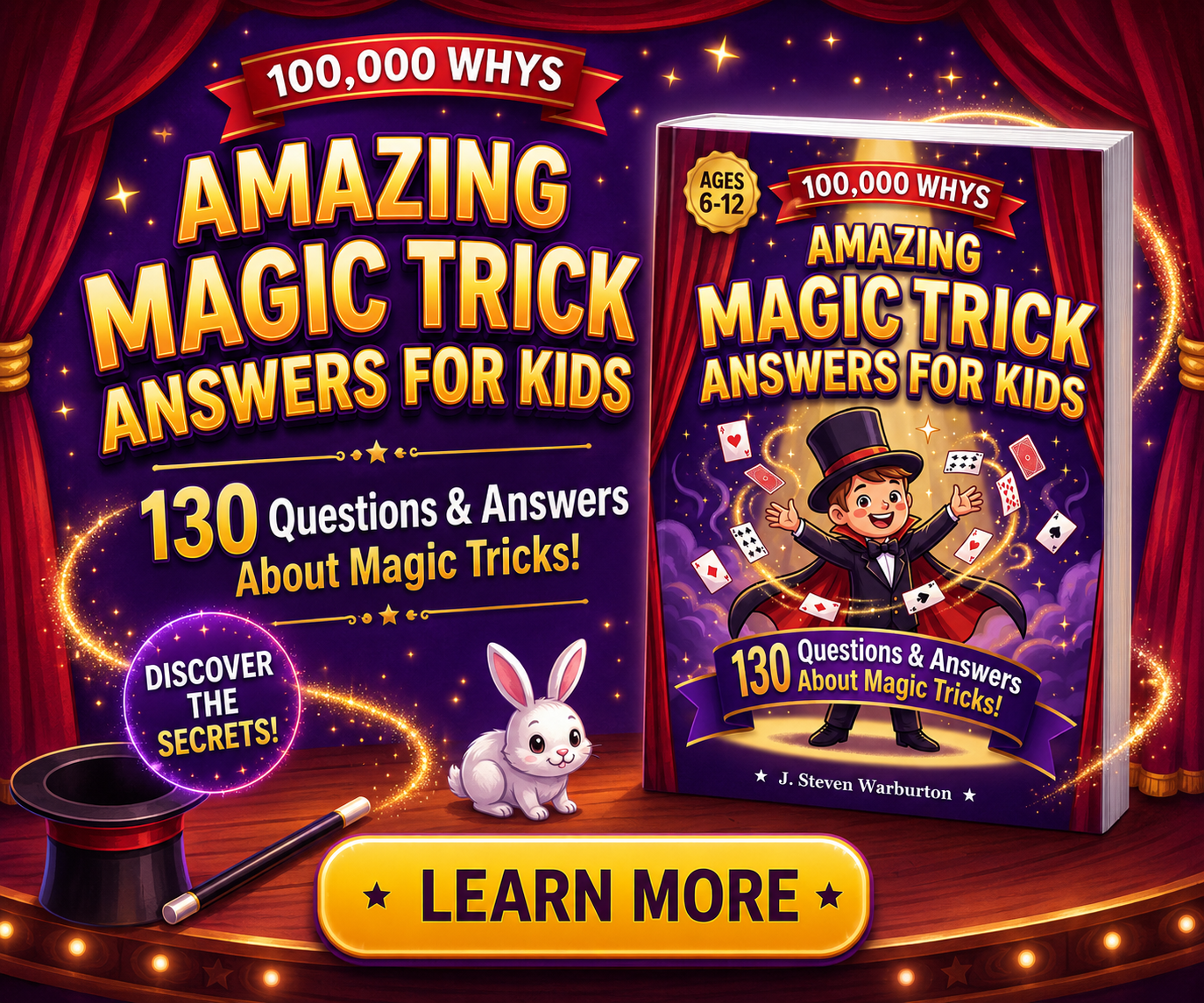
Amazing Magic Trick Answers For Kids With 100,000 Whys
Rather than focusing only on teaching a collection of tricks, the book explores the questions children naturally ask about the entire world of magic.
It includes 130 questions and answers covering subjects such as:
Famous magicians. Card tricks. Escape artists. Mind reading. Levitation and flying. Magic from around the world. Illusions. Performance secrets. And many of the mysteries children wonder about after watching a magician.
The book was created especially for children ages 6-12 , using colorful illustrations and clear, kid-friendly explanations.
The goal is simple:
Turn “How did they do that?” into “Wow—I want to learn more.”
Read Magic Books Together
Parents and grandparents can make magic even more meaningful by exploring it with a child.
You don’t need any magical knowledge.
In fact, not knowing the answers can sometimes make the experience better.
Take turns choosing questions.
Ask the child to predict the answer before reading it.
Talk about famous performers.
Look up historical photographs.
Watch an age-appropriate performance.
Try a beginner trick together.
Create a small family magic show.
Let the child design a poster or admission ticket.
Invite grandparents, siblings, or friends.
Suddenly reading becomes an activity rather than an assignment.
Let Children Become the Teacher
One of the best ways to discover whether someone understands a subject is to ask that person to explain it.
Magic makes this easy.
After a child learns something interesting, ask:
“Can you explain that to me?”
Maybe the child just learned why magicians use misdirection.
Let them explain it.
Perhaps they learned who Houdini was.
Ask for three interesting facts.
Maybe they learned about card magic.
Ask what makes card tricks so popular.
When children teach what they have learned, they strengthen their own understanding.
They also practice communication.
Help Them Create Their First Magic Show
Eventually, curiosity may turn into performance.
Encourage it.
A first magic show doesn’t need a theater.
A living room works perfectly.
Help the young magician choose three to five tricks.
Then arrange them in an order.
Perhaps:
Start with something quick.
Perform a card or coin trick.
Include an audience participation trick.
Perform something visual.
Finish with the strongest trick.
Then practice the words between the tricks.
That matters.
Instead of:
“Okay, here’s another trick.”
Teach the child to create a story.
“Magicians have been making objects disappear for hundreds of years. I’m going to try something similar with this coin.”
Now the performance has context.
The child isn’t simply demonstrating a secret.
The child is becoming an entertainer.
Praise the Practice, Not Just the Result
When children perform magic, adults naturally respond to the final effect.
“Wow!”
“That’s amazing!”
“How did you do that?”
Those reactions are fun.
But also praise the work behind the performance.
“I can tell you practiced that.”
“Your presentation was much smoother.”
“You did a great job speaking clearly.”
“You handled that mistake really well.”
“You kept going even when something didn’t work perfectly.”
Those comments reinforce habits that matter far beyond magic.
Every Great Magician Started by Being Curious
No magician begins by knowing everything.
Every performer was once a beginner.
Every collector once owned a first magic trick.
Every expert once struggled with something that eventually became easy.
And almost every lifelong interest begins with a question.
For a child, that question might be:
How did the magician know that card?
Or:
How did Houdini escape?
Or:
Can people really levitate?
Or simply:
How does magic work?
Adults don’t always need to provide immediate answers.
Sometimes our most important role is keeping the curiosity alive.
Encourage children to watch.
Encourage them to read.
Encourage them to practice.
Encourage them to ask questions.
And when they arrive with another mystery—another one of their seemingly 100,000 whys —take the question seriously.