








⚡ TL;DR: This guide explains how Howard Thurston scaled wonder into a repeatable touring business through positioning, operations, and trust.
📋 What You’ll Learn
In this comprehensive guide about Howard Thurston, we’ve compiled everything you need to know. Here’s what this covers:
- Positioning that audiences repeat – Learn how Howard Thurston’s “single-sentence promise” reduced cognitive load, stabilized messaging across posters, press, and venue listings, and increased ticket conversion by preventing brand drift.
- Touring operations as a scalable production system – Discover why the Golden Age advantage was runbooks, checklists, cueing, redundancy, and prop lifecycle management—turning illusions into predictable, safe, and cost-controlled deliverables.
- Distribution and route economics over vanity venues – Understand how Howard Thurston’s routing logic prioritized attendance probability, lower deadhead miles, and dependable local partners—an approach that maps to modern ticketing analytics, UTMs, and platform dashboards.
- Trust-first marketing that compounds – Master the credibility stack—reviews, local press relationships, clear customer experience details (runtime, policies, access), and consistent delivery—so “mystery” sells externally while operations stay transparent internally.
Quick Summary & Key Takeaways
- Howard Thurston didn’t “just perform.” He engineered a touring brand with repeatable production systems, controlled messaging, and a ruthless focus on audience psychology.
- The headline lesson for working magicians: build an operational stack (people, cases, cueing, maintenance, transport) before chasing bigger props and pricier ads.
- Marketing mattered, but so did proof: reviews, local press relationships, and venue-specific positioning created a compounding trust effect.
- Modern equivalents—CRM, ticketing pixels, creative testing, and merch funnels—map cleanly onto the old playbook when applied with discipline.
- The hard truth: “mystery” sells best when the business is transparent internally—budgets, roles, safety checks, and ownership of methods.
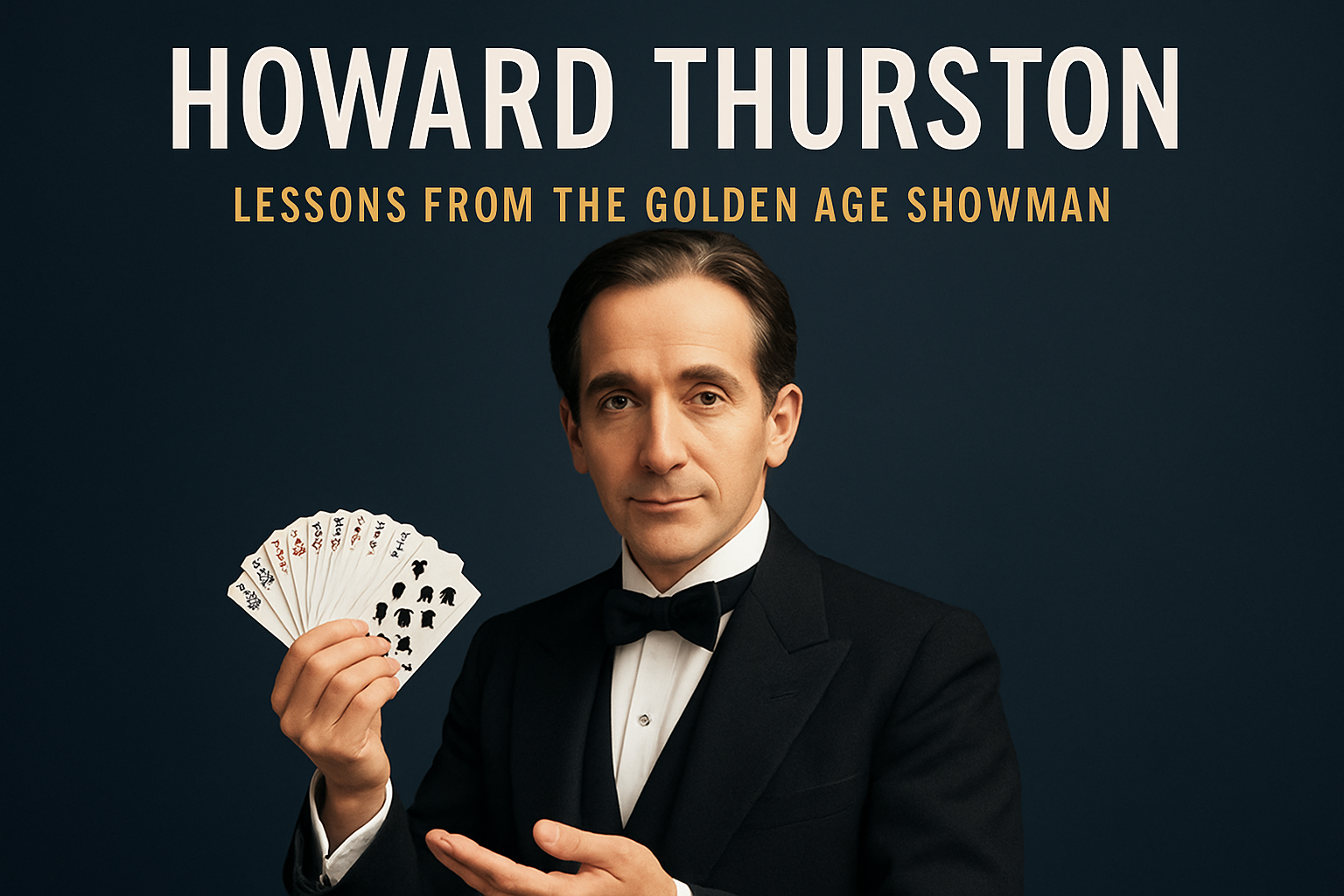
Howard Thurston is often introduced as a name on posters—top hat, grand stage, impossible vanish—yet the sharper story sits behind the curtain. In 2026, live-event operators are paying attention to the same constraint Thurston fought: attention is expensive. PwC’s 2026 Entertainment & Media outlook projects global live events revenue growth with uneven regional rebounds and rising customer acquisition costs, forcing producers to tighten operations and differentiate branding (https://www.pwc.com/gx/en/industries/technology/publications/global-entertainment-media-outlook.html). That pressure makes Howard Thurston newly practical, not nostalgic. Howard Thurston built a repeatable spectacle in a chaotic touring era—without pixels, retargeting, or automated ticketing.
The contrarian point: the “Golden Age” wasn’t powered by secrets; it was powered by systems. Howard Thurston treated wonder like a manufactured product—designed, rehearsed, routed, maintained, sold, and reviewed. Read him as a founder with stagehands instead of engineers. For today’s magician industry—cabaret headliners, cruise-ship acts, theater illusionists, and corporate mentalists—his playbook translates into modern magician branding strategy, touring illusion show logistics, and ticket marketing for stage magicians without losing the art.

Advanced Insights & Strategy
Think of Thurston’s success as a three-layer stack: (1) a clear promise the public could repeat, (2) a production pipeline that kept that promise consistent across cities, and (3) distribution—press, venues, and routing—that made the pipeline financially viable. The lesson isn’t “be famous.” It’s “be shippable.”
Positioning As A Single Sentence The Audience Can Repeat
Thurston-era posters didn’t ask the public to understand method; they offered a clean, legible outcome: mysteries, marvels, and a night worth dressing up for. That’s not a tagline exercise—it’s cognitive load management. In modern terms, it’s the same reason short-form ad creative outperforms in early funnel: people decide fast, then justify later.

For a working act, this becomes a hard constraint: if the show cannot be described in one sentence by a venue manager and repeated accurately by a local paper, it will drift. Drift kills conversions. A practical test used by several theater marketing shops—such as AKA NYC and Situation Interactive—is message recall in post-click surveys, where users are asked what they think they’re buying before checkout (https://www.aka.nyc/, https://situationinteractive.com/). Apply the same logic to magic: the promise must be stable across posters, PR blurbs, event pages, and the emcee’s intro.
Production As A Repeatable “Runbook,” Not A Vibe
The public sees miracles; the crew sees a checklist. Thurston’s era demanded standardized packing, setup, maintenance, and cues because a broken illusion in a new city didn’t just disappoint—it threatened the route’s profitability. Today, touring magic that scales uses the same operational doctrine: written runbooks, redundancy for critical components, and a strict “no improvisation” rule for safety items (trapdoors, blades, pyrotechnics, suspension rigs).
Modern production management borrows from theater and corporate events: cue stacks, prop tracking, and preflight inspections. Tools like Monday.com and Notion aren’t glamorous, but they prevent the “where is the gimmick” spiral at 5:40 p.m. before doors. The strategic move is to treat every prop as an asset with lifecycle costs: build, transport, wear, repair, insurance, and failure risk. That framing turns artistry into a controllable P&L line item.
Distribution: Route Economics Beats “Biggest Stage” Ego
Thurston’s business logic favored routes that reduced deadhead miles and maximized high-probability attendance. In 2026, route optimization is more measurable: fuel costs, crew overtime, local marketing spend, and venue deal terms can be modeled city-by-city. Event producers use routing heuristics similar to touring bands—cluster markets, stabilize load-in times, and avoid calendar conflicts with local tentpoles.
Ticketing data has made the distribution layer brutally transparent. Platforms like Ticketmaster and AXS provide dashboards, while independent sellers can approximate with GA4, Meta Ads Manager, and UTM-tagged links. The “Thurston translation” is simple: design the tour around conversion probability, not vanity. A 900-seat theater with a press partner and a responsive email list can outgross a 2,200-seat room that treats magic as filler between tribute bands.
Howard Thurston And The Business Engine Behind The Wonder
This section breaks the romance on purpose. The show was a product line, and the product line had constraints: brand clarity, controlled narratives, and repeatable audience satisfaction. Howard Thurston operated like an operator—building trust at scale while guarding quality.
Howard Thurston’s Brand Was Built On Trust, Not Just Mystery
Audiences didn’t buy tickets because they understood levitation; they bought tickets because they believed the night would be worth it. Trust came from consistency: reviews that matched the poster’s promise, a venue that felt respectable, and an act that hit its marks. That’s brand—expectations met repeatedly, under different conditions.
Modern magicians often chase “viral” moments while neglecting the boring trust machinery: refund policies, clear runtime, ADA access notes, and professional comms with venues. In live entertainment, friction is a silent killer. Even small improvements matter. Google’s Search documentation and performance guidance stresses reducing user friction and improving page experience signals (https://developers.google.com/search/docs). Translate that to magic: your ticketing page, FAQs, confirmation emails, and door policy are part of the act.
Publicity And Press: The Original Performance Funnel
Before paid social, the local paper was the targeting engine. A smart publicist could frame the show as culture, not novelty—an evening of “refined astonishment” rather than a cheap trick night. The mechanism is familiar: earned media carries borrowed credibility, and credibility reduces purchase anxiety. The old press-clipping scrapbook is the analog version of a modern “as seen in” bar.
Today’s equivalent is a press stack across local culture desks, morning TV, venue newsletters, and short-form creator partnerships. The strongest magician PR campaigns still angle for narrative specificity: not “magician performs downtown,” but “restored 1920s theater hosts a one-night illusion spectacular with live music and practical effects.” A clean kit—press photos, 20-second b-roll, and a venue-ready blurb—does what Thurston’s posters did: it makes the story easy to repeat accurately.
Merch, Upsells, And The Quiet Economics Of The Lobby
The magician industry tends to treat merchandise as something bands do. That’s leaving money on the table. Golden Age touring acts understood that the lobby is where the audience converts emotion into keepsakes. In modern touring, that can be souvenir programs, signed decks, premium photos, or VIP post-show micro-performances with strict throughput control.
Payment friction has dropped dramatically. Stripe’s 2026 commerce updates emphasize streamlined checkout flows and local payment methods that raise completion rates in live settings (https://stripe.com/newsroom). A practical “Thurston” approach is to design merch that matches your promise: if the show sells elegance, don’t sell cheap plastic. If it sells danger, sell artifacts—numbered “case files,” metal tokens, signed posters with city/date, and premium bundles reserved for VIP tiers.
Touring Operations: The Logistics That Made The Illusion Possible
Great magic fails for mundane reasons: late trucks, missing hardware, inconsistent stagehands, and a soundcheck that eats rehearsal time. Touring success has less to do with “bigger illusions” and more to do with operational discipline. The Thurston lesson is clear: logistics is part of the method.
Road Cases, Maintenance Cycles, And Failure Budgets
Illusions are machines that get shaken for a living. A touring act that doesn’t track maintenance will eventually pay in public. The practical standard used by many production managers mirrors aerospace-style preflight logic: define inspection intervals, document wear points, and pre-stage replacements. Hardware fatigue isn’t dramatic until it is.
Build a failure budget into the tour economics: spare hinges, duplicate electronics, backup remote triggers, redundant mic capsules, and at least one “if everything breaks” segment that can close the show without betraying quality. In the magician industry, that fallback is often a tight, high-impact mentalism set or a comedy bit that plays big on minimal gear. The show remains shippable even when the truck betrays you.
Cueing, Sightlines, And The Unsexy Science Of Blocking
One reason Golden Age stage magic hit so hard: it was staged for the room. Sightlines were managed; angles were policed; assistants’ paths were choreographed. That’s not just choreography—it’s risk management. Blocking errors don’t merely expose method; they fracture belief.
Modern crews can quantify this with pre-rig diagrams and venue-specific overlays. Many touring productions use Vectorworks Spotlight or SketchUp to map stage footprints and prop placement before arrival. The Thurston-style discipline is to treat every venue as a new problem with known variables—proscenium width, wing depth, loading access, and fly system limits—rather than assuming the show “should” fit. That mindset prevents last-minute compromises that make illusions look small or suspicious.
Insurance, Safety, And Contracts That Protect The Secret
Contracts rarely feel artistic, but they safeguard the conditions needed for deception: controlled access, limited photography, and safe working practices. Modern venues can support phone-lock systems (like Yondr) for select segments, and many theater contracts already allow no-recording language. The more professional the paperwork, the easier it is to enforce without sounding paranoid.
Safety is also reputational capital. A single incident spreads faster than any poster ever did. For reference points on venue safety norms and event risk planning, the Event Safety Alliance publishes practical guidance for live-event operations (https://www.eventsafetyalliance.org/). A “Thurston-grade” operation treats safety briefings as part of the call: trap checks, blade locks, harness inspections, and a clear stop protocol. The audience should never see the machinery—unless the machinery fails.
The Modern Magician’s Playbook Through A Howard Thurston Lens
It’s tempting to treat early 1900s showmanship as an antique skillset. That misses the point. Thurston’s competitive advantage—clear promise, consistent delivery, and aggressive distribution—maps cleanly onto modern social media, SEO, email marketing, and conversion analytics when used with restraint and taste.
SEO And Discoverability: Turning Curiosity Into Ticket Sales
Search demand for live entertainment is spiky: it surges around holidays, school breaks, and corporate event seasons. The modern version of a poster wall is a search results page. That means the working magician needs structured pages that match intent: “stage magician for corporate gala,” “illusion show near me,” “family-friendly theater magic,” and “parlor magic evening with cocktails.” Those are long-tail keywords that convert because they reflect a buyer’s plan, not a browser’s whim.
Google’s guidelines emphasize helpful, specific content that satisfies the query quickly (https://developers.google.com/search/docs/fundamentals/creating-helpful-content). Apply the Thurston lens: write venue-ready pages that answer runtime, age guidance, accessibility, and what the audience will feel—without explaining methods. Pair that with fast pages, clean schema for events, and localized landing pages per city on a tour. This is magician website SEO that behaves like a ticketing machine, not a vanity portfolio.
Creative Testing Without Killing The Mystique
Ad platforms reward iteration. Magic punishes overexposure. That tension can be managed with a simple rule: test framing, not method. Run A/B tests on promises (e.g., “practical illusions + live music” vs. “mind-reading + stage spectacle”), on audience identity (“date-night crowd” vs. “family matinee”), and on the first three seconds of video—without showing the payoff of your signature piece.

Meta’s advertiser resources and best practices for creative diversification outline why varied hooks and formats sustain performance (https://www.facebook.com/business/learn). The magician-industry version is to create multiple “entry points”: rehearsal-room texture, prop-case ASMR, comedic audience reactions, and venue glamour shots. Keep the method protected; sell the feeling. That’s straight Thurston: the poster never taught the trick, it sold the night.
Pricing Architecture: Prestige, Accessibility, And The Mid-Tier That Pays Rent
Ticket pricing is where many acts quietly cap their growth. A single price point forces one audience to subsidize another. Strong touring shows use a tiered architecture: limited premium seats, a broad mid-tier, and a controlled low-price tranche for accessibility and last-minute fill. The psychology is familiar in theater and sports: anchors, scarcity, and the comfort of “good choice” seats.
In 2026, dynamic pricing is normal across live events, but it can backfire in niche entertainment if it feels predatory. The Thurston approach would be to make the premium feel like a different product: early entry, a signed program, a short private effect, or a backstage walk-through of non-secret set pieces. This is the “best marketing strategies for stage magicians” issue that rarely gets treated with seriousness: pricing is messaging. A cheap ticket says “small night.” A fair mid-tier says “professional night.” A premium tier says “occasion.”
What Most Get Completely Wrong About Howard Thurston
The popular takeaway is that Howard Thurston succeeded because he had better tricks. That’s the story magicians tell because it’s comfortable: it keeps the competition inside the prop case. The uncomfortable truth is that the biggest edge was operational and commercial. The show was engineered to travel, to sell, and to be remembered accurately by people who didn’t care how it worked.
I learned this the hard way watching a technically stronger illusionist struggle to sell a 600-seat run while a “simpler” act sold out four nights in the same market. The difference wasn’t skill; it was packaging. One show had a one-sentence promise, tight press photos, and a venue partnership that put the act in three newsletters and a local arts podcast. The other had a brilliant trailer that explained too much and a ticket page that buried the runtime.
My rule: protect the secret, expose the system. When an act documents cueing, maintenance, travel timing, and sales assets, it becomes repeatable. When it treats everything as improvised art, it becomes fragile. Howard Thurston didn’t build fragile.
“The audience doesn’t buy method; they buy certainty—certainty that the night will feel special and the story will be easy to retell.” – Celia Moreno, Touring Producer, ArcLight Live Entertainment
Howard Thurston’s Legacy: Ethics, Credit, And The Real Cost Of Secrecy
Legacy in magic is complicated because the product is hidden. That makes credit, ethics, and ownership unusually contentious. Thurston’s era sharpened these tensions: posters sold spectacle while creators and builders fought for recognition behind the scenes. Today’s magician industry still lives inside that same paradox.
Credit In Magic: The Hidden Supply Chain
Magic methods often come from a network: inventors, builders, choreographers, costume designers, composers, and consultants. The public sees one name. The backstage reality looks more like a film credit roll. When that supply chain is invisible, disputes become personal and public trust erodes inside the industry.
Modern professional practice is moving toward clearer attribution in private channels: contracts specifying licensing, NDAs that also define credit language, and builder agreements that separate “use rights” from “ownership.” It’s not about virtue signaling. It’s about reducing ambiguity. Clear paperwork is cheaper than drama, and drama is expensive when tours depend on relationships with builders and consultants.
Secrecy As Brand Asset vs. Secrecy As Operational Liability
Secrecy sells tickets, but secrecy can also choke an organization. If only one person knows how to reset the signature illusion, the tour is one flu away from disaster. If only one person has the audio session files, a corrupted laptop becomes a show-stopper. The practical answer is compartmentalization: keep method protected while distributing operational knowledge.
This is standard in security and safety cultures: limit sensitive details while ensuring redundancy for critical operations. A useful analogy appears in NIST’s security frameworks—segmentation, role-based access, and documentation that supports continuity (https://www.nist.gov/cyberframework). For magicians, that means: crew knows how to run it, not why it works. That’s how a Thurston-scale tour survives friction.
Reputation Compounds: How Legends Stay Bankable
Reputation in live entertainment is a compounding asset. A show that reliably delivers becomes easier to book, easier to insure, easier to staff, and easier to promote. That compounding effect is why “legend” status persists across decades: it creates an assumption of quality before the first ad is served.
Modern analogs are measurable: review velocity, refund rates, and email list growth. While the specifics vary by platform, the mechanism is consistent—social proof reduces perceived risk. For magicians, this is where audience management matters: clean show flow, crisp endings, and intentional “memory beats” that people describe afterward. Thurston understood that the post-show story is part of the show.
Frequently Asked Questions About Howard Thurston
How can a touring illusionist apply Howard Thurston’s routing logic to a 2026 regional theater run?
Cluster markets to reduce deadhead and stabilize crew hours, then negotiate bundled dates with venues (two-night holds convert better than one-offs). Use ticketing UTM links per city, track conversion by channel in GA4, and shift paid spend toward markets where email and venue newsletters show higher assisted conversions. The principle mirrors Thurston: route economics first, ego second.
Conclusion
Howard Thurston remains instructive because the core problem hasn’t changed: sell a promise of wonder, then deliver it flawlessly under messy conditions. Howard Thurston treated magic as a disciplined touring product—brand clarity, operational runbooks, and distribution that favored conversion over vanity—while keeping the art intact. The modern magician who studies that engine, not just the legend, gets bankable.
The Myth: Bigger Secrets Win—The Reality: Better Systems Win
The industry loves to credit success to a new method, but audiences pay for consistency and confidence. A tightly engineered 75-minute show with repeatable staging will out-earn a “cleverer” act that can’t load in, reset, and sell itself cleanly across venues.
A Real-World Example That Mirrors The Thurston Playbook
Cirque du Soleil’s touring model demonstrates the same doctrine at modern scale: standardized production roles, rigorous maintenance, venue advancing, and a brand promise audiences can repeat. Their public operational materials and hiring pipelines show how repeatability—not constant reinvention—keeps complex live spectacle financially stable (https://www.cirquedusoleil.com/).
The Core Rule That Keeps Magic Bankable
Protect the method, standardize the delivery: every illusion should have documented cueing, reset, maintenance, and a venue-fit plan so the audience experiences wonder—not the cost of improvisation.

Find out more information about “Howard Thurston”
Search for more resources and information: