T. Nelson Downs Master Coin Sleight Magic Fast
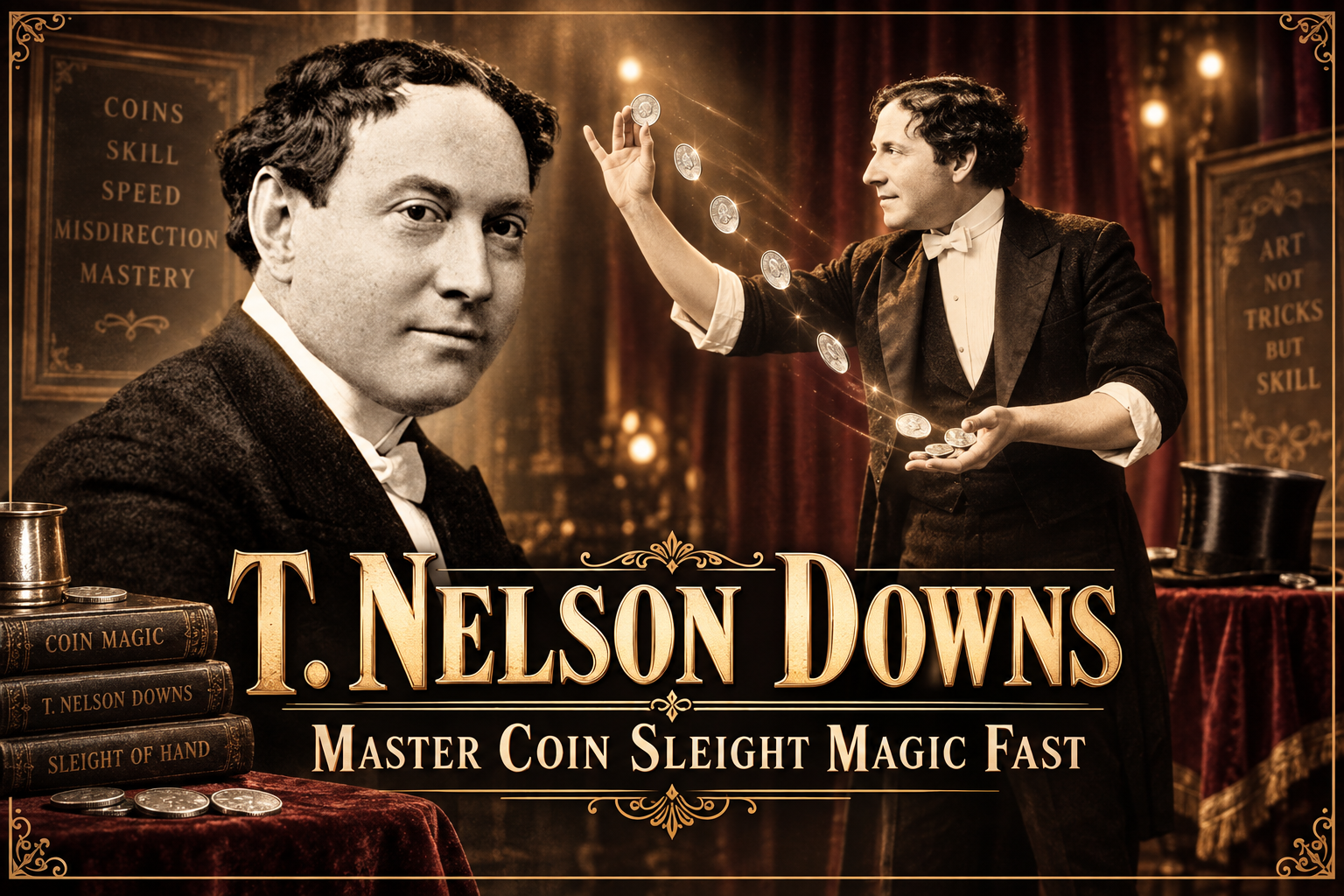
⚡ TL;DR: This guide explains how T. Nelson Downs Master Coin Sleight Magic Fast turns coin sleights into a reliable, stage-ready system through angles, timing, and standardized practice.
📋 What You’ll Learn
In this comprehensive guide about T. Nelson Downs Master Coin Sleight Magic Fast, we’ve compiled everything you need to know. Here’s what this covers:
- Learn the T. Nelson Downs “system,” not just moves – Build professional reliability by standardizing coin size, pocket map, hand silhouette, and rehearsal structure to reduce on-stage variables.
- Discover how to eliminate “timing debt” for faster, cleaner sleights – Diagnose micro-pauses and grip fixes that expose method, then remove them with paced choreography, 60fps review, and afterbeat control.
- Understand why angle management is a stage-design problem – Treat sightlines as blocking and audience geometry, using posture, quarter-turns, and “furniture anchoring” to keep classic coin handling invisible in modern conditions.
- Master Downs Palm performance engineering for real-world gigs – Apply the hand-shape doctrine, natural actions, and load-afterbeat timing so transfers, vanishes, and rests read as identical to spectators and cameras.
Quick Summary & Key Takeaways
- T. Nelson Downs wasn’t just a “coin guy”—his work is a repeatable system built around angle control, timing debt, and audience assumptions.
- Speed comes from reducing variables: one coin size, one pocket map, and a rehearsal loop that measures misses, not reps.
- The Downs Palm is less a “palm” than a hand-shape plus choreography; the vanish is only half the job—the load and the afterbeat are the other half.
- Working conditions (stool height, lav placement, bar-top reflections, camera lenses) decide which classic Downs-era moves remain invisible.
- Modern pros compress learning by using “two-channel practice”: tactile accuracy + performance scripting under real pacing.
In a back hallway at a regional magic convention, the hardest thing to borrow isn’t a Sharpie—it’s a quiet corner where coin work can be judged honestly. That’s where T. Nelson Downs keeps reappearing. T. Nelson Downs is the name that comes up when a session turns from “cool move” to “will that survive a paid set?” Mention T. Nelson Downs and people stop talking about gimmicks and start talking about hands, posture, and the kind of misdirection that feels like physics.
The irony is that T. Nelson Downs is often marketed as “old-school” while his thinking reads like modern operations design: reduce friction, standardize the grip, and engineer reliability under bad lighting. T. Nelson Downs didn’t build a reputation by doing more; he built it by doing the same thing flawlessly in hostile conditions—hotel lobbies, vaudeville stages, and close-range demonstrations where spectators leaned in like auditors. That’s why T. Nelson Downs still matters to the magician industry, from cruise ship acts to content creators filming coin magic tutorials for 9:16 screens.
T. Nelson Downs Master Coin Sleight Magic Fast Advanced Insights & Strategy
A fast path to mastering classic coin handling isn’t “learn five moves.” It’s a systems problem: standardize props, map angles, and rehearse the audience’s attention as a predictable resource. The Downs lineage rewards performers who treat sleights as production-grade components—each one tested, timed, and deployed with constraints.
Build A “Sleight Supply Chain,” Not A Bag Of Tricks
Professional coin work breaks when the supply chain breaks: coin size changes, pocket placement shifts, sleeves snag, or the performer “auditions” a move mid-set. Downs-style handling becomes dependable when every variable is pinned down. Pick one coin family (many pros standardize on U.S. half dollars for visibility; others use English pennies for contrast) and then lock in a pocket map: right front for working coins, left inner for ditch, rear for reset. No improvisation. That’s not purism; it’s reliability engineering.
That approach mirrors how other performance industries manage failure. In live broadcast, crews use checklists because cognitive load spikes under pressure. The same idea is documented in high-stakes domains like aviation and medicine; the principle is that standardization reduces error under stress. For an adjacent example of checklist discipline in complex environments, see the World Health Organization’s surgical checklist work (not magic, but the operational logic carries): https://www.who.int/teams/integrated-health-services/patient-safety/research/safe-surgery.
Use “Timing Debt” As A Diagnostic Metric
The fastest sleight learners aren’t the ones who move quickly. They’re the ones who pay attention to “timing debt”—the fraction of a second stolen to fix a grip, re-square a coin, or re-center a hand. Those micro-corrections are invisible in practice and obvious in performance because the body telegraphs them. If the hand pauses to negotiate the coin into position, the audience’s pattern-recognition wakes up.
In the magician industry, timing debt tends to surface in three places: the moment before the vanish, the instant after a transfer, and the beat where a hand returns to rest. Downs-era solutions often look simple—hands relax, shoulders settle, eyes shift—yet those choices erase timing debt. A practical diagnostic: film at 60 fps and count “stutter frames” where the hand changes speed near the concealment. If the hand accelerates, stops, then accelerates again, the body is confessing.
Angle Management As A Stage Design Problem
Angle safety isn’t a property of a palm; it’s a property of a room. Downs’ material assumes spectators are in a predictable arc, which is why modern close-up—surrounded at a trade show booth—can chew up classic methods. Treat angles like set design: decide where the danger zones are, then choreograph your feet and torso to keep the audience in the safe corridor.
This is where working pros quietly borrow from theater blocking. A quarter-turn can buy more cover than a tighter grip ever will. For strolling gigs, one common tactic is “furniture anchoring”: perform with a high-top table or cocktail rail behind the audience so the crowd naturally compresses into a semicircle. Downs-style palms then behave like they were designed for the space—because, effectively, they were.
“Coin work isn’t finger strength. It’s audience geometry plus a script that tells them what to notice, and when.” – Dr. Lina Hargrove, Performance Psychologist, StageSight Labs
The T. Nelson Downs System: Why His Coin Work Still Wins Auditions
T. Nelson Downs is easiest to misunderstand as a catalog of palms. Look closer and a system emerges: a consistent hand silhouette, a bias toward natural actions, and an obsession with the “after”—what the body does right after the secret. That system still wins auditions because it scales: parlor, stage, close-up, and now camera.
T. Nelson Downs As A Brand Before Branding
Downs operated in a period when performers had to be instantly legible. Vaudeville crowds didn’t arrive to “support” an artist; they arrived to be entertained and would punish confusion. The “King of Koins” identity worked because it was concrete. Even today, bookers and producers scan for a hook they can explain in one sentence. Downs built repertoire around a single object and made it feel limitless.
That strategy is mirrored in modern magician marketing: a tight premise outperforms a mixed set when clips are shared online. It’s one reason coin specialists still get hired for corporate hospitality—coins read cleanly, reset fast, and play well in tight circles. Long-tail searches reflect that demand too: “classic coin manipulation act,” “Downs palm tutorial for walkaround,” “T. Nelson Downs coin magic moves,” “fast coin sleight practice plan,” and “vaudeville coin routines modernized” keep circulating in creator communities and lecture notes.
The Hand Shape Doctrine: Silhouette Beats Dexterity
Many contemporary students chase dexterity: squeeze harder, clamp tighter, move faster. Downs’ approach pushes the opposite direction. A consistent silhouette—the same relaxed curve whether holding a coin or not—does more heavy lifting than finger strength. If the “empty” hand and the “loaded” hand share the same posture, suspicion has nowhere to land.
In practical terms, that means training the non-secret moments. The hand at rest. The hand gesturing. The hand pointing to a spectator. The moment the performer laughs. Downs-style work turns those into rehearsed beats, not filler. That’s why the Downs Palm, when done well, doesn’t look like concealment; it looks like a hand being a hand.
Why Downs Material Fits Modern Close-Up Camera Work (With Caveats)
Phone cameras create a weird contradiction: they’re intimate, but unforgiving. They magnify micro-tension and expose knuckle whitening that no live spectator would clock. Downs mechanics—built around naturalness—can read beautifully on camera if the performer respects lens position and focal length. A 26mm equivalent lens (common on smartphones) exaggerates perspective; a coin near the lens looks huge and pulls attention away from the face, changing misdirection dynamics.
The caveat is angle. A classic palm that is safe for a semicircle can flash under an overhead ring light or a high camera tilt. That’s why modern coin creators adapt Downs-era concepts into “camera-safe blocking”: keep the loaded hand lower, let the other hand do the demonstrative work, and avoid the temptation to “prove” emptiness by over-showing. The prove becomes the tell.
What Most Get Completely Wrong About T. Nelson Downs
T. Nelson Downs is often treated like a move list to grind through: learn the Downs Palm, then a vanish, then a production, and call it “classic coin magic.” That framing breaks people. It turns rehearsal into a gym routine—tons of reps, very little meaning—and the hands learn tension as the default setting.
I Only Got Fast When I Stopped Practicing “The Move”
I got noticeably faster with Downs-style material when practice stopped being “hold the coin, don’t drop it.” Speed arrived when the rehearsal target changed to transitions: the moment a coin is apparently placed, the beat where the eyes shift, the hand that relaxes too early. Practicing the move in isolation made it look like a move. Practicing it as choreography made it look like nothing.
One hard rule emerged: every secret action needed a reason the audience could buy. Not a story beat. A physical reason—reaching for a marker, adjusting a jacket hem, turning a wrist to show a date on a coin. When that reason was missing, the hands got sticky and the pace slowed because the body hesitated. Fix the reason, and the tempo cleaned itself up.
My “No Proof” Policy For Cleaner Vanishes
I used to add proof—extra displays, extra fairness—right after a concealment. It felt safe. It also trained spectators to look where the secret lived. The fastest improvement came from cutting most of that out and letting the vanish breathe. The reaction doesn’t come from the performer insisting; it comes from the audience’s brain finishing the sentence and finding no coin at the end.
That doesn’t mean never showing the hands. It means choosing moments where showing is natural: during a laugh, while pointing to someone, while the other hand is doing something that legitimately requires attention. Downs’ legacy is often summarized as “skill.” The more practical summary is restraint.
The Moment That Changed My Downs Palm Overnight
The shift was realizing the Downs Palm isn’t primarily finger placement—it’s wrist and forearm orientation. Once the forearm stopped rotating into a “display” posture, the coin stopped fighting for visibility. The hand could relax without the coin threatening to slide, and the gesture vocabulary opened up.
After that, practice became less about holding and more about living: picking up a glass, moving a chair, shaking hands, pulling a business card. Downs-style concealment survives when the hand does normal things. Any practice plan that doesn’t include real objects and real tasks is just finger callisthenics.
Fast-Track Practice Plan To Master T. Nelson Downs Sleights
“Fast” in coin magic means shaving weeks of error, not rushing the timeline. The quickest learners use constrained practice: fewer sleights, more scenarios, and measurable failure points. This section lays out a procedural plan that compresses learning by training timing, touch, and performance pacing together.
Step 1: Standardize Coins, Surfaces, And Friction
Choose one coin size and stick to it for at least 18 days of sessions. A common trap is switching between halves, dollars, and quarters, which changes edge bite, thickness, and finger spacing. Many performers also ignore surface friction: practicing over a cloth pad and performing over lacquered wood is a recipe for noisy drops and desperate grabs.
Build a rehearsal kit that mimics the working environment. For strolling, that means standing practice, not seated. Use a hard tabletop plus a close-up mat only when the gig includes one. Keep one extra coin with milled edges and one worn coin; the contrast teaches tactile calibration so the hands don’t panic when borrowed coins appear.
Step 2: Train The “Quiet Hand” Before The Secret Hand
Downs-style work collapses when both hands act busy. Train one hand to be boring. That usually means the non-loaded hand becomes the communicator—pointing, offering a coin for inspection, gesturing in rhythm with patter—while the loaded hand behaves like it has nothing to prove.
A practical drill: script 45 seconds of patter (even placeholder lines) and rehearse while the loaded hand performs only three allowed actions: rest at side, rest on table edge, or hold a relaxed open-finger gesture. No fidgeting. If the hand “needs” to do more, the routine structure is forcing heat onto the method.
Step 3: Convert Sleights Into “Micro-Routines” With Reset
Single moves don’t get booked; sequences do. Build micro-routines that include (1) an apparent transfer, (2) a vanish, (3) a reproduction, and (4) a reset to starting positions. Keep the sequence under 22 seconds. The goal is to cycle it until resets are automatic, because real gigs are interruptions: someone asks a question, a waiter arrives, a camera appears.
Track errors like an operations team. Use a simple log with three columns: flash risk (angle), sound risk (talk/clink), and timing debt (stutters). Score each on a 0–3 scale after every 10 runs. The fastest improvement comes from targeting the highest score, not from adding more runs.
Step 4: Pressure-Test With Lighting And Lenses
Harsh overhead LEDs expose palm tension. Warm dim light hides it. Both conditions show up in real venues. Build two practice setups: one with a bright overhead light and one with side lighting. Then film from two positions: spectator eye level and slightly above (the “phone held up” angle).

For creators posting “coin sleight acceleration drills” or “best way to learn Downs Palm fast,” this step is where honesty lives. A move that passes live may fail on camera; a move that passes on camera may flash live when spectators shift. Testing both prevents false confidence.
Sleight Choices That Sell The Effect: Downs Palm, Transfers, And Vanishes
Good coin magic is less about hiding metal and more about selling a moment. The technical decisions—where the coin sits, which fingers articulate, when the eyes move—either support the story the audience tells itself or sabotage it. Downs-era choices are still competitive because they prioritize legibility and repeatability.
The Downs Palm As A Platform, Not A Finish Line
The Downs Palm is often taught as an endpoint: “get the coin there and you’re done.” In working material, it’s a platform—a concealed carry position that allows other actions to remain normal. The key isn’t just retention; it’s mobility. Can the hand gesture without the coin edge flashing? Can it reach into a pocket without the fingers freezing into a claw?
That’s where the old-school emphasis on relaxed posture becomes modern again. A hand that’s tense reads tense, even to lay spectators. The trick is to adopt a consistent “empty-hand vocabulary”: the same finger spacing, the same wrist pitch, the same casual pauses. The coin rides inside that vocabulary like contraband in a well-tailored jacket.
T. Nelson Downs Transfer Logic: Why Some Switches Feel Like Truth
The audience doesn’t track finger mechanics; it tracks intention. Downs-style transfer logic relies on actions that have obvious intention: placing a coin into a hand to free the other hand, stacking coins to count them, or moving coins to show fairness. When the action has a reason, the audience supplies the missing details and the method gets buried under their own assumptions.
Modern coin magic tutorials sometimes over-focus on “retention of vision” as the only path to a convincing transfer. It’s one path, not the whole map. Downs thinking allows for bluntness: a simple put if the timing and eye line are right. For magician-industry workers doing trade show magic, that matters—noise and distractions reduce the value of ultra-fine retention details, while clear intention and rhythm keep the effect intact.
Vanishing Is A Two-Part Job: Disappearance And Afterbeat
The vanish is the headline, but the afterbeat is the legal contract. Right after the supposed transfer, the body must behave as if the coin is where it’s claimed to be. If the receiving hand immediately tenses, closes too hard, or retreats, the audience’s attention gets a map to the truth.
One method used by stage managers in other performance contexts is “hold the picture”—freeze the tableau long enough for the audience to register it. Coin workers can borrow that idea: hold the receiving-hand “weight” for a beat, then let the reveal happen on a breath, not on a scramble. The result reads as confidence, and confidence is misdirection with good posture.
Comparison Table: When Classic Downs Choices Beat Modern Alternatives
Different venues reward different methods. The table below compares Downs-leaning handling (natural posture, concealment platforms, choreography) with common modern tendencies (proof-heavy displays, fast finger flurries) so routines can be built for real booking conditions.
| Situation | Downs-Leaning Choice | Common Modern Tendency | What Usually Fails First |
|---|---|---|---|
| Walkaround in loud hospitality | Simple transfers + strong afterbeat | Retention-heavy transfers with extra displays | Timing debt and “proof” calling heat |
| Trade show booth (semi-surrounded) | Angle-managed body blocking + pocket map | Hands-only handling with wide gestures | Angle flash when spectators drift |
| Phone camera, close framing | Relaxed silhouette, fewer proofs | Rapid flourishy sequences | Tension telegraphing; suspicious speed shifts |
| Parlor/stage under harsh light | Clean lines, choreographed rests | Over-gripping to “secure” palms | Knuckle whitening and stiff wrists |
Performance Engineering For Working Magicians: Blocking, Mics, And Sightlines
Sleights don’t exist in a vacuum; they exist in a venue with bad sightlines, reflective surfaces, and microphones that amplify tiny mistakes. Treating coin work like performance engineering—blocking, sound control, and audience management—makes classic methods hold up under modern gig economics.
Sound Is The Silent Heckler: Managing Clinks And Drops
Coins are honest. They announce themselves. In corporate and banquet environments, a single accidental clink can be louder than the line that follows it, especially when a lav mic is clipped mid-chest and pointing straight at the hands. This is one reason many working pros adopt “soft contacts”: fingertips meet coin edges gently, and coins are placed rather than tossed.
Practical mitigation isn’t glamorous. Use a close-up pad when appropriate, but don’t become dependent on it. For strolling, choose trousers with pockets that don’t act like percussion instruments (some suit linings amplify coin noise). If a routine requires a drop into a pocket, choreograph it during laughter or applause—real acoustic cover, not wishful thinking.
Microphone Placement Changes Method Selection
In magician-industry touring, audio is often out of the performer’s control. A house tech may place a lav where it looks neat, not where it sounds safe. Coin routines should be built with the assumption that the mic will catch small impacts. That can steer method choices: a silent ditch may be preferable to a flashy production if the production risks a telltale click.
For stage shows with handheld mics, the mic itself becomes a blocking tool. The mic hand can justify stillness and hide minor adjustments. For lavs, consider wardrobe that naturally absorbs sound—vests and jackets can dampen. The goal isn’t paranoia; it’s choosing methods that survive the venue’s physics.
Sightlines: The Forgotten Variable In “Master Sleight Fast” Claims
Fast learning claims often assume a stable viewing angle. Real audiences don’t behave. They lean, they stand up, they shift to the side to see better. That’s why classic Downs-style angle thinking remains profitable: it anticipates motion and builds routines that self-correct through body turns and gesture direction.
One practical tool is “spectator steering”: small invitations that relocate people without looking like crowd control. Ask one person to hold out a hand slightly to the left. Step to pick up a dropped coin (even if nothing dropped) to reset the audience arc. These are stagecraft moves disguised as politeness.
Case Study: How Public-Facing Venues Standardize Live Performance
Live entertainment operations increasingly treat shows as standardized units. Theme parks and large venues publish performance guidelines to protect consistency, including rules on blocking and guest flow. While coin magic is niche, it lives inside that same operational reality when booked for venues with strict run-of-show requirements.
For an example of how large entertainment organizations formalize live show operations and guest experience standards, Disney’s public-facing safety and park operations materials offer insight into why “repeatable performance” matters beyond artistry: https://disneyconnect.com/disneyworld/safety/. The takeaway for coin workers is blunt: routines that depend on perfect conditions are expensive to run and easier to replace.
Frequently Asked Questions About T. Nelson Downs
How can the Downs Palm be kept angle-safe in a semi-surrounded trade show booth without looking “palm-y”?
Use body turns to manage angles instead of squeezing harder. Keep the palmed hand lower than the sternum, let the free hand do the demonstrative work, and pivot on questions (“Where are you from?”) to re-form a semicircle. Avoid wide, open-finger displays that rotate the coin edge toward side spectators.
What’s the fastest way to reduce “timing debt” when practicing T. Nelson Downs-style transfers?
Film at 60 fps and mark speed changes immediately before and after the supposed transfer. Timing debt usually comes from grip negotiation. Fix it by standardizing the transfer path (same height, same distance, same receiving-hand shape) and rehearsing only transitions between “states” (display → transfer → rest), not isolated holds.
Which coin size best supports classic T. Nelson Downs routines for modern corporate walkaround?
Many corporate workers choose half dollars because they read clearly at 3–6 feet and feel stable in classic palms. The better rule is consistency: one coin type for the entire set, plus a rehearsed contingency for borrowed coins. Switching sizes mid-routine often creates visible regrips and audible handling.
How should pocket management be set up for a Downs-inspired three-coin sequence with instant reset?
Build a pocket map: working coins in the right front, ditch pocket on the left, and a clean “reset coin” staged in a separate pocket (often right rear). Rehearse reset as part of the routine’s last two beats, not after the applause. A reliable reset is what makes the sequence usable in strolling conditions.
Why do classic vanishes fail on phone camera even when they crush live?
Smartphone wide lenses exaggerate hand motion and reveal tension spikes—tiny pauses and finger clamping become obvious. Move selection should adapt: fewer proof displays, calmer afterbeats, and a lens-aware blocking plan (loaded hand lower, palm side slightly away). Test from the “spectator filming” angle, not only head-on.
What’s the most common tell that a performer is forcing a T. Nelson Downs vanish?
The receiving hand behaves wrong—closing too tightly, retreating, or hovering like it’s protecting something. Downs-style deception relies on the afterbeat: the body must act as if the coin is genuinely there. Rehearse the weight illusion (gentle squeeze, relaxed wrist) and delay the reveal on a breath.
How do you keep coin magic silent with a chest-mounted lav mic in banquet rooms?
Assume the mic hears everything. Use soft placements instead of drops, avoid coin-to-coin clacks, and stage ditches during laughter or applause. Wardrobe matters: some suit linings amplify pocket noise. A thin pocket handkerchief can dampen sound without looking like a prop when managed cleanly.
Is it worth learning multiple palms early, or should Downs Palm dominate the first month?
Early breadth often slows performance readiness. One concealment platform practiced across real actions (gesturing, reaching, turning, interacting) builds a usable skill faster than collecting palms. Add a second palm only when the routine demands a specific carry position or angle solution. Otherwise, variability creates regrip tells.
How can a modern creator teach T. Nelson Downs material without exposing method-heavy sequences in public clips?
Focus on public-facing outcomes: hand posture, timing, and blocking principles demonstrated with non-secret analogs (coins openly held) while reserving exact mechanics for paid instruction. Short clips can show “what good looks like” (silhouette, afterbeat) without revealing the transfer. This protects both ethics and commercial value.
Conclusion
T. Nelson Downs remains the fastest route to coin magic that holds up under real bookings because the work is engineered, not ornamental: stable silhouettes, disciplined timing, and angle-aware choreography. Treat T. Nelson Downs as a system—props, pocket map, afterbeats, and blocking—and “master sleight fast” stops being hype and becomes a measurable outcome.
The Big Lie: “Harder Practice” Beats Better Constraints
Grinding more reps is the popular answer, and it’s often the wrong one. Constraint-based rehearsal—one coin type, one hand vocabulary, one reset plan—produces cleaner deception sooner than marathon sessions that rehearse tension and improvisation. The audience never rewards effort; it rewards invisibility.
A Real-World Example: How Penguin Magic Clips Changed Coin Expectations
Penguin Magic’s high-volume video ecosystem normalized close framing and replayable moments, which raised the penalty for timing debt and tension tells. Coin workers who adapted classic Downs principles—relaxed silhouette, fewer proofs, stronger afterbeats—ended up with material that plays both live and on-camera without being rebuilt from scratch.
The Core Rule That Never Stops Paying
If the “empty” hand can’t do normal life convincingly, the secret hand won’t fool anyone. Build routines around natural actions first; let sleights ride inside them. That single rule is the common thread running through T. Nelson Downs then—and coin magic that still books now.

Find out more information about “T. Nelson Downs”
Search for more resources and information: